What Is Hedera (HBAR)? A Plain-English Guide
Hedera is a public network for building applications, and HBAR is the token that powers it. Instead of a traditional blockchain, it uses a different design called Hashgraph. This guide explains what Hedera is in plain English, how it works, and how to think about it without the hype.
The 20-second version
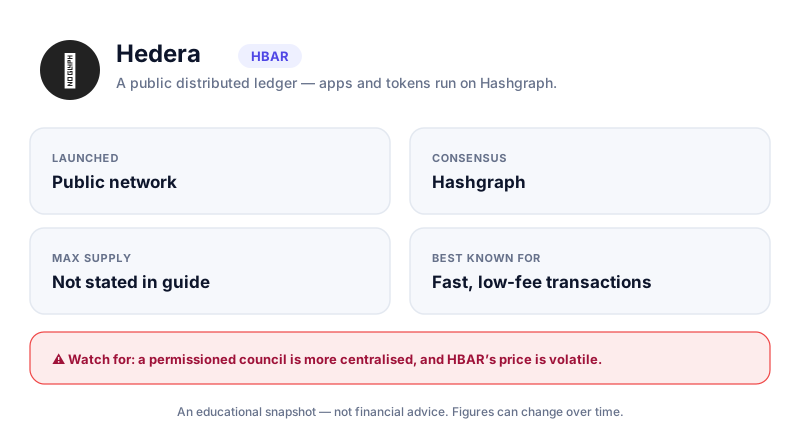
Hedera is a public distributed ledger that runs on Hashgraph consensus instead of a classic blockchain. Its token, HBAR, pays for transactions and secures the network. It's governed by a council of large organisations rather than anonymous miners.
What is Hedera?
Hedera is a public network where developers can build apps, issue tokens, and record data — similar in purpose to Ethereum or Solana. The key difference is the technology underneath: rather than a chain of blocks, Hedera uses a structure called Hashgraph.
The network's native token is HBAR. You use it to pay transaction fees and, through staking, to help secure the network. When people say 'Hedera' they usually mean the network; 'HBAR' refers specifically to the coin.
How Hedera works
Hedera processes transactions using Hashgraph consensus, which lets the network agree on the order and timing of events very quickly. It's designed for high throughput and low, predictable fees measured in fractions of a cent.
- HBAR is the fuel: it pays fees and is staked to support consensus.
- The Governing Council is a group of large organisations that run the network's nodes and make decisions together.
- Services include token issuance, smart contracts, and a tamper-evident timestamping service.
Who runs Hedera?
Unlike Bitcoin's open mining or many proof-of-stake chains, Hedera is governed by the Hedera Governing Council — a body of well-known companies and institutions across different industries and regions. Each holds an equal vote and serves a limited term.
Supporters argue this brings stability and accountability. Critics counter that a permissioned council makes the network more centralised than fully open alternatives. Both points are worth weighing.
What is HBAR used for?
- Paying network fees when you send tokens or run an app.
- Staking to help secure the network and earn rewards — see what is staking.
- Powering applications built on Hedera, from payments to supply-chain tracking.
A fair warning
HBAR's price is highly volatile, and no network's long-term success is guaranteed. Only ever risk what you can afford to lose, and never borrow to buy crypto. This guide is education, not financial advice.
Where to go next
If the technology interests you, start with what is Hashgraph. When you're ready, read how to buy Hedera and — most importantly — how to store Hedera safely. Whichever way you lean, the storage rule doesn't change: serious amounts belong offline, on a hardware wallet like the Ledger Nano X.
Key takeaways
- Hedera is a public network; HBAR is its native token.
- It uses Hashgraph consensus instead of a traditional blockchain.
- A council of large organisations governs the network.
- HBAR is volatile — only risk what you can afford to lose.
Frequently asked questions
Is Hedera a blockchain?
Not in the classic sense. It's a distributed ledger built on Hashgraph, which orders transactions differently from a chain of blocks — though it serves a similar overall purpose.
What is HBAR used for?
HBAR pays network fees, is staked to help secure the network, and powers applications built on Hedera.
How do I keep HBAR safe?
For larger amounts, a hardware wallet that keeps your keys offline is the safest approach. Never share your seed phrase with anyone.
Keep reading
What Is Hashgraph? The Consensus, Simply
A plain-English explanation of Hashgraph — the consensus mechanism behind Hedera — and how it differs from a t
How to Buy Hedera (HBAR): A Beginner's Guide
A step-by-step, no-hype guide to buying HBAR safely — choosing an exchange, verifying your account, placing an
How to Store Hedera (HBAR) Safely
Keep your HBAR safe from hackers and mistakes: hot vs cold wallets, hardware wallets, seed-phrase backups, and