What Is Restaking? EigenLayer and the Risks Explained
Restaking is one of the newer and more advanced ideas in crypto. It lets coins that are already staked to secure a blockchain be reused to help secure other services too — earning extra rewards, but also stacking extra risk. This guide explains restaking in plain English, what protocols like EigenLayer do, and why the layered nature makes it firmly a topic for experienced users.
The 20-second version
Restaking reuses staked crypto to secure additional services beyond the base blockchain, in exchange for extra rewards. The catch is that your stake can now be penalised ('slashed') by more than one system — so the rewards come with compounded, harder-to-assess risk.
Read this first
Restaking stacks risk on risk
By securing several services at once, your stake becomes exposed to multiple slashing conditions and new, less-tested code. It's an advanced, evolving area. This guide is education, not financial advice — never restake more than you can afford to lose.
What is restaking?
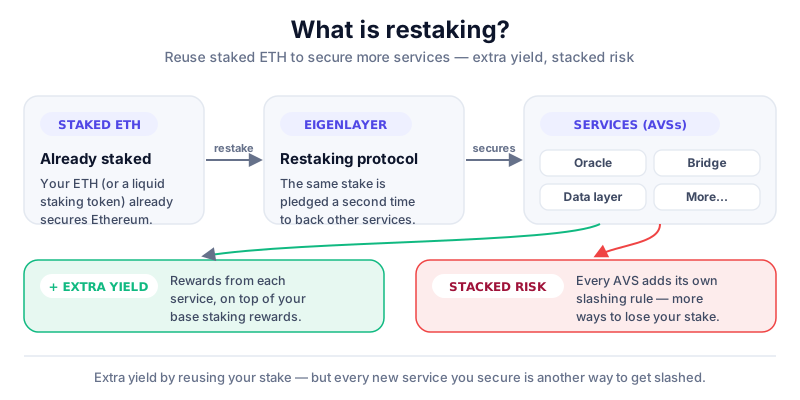
When you stake ETH, it secures Ethereum and earns rewards. That staked ETH normally does one job. Restaking lets the same staked ETH (or a liquid staking token representing it) be put to work a second time — pledged to help secure *other* services that need their own security but don't want to build a network from scratch.
The best-known restaking protocol is EigenLayer on Ethereum. The services that borrow this security are called Actively Validated Services (AVSs) — things like data-availability layers, oracles, or bridges. In return for backing them, restakers earn additional rewards on top of their base staking yield.
How it works
- You restake ETH or an LST through a restaking protocol.
- You opt in to secure one or more AVSs.
- You earn extra rewards from those services for providing security.
- You accept extra slashing rules — each AVS can have its own conditions for penalising misbehaviour.
Why the risk is different
Restaking is appealing because it makes capital more productive — but that efficiency cuts both ways.
- Compounded slashing: your stake can now be penalised by several systems, not just one.
- New, less-tested code: AVSs and restaking contracts are newer than core blockchains, so the attack surface is larger.
- Correlated failures: if many services rely on the same restaked security, a single problem could ripple across them.
- Centralisation concerns: heavy reliance on one restaking protocol concentrates risk for the wider ecosystem.
Understand before you opt in
Restaking is not a 'set and forget' yield. Every AVS you back adds its own rules and risks. If you can't clearly explain what you're securing and how you could be slashed, you're not ready to restake.
Where to go next
Make sure the foundations are solid first: what is staking and what is liquid staking. Then see how restaking fits the broader landscape in what is DeFi and how rewards compare in what is yield farming. One habit worth adopting from day one: delegate from a hardware wallet like the Keystone 3 Pro, so staking never means exposing your keys.
Key takeaways
- Restaking reuses staked crypto to secure additional services for extra rewards.
- EigenLayer is the best-known restaking protocol; the services it secures are called AVSs.
- Your stake can be slashed by multiple systems, not just the base chain.
- It's an advanced, fast-evolving area — only restake what you can afford to lose.
Frequently asked questions
Is restaking the same as staking twice?
Loosely, yes — it reuses your staked security to back additional services. But each new service adds its own rewards and its own slashing rules, so the risk grows with every layer.
What is an AVS?
An Actively Validated Service is something — like an oracle, bridge, or data layer — that borrows security from restakers instead of building its own validator network.
Is restaking suitable for beginners?
Generally no. It layers new, less-tested risks on top of normal staking. Beginners are usually better served understanding plain staking first.
Keep reading
What Is Staking? How It Works and What It Costs
A plain-English guide to crypto staking: how it secures proof-of-stake networks, how rewards work, and the loc
What Is Liquid Staking? stETH and LSTs Explained
Liquid staking explained: how tokens like stETH let you stake crypto while keeping it usable in DeFi, plus the
What Is DeFi? Decentralised Finance Explained
A beginner's guide to decentralised finance: what DeFi is, how lending, trading and yield work without a bank