What Is Monero (XMR)? A Plain-English Guide
Monero (ticker: XMR) is a cryptocurrency built around one idea above all others: privacy. Where Bitcoin records every transaction on a public ledger anyone can read, Monero is designed so the sender, receiver and amount are hidden by default. This guide explains what Monero is in plain English, how it achieves that privacy, and the honest trade-offs that come with it.
The 20-second version
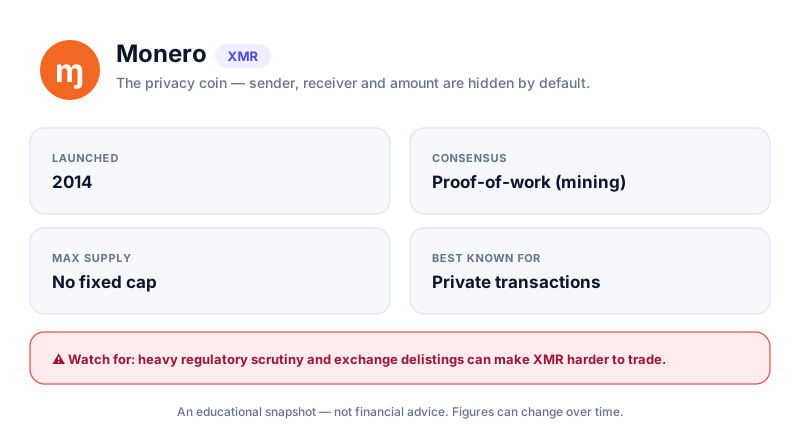
Monero is digital money that hides who paid whom and how much, on by default. It uses clever cryptography to make transactions private and 'fungible'. That privacy is its whole point — and also why it faces regulatory pressure and exchange delistings.
What is Monero?
Monero is an open-source cryptocurrency that launched in 2014. Like Bitcoin, it's decentralised digital money secured by a network of computers rather than a bank. The big difference is privacy: on Bitcoin's blockchain, anyone can look up a wallet's full transaction history. On Monero, those details are obscured by design.
Supporters describe Monero as 'electronic cash'. The goal is that spending XMR should feel like handing over a banknote — the person you pay doesn't see your whole financial history, and outsiders can't trace it. This is why Monero is the best-known of the privacy coins. A privacy coin hides your on-chain history, but not the IP address behind your activity — a VPN like NordVPN covers that side.
How Monero keeps transactions private
Monero combines three main technologies to hide the three parts of any payment — who sent it, who received it, and how much moved:
- Ring signatures mix your transaction with several others, so an observer can't tell which input is genuinely yours — hiding the sender.
- Stealth addresses generate a fresh one-time address for every payment, so funds can't be linked to a published wallet — hiding the receiver.
- RingCT (Ring Confidential Transactions) conceals the amount being sent while still letting the network verify no money was created out of thin air.
Unlike some other privacy projects, these protections are on by default for every transaction — there is no 'transparent' mode to forget to switch on.
Why fungibility matters
Monero's community cares a lot about fungibility — the idea that every coin is interchangeable with every other, like one £10 note being worth the same as any other £10 note.
On a transparent chain like Bitcoin, coins carry a visible history. A coin that once passed through a hacked exchange could in theory be 'tainted' and refused by a business. Because Monero hides history, every XMR is treated as identical. Critics counter that this same property is exactly what makes the coin attractive for illicit use — a tension we cover honestly in our privacy coins guide.
The controversy and regulation
Privacy is Monero's strength and its biggest headache. Law-enforcement and regulators worry that untraceable money helps tax evasion, money laundering and ransomware. As a result, several major exchanges — including Binance and Kraken in some regions — have delisted XMR, and some jurisdictions have restricted privacy coins outright.
Defenders argue that financial privacy is a legitimate right, that the vast majority of crypto crime still happens on transparent chains, and that Monero is used by ordinary people who simply don't want their spending public. Both points can be true at once. The practical upshot for you: XMR can be harder to buy and sell than mainstream coins, and the rules where you live may change.
A fair warning
Monero's price is highly volatile, like all crypto. Only ever risk what you can afford to lose, and never borrow to buy. Privacy coins also carry extra regulatory risk — they can be delisted or restricted. This guide is education, not financial advice.
Where to go next
If you want to go further, learn the trade-offs between privacy projects in our Monero vs Zcash comparison, then read how to buy Monero and — most importantly — how to store it safely.
A VPN encrypts your traffic and hides your IP — sensible on public Wi-Fi and before logging into any exchange. NordVPN also blocks known phishing and malware sites. It's privacy, not anonymity — it won't undo on-chain traceability.
Key takeaways
- Monero (XMR) is a cryptocurrency built for privacy — sender, receiver and amount are hidden by default.
- It uses ring signatures, stealth addresses and RingCT to obscure transaction details.
- Its privacy makes coins fungible but also attracts heavy regulatory scrutiny and delistings.
- It's volatile and carries extra regulatory risk — only risk what you can afford to lose.
Frequently asked questions
Is Monero illegal?
Owning Monero is legal in most countries, but some have restricted privacy coins and several exchanges have delisted XMR. Always check the rules where you live before buying.
Is Monero completely untraceable?
Its design makes tracing very hard, and no widely accepted method exists to reliably de-anonymise it today. But no system is provably perfect, and using exchanges with ID checks still links your identity to your purchases.
How is Monero different from Bitcoin?
Bitcoin records every transaction publicly; Monero hides the sender, receiver and amount by default. Bitcoin is more widely accepted and easier to buy.
Keep reading
What Are Privacy Coins? The Regulatory Debate, Fairly
A balanced, plain-English explainer of privacy coins like Monero and Zcash — how they work, why people use the
Monero vs Zcash: How the Two Privacy Coins Compare
A fair, plain-English comparison of Monero (XMR) and Zcash (ZEC) — privacy by default vs optional, technology,
How to Buy Monero (XMR) Safely: Step by Step
A safe, beginner-friendly walkthrough of how to buy Monero (XMR) — choosing an exchange, the privacy-coin catc