What Is Slashing? Validator Penalties Explained
Slashing is the penalty that keeps proof-of-stake blockchains honest. If a validator misbehaves or breaks the rules, the network destroys some of the crypto they put up as a deposit. This guide explains what slashing is, why it exists, and why it matters if you're thinking about staking.
The 20-second version
Slashing is when a proof-of-stake network confiscates part of a validator's staked crypto as punishment for breaking the rules. It deters bad behaviour — and it's a real, if small, risk to understand before you stake.
What is slashing?
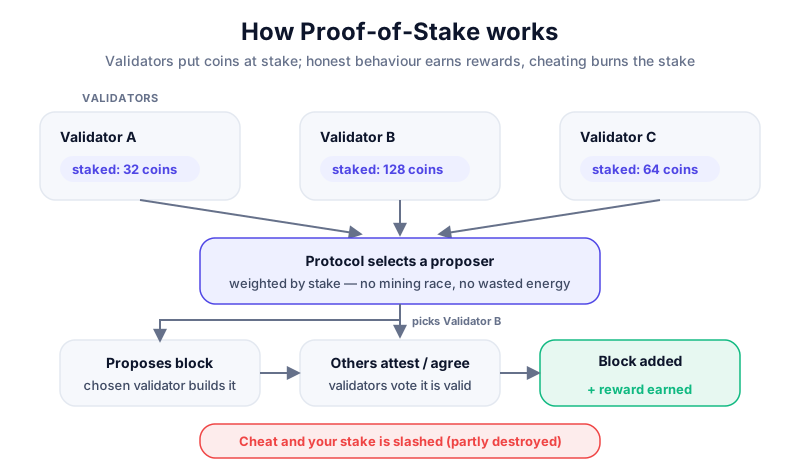
Slashing is a penalty used by proof-of-stake blockchains. To help run the network, validators lock up — or 'stake' — a deposit of the network's cryptocurrency. If a validator breaks the rules, the protocol automatically takes away part (or in serious cases, all) of that deposit. That confiscation is called slashing.
The logic is simple: validators have real money on the line, so honest behaviour is in their own financial interest. Misbehave, and it costs you.
Why networks use slashing
Proof-of-stake replaced the energy-intensive 'mining' of Bitcoin with economic incentives. But incentives only work if there's a cost to cheating. Slashing supplies that cost.
- It makes attacking the network expensive — a dishonest validator stands to lose their stake.
- It encourages validators to keep their systems reliable and online.
- It protects everyone else by keeping the rules credibly enforced.
What can trigger slashing
Exact rules vary by network, but slashing generally falls into two buckets: serious offences that suggest an attack, and lesser failures of upkeep.
- Double-signing — validating two conflicting versions of the chain, which can be a sign of an attack. This usually carries a heavy penalty.
- Equivocation — sending contradictory messages that could confuse the network.
- Downtime — being offline when you're meant to be validating. On many networks this is a smaller penalty than slashing proper, but it still costs rewards.
Different blockchains draw these lines differently. On Ethereum, for example, slashing is reserved for clearly malicious actions, while ordinary downtime leads to smaller 'inactivity' losses rather than full slashing.
What it means if you stake
If you stake your crypto — especially by running your own validator — slashing is a genuine risk to weigh. Even honest operators can get slashed through misconfiguration, running the same keys on two machines, or hardware faults.
Staking is not risk-free
Slashing, lock-up periods, and the volatility of the underlying coin all mean staking can lose value. Only stake what you can afford to have tied up or reduced, and research the specific network's rules. This is education, not financial advice.
If you stake through a provider
When you stake via an exchange or pool, the operator runs the validator, so slashing risk depends on how competent and well-insured they are. Read the terms carefully — some cover slashing losses, many don't.
Where to go next
Slashing only makes sense alongside the bigger picture. Read what staking is to understand the rewards side, and what a validator does to see who's actually being penalised. Whichever way you lean, the storage rule doesn't change: serious amounts belong offline, on a hardware wallet like the Ledger Nano X.
Key takeaways
- Slashing is a penalty that destroys part of a validator's staked deposit for breaking the rules.
- It makes attacking a proof-of-stake network financially costly.
- Double-signing is usually punished heavily; downtime more lightly.
- If you stake, slashing is a real risk — research the network and your provider.
Frequently asked questions
Can I be slashed just for going offline?
On many networks, downtime leads to smaller penalties or lost rewards rather than full slashing, which is reserved for clearly malicious acts. The rules vary by network.
Does slashing affect me if I stake through an exchange?
Indirectly. The exchange runs the validator, so its competence and policies determine your exposure. Check whether it covers slashing losses before you commit.
How much can be slashed?
It depends on the offence and the network — from a small fraction for minor issues up to a large portion of the stake for serious, attack-like behaviour.
Keep reading
What Is Staking? How It Works and What It Costs
A plain-English guide to crypto staking: how it secures proof-of-stake networks, how rewards work, and the loc
What Is a Crypto Validator? A Plain-English Guide
A beginner-friendly guide to crypto validators: what they do, how proof-of-stake works, how to become one, and
What Is Ethereum? A Plain-English Guide
A beginner-friendly explanation of Ethereum: what it is, how it differs from Bitcoin, what smart contracts do,