What Is Total Value Locked (TVL) in Crypto?
Total Value Locked, almost always shortened to TVL, is one of the most quoted numbers in decentralised finance. It tries to capture how much money is sitting inside a protocol. It's a useful gauge of size and trust — but it's also easy to misread. This guide explains what TVL really measures and where it falls short.
The 20-second version
TVL is the total value of crypto deposited in a DeFi protocol — its lending pools, exchanges or vaults. A higher TVL suggests more usage and liquidity, but it moves with token prices and can be inflated, so never treat it as a safety score.
What is TVL?
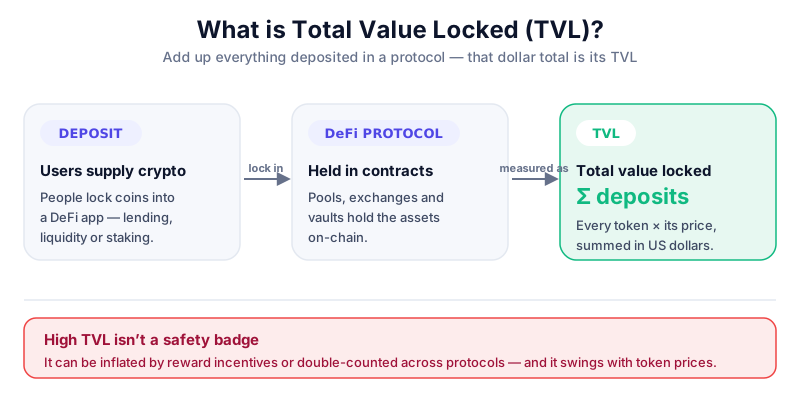
Total Value Locked measures the combined value of all the crypto assets deposited into a DeFi protocol at a given moment. When you supply coins to a lending app, add liquidity to a decentralised exchange, or stake into a yield vault, those deposits count toward that protocol's TVL.
It's usually expressed in US dollars so different protocols can be compared. You'll see TVL quoted for individual apps, for whole blockchains, and for DeFi as a whole.
How TVL is calculated
The basic idea is simple: count every token deposited in the protocol and multiply by its current market price, then add it all up.
- Step 1 — total up the quantity of each asset held in the protocol's smart contracts.
- Step 2 — multiply each by its current price in dollars.
- Step 3 — sum the results to get one headline figure.
Because prices change constantly, TVL changes constantly too — even if not a single coin moves in or out.
Why people watch TVL
TVL is popular because it's a quick proxy for how much a protocol is actually being used. More deposits generally mean deeper liquidity, more fees earned, and more users trusting the contracts with real money.
Comparing TVL across protocols or chains can show where activity is flowing — for example, which networks are attracting capital and which are losing it.
Where TVL misleads
A high TVL is not a safety rating
TVL tells you how much money is deposited, not how safe a protocol is. Large protocols have still been hacked or have failed. Never assume a big number means low risk.
- Price-driven swings — TVL rises and falls with token prices, so a 'growing' figure may just reflect a market rally.
- Double counting — deposits can be reused across protocols, inflating the headline total.
- Incentive farming — temporary reward programmes can attract 'mercenary' capital that leaves the moment rewards stop.
- Token-denominated reality — measuring in dollars can hide that the underlying coin amounts are flat or falling.
Using TVL sensibly
Treat TVL as one signal among many. Look at the trend over time rather than a single snapshot, check whether it's measured in dollars or token terms, and pair it with other research like audits, team transparency and tokenomics. Whichever way you lean, the storage rule doesn't change: serious amounts belong offline, on a hardware wallet like the BitBox02.
A fair warning
DeFi carries real risks including smart-contract bugs and total loss of deposits. TVL won't protect you from any of them. Crypto is volatile — only risk what you can afford to lose. This is education, not financial advice.
Key takeaways
- TVL is the dollar value of all assets deposited in a DeFi protocol.
- It rises and falls with token prices, not just with new deposits.
- A high TVL means usage and liquidity — not safety.
- Watch the trend over time and combine TVL with deeper research.
Frequently asked questions
Does a higher TVL mean a protocol is safer?
No. TVL measures how much money is deposited, not how secure the code is. Large, high-TVL protocols have still been exploited. Always research audits and security separately.
Why did a protocol's TVL drop without users leaving?
Because TVL is measured in dollars, a fall in the price of the deposited tokens lowers TVL even if the same amount of coins is still deposited.
Where can I see TVL figures?
Independent DeFi analytics dashboards track TVL by protocol and by blockchain. Cross-check more than one source, as methodologies differ.
Keep reading
What Is DeFi? Decentralised Finance Explained
A beginner's guide to decentralised finance: what DeFi is, how lending, trading and yield work without a bank
What Is a DEX? Decentralised Exchanges Explained
A plain-English guide to decentralised exchanges (DEXs): how they let you swap tokens without an account, how
What Is Tokenomics? How Crypto Supply and Incentives Work
Tokenomics explained in plain English: supply, distribution, emissions, utility and incentives — and how to re