What Whale Wallets Are Buying (And Why It's Not a Signal to Copy)
Because public blockchains are open, anyone can watch the biggest wallets move money — and a whole cottage industry exists to tell you what 'the whales' are buying. It's genuinely fascinating, and occasionally useful context. But the leap from 'a big wallet bought this' to 'I should buy it too' is where a lot of people get hurt. This is a guide to what whale-watching actually shows you, and the large gap between that and a reason to act.
The 20-second version
Whale-watching means tracking large crypto wallets on-chain. It can add context, but a whale buying tells you almost nothing about whether you should — whales can be wrong, can be hedging, and can dump on the very people copying them.
What 'whale-watching' means
In crypto slang, a whale is a wallet holding a very large amount of a coin — enough that its trades can move the market. Because most blockchains are public ledgers, every one of those trades is visible. When you make any crypto transaction, it's recorded permanently and anyone can look it up. Whale-watching is simply the practice of monitoring those big wallets to see what they're accumulating or selling.
The appeal is obvious: if someone with deep pockets and apparent expertise is buying something, surely that's a hint? It can be — but as we'll see, what you're actually looking at is far murkier than it first appears, and treating it as a buy signal is a trap.
The tools people use
You don't need anything fancy to start. At its simplest, a block explorer lets you paste in a wallet address and see its full history of holdings and transactions, for free. From there, dedicated platforms add labels and analytics on top of the raw data.
- Block explorers — the raw, free view of any address. Great for verifying a specific transaction yourself.
- Labelling platforms — services that tag wallets they believe belong to exchanges, funds, or known traders, so the addresses aren't just anonymous strings.
- Alert services — tools that ping you when an unusually large transfer happens between wallets or onto an exchange.
- Analytics dashboards — community-built charts tracking flows, holder concentration and 'smart money' activity across many chains.
Labels are educated guesses
Wallet labels like 'institutional fund' or 'top trader' are inferred from behaviour, not confirmed by the owner. They're often right, but they can be wrong or out of date — and savvy whales deliberately split funds across many wallets precisely so they're harder to follow.
What a whale move does — and doesn't — tell you
Here's the crux. A large transaction is a fact: the coins moved. But the *reason* they moved is hidden, and you're almost always guessing at it. The same on-chain event can mean wildly different things.
Take a whale sending a big amount of a token to an exchange. The popular read is 'they're about to sell' — but it could equally be moving collateral, rebalancing, lending it out, or simply shifting custody. You can see the *what*; you cannot see the *why* or the *intent*.
| What you observe on-chain | What it might mean | What it does NOT confirm |
|---|---|---|
| A whale buys a token | Conviction — or a hedge, a paid promotion, or wash trading | That the token will go up |
| A whale sends coins to an exchange | Possibly selling — or posting collateral, or moving custody | That a dump is coming |
| A wallet holds a huge position | Long-term belief — or coins they're stuck with and can't exit | That they're in profit |
| 'Smart money' is accumulating | A pattern worth noting | That you'll get the same entry price or timing |
Even when you guess the intent correctly, you're seeing it *after* it happened. The whale already has their position at their price. By the time the move shows up on a dashboard and you act on it, the easy part may be over — and you might be the late buyer providing their exit.
Why copying whales is dangerous
'Follow the smart money' sounds shrewd, but it rests on assumptions that often don't hold. Here's why blindly mirroring a big wallet can go badly wrong.
- Whales are often wrong. Holding a lot of crypto doesn't make someone right. Plenty of large wallets have ridden positions straight to zero.
- You can't see the whole strategy. A buy you're copying might be one leg of a hedge — they could be short somewhere else, leaving you exposed to the side they're protected against.
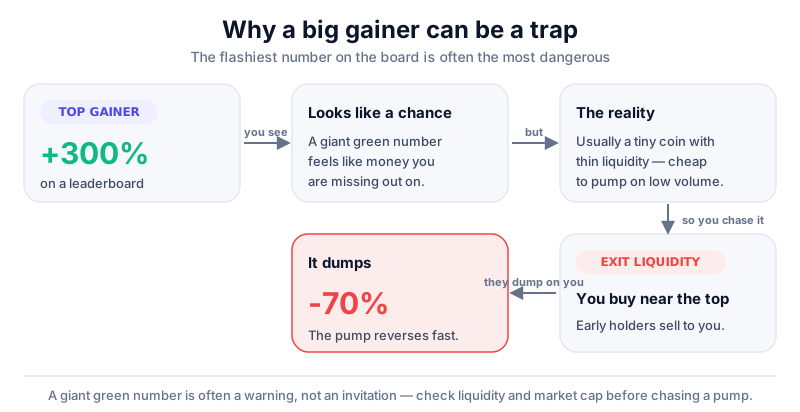
- They can dump on you. In thin markets, a whale who knows others copy them can buy, wait for followers to pile in and lift the price, then sell into that demand. You become their exit liquidity.
- Timing and size are everything. They may have entered far lower and can absorb a 60% drop you can't. The same trade is a totally different risk at your size and entry.
- Some 'whale activity' is staged. Wash trading and coordinated wallets can manufacture the appearance of accumulation to lure copycats — a manipulation close to the tactics in meme coin risks and red flags.
A signal can be bait
Visible on-chain moves aren't just observed by you — they're observed by the people making them, who know they're being watched. That makes a 'whale buy' something that can be deliberately set up to be copied. Treat any pattern that conveniently points you toward buying with extra suspicion, and read how to avoid crypto scams on manipulation tactics.
Using whale data sensibly
None of this means on-chain data is useless. It just means it's *context*, not a *command*. Used well, it's one input among many rather than a reason to act on its own. One whale habit genuinely worth copying is security: keeping long-term holdings in cold storage, which works at any scale with a Ledger Nano X.
- As confirmation, not a trigger. Use it to sanity-check a view you formed for other reasons, not to form the view in the first place.
- For risk-spotting. Seeing that a handful of wallets hold most of a token's supply is a genuine red flag worth knowing — it's part of how to research a meme coin.
- To verify, not to follow. On-chain data is brilliant for confirming a project's claims (is liquidity really locked? is supply really distributed?) — a far better use than trying to ride someone's coat-tails.
- With humility. You're seeing a slice of one wallet's activity, stripped of context, after the fact. Hold any conclusion loosely.
The takeaway
Whale-watching is a window onto something traditional markets never offered: the actual moves of the biggest players, in real time, for free. That's worth appreciating. But a window isn't a roadmap. You can see what a whale did, not why, not whether they were right, and not whether you can survive the same position. The honest use of on-chain data is to add context and spot risks — never to outsource your thinking to an anonymous wallet that may be hedged, mistaken, or quietly selling to the very people copying it. Crypto is volatile and you can lose money, and 'a big wallet bought it' has never been a reason that protects you from that.
Key takeaways
- Whale-watching means tracking large wallets on public blockchains — anyone can do it with a block explorer.
- You can see what a whale did, but almost never why, which makes intent a guess.
- Whales can be wrong, can be hedging elsewhere, and can deliberately dump on the people copying them.
- By the time a move appears on a dashboard, the whale already has their position at their price.
- Treat on-chain data as context and a risk-spotting tool — not as a buy signal to follow.
Frequently asked questions
How do people see what whale wallets are buying?
Because most blockchains are public, every transaction is visible. You can paste a wallet address into a block explorer to see its history for free, and labelling platforms add guessed identities and analytics on top. The data is real — the interpretation is where it gets uncertain.
If a whale buys a coin, should I buy it too?
No — that's the core warning here, and we don't give buy or sell advice. A whale buying tells you nothing about whether the coin will rise, whether they're right, or whether they're hedged elsewhere. They may even be relying on copycats to create the demand they sell into. Use on-chain data as context, not a command.
Are wallet labels accurate?
They're educated guesses based on behaviour, not confirmed by the wallet owners. Often they're correct, but they can be wrong or stale — and sophisticated whales deliberately split funds across many wallets to stay hard to track, so what you see may be only part of the picture.
Keep reading
What Is a Crypto Transaction?
What happens when you send crypto: how a transaction is signed, confirmed and recorded, why fees and confirmat
Meme Coin Risks and Red Flags
The core safety lesson on meme coins: the real risks, the warning signs to look for, and the scams that separa
How to Avoid Crypto Scams: The Cornerstone Safety Guide
The common crypto scams — fake support, phishing, giveaways, romance and rug pulls — and the simple habits tha