Meme Coin Risks and Red Flags
You now know what meme coins are and how the plumbing works. This is the lesson that matters most. Meme coins combine the extreme volatility we've already met with the highest concentration of scams anywhere in crypto. Here are the real risks and the red flags that should make you close the tab and walk away — no exceptions.
The 20-second version
Most meme coins lose nearly all their value, and many are outright scams. The biggest dangers are rug pulls, pump-and-dumps, honeypots and concentrated ownership. If a coin promises guaranteed returns, hides who made it, or pressures you to hurry, walk away.
The core risk: most go to zero
Before any specific scam, anchor yourself to the base rate, because everything else is a footnote next to it: the large majority of meme coins decline to near-zero, and many do so within days or weeks of launching. This isn't bad luck or poor timing — it's the default outcome. A coin with no product and no users has nothing to fall back on once the attention moves elsewhere, and attention always moves elsewhere.
Even the survivors are brutally volatile. The biggest, most established meme coins have routinely fallen 50% or more in a matter of hours, and 80–90% over a cycle. So the first risk isn't some clever con — it's simply that the asset does what meme coins usually do, and you're left holding it. We'll meet the cons next, but never let them distract you from this plain fact.
Educational, not financial advice
Crypto is volatile and meme coins are the most volatile corner of it. Never invest money you can't afford to lose entirely, never borrow to buy, and treat any meme-coin purchase as money that could vanish overnight. Nothing here is a recommendation to buy any coin.
Rug pulls
A rug pull is when the creators yank the value out and disappear, leaving holders with tokens that can't be sold for anything. The name is literal: the rug is pulled out from under you. In practice it might mean withdrawing the liquidity pool we covered last lesson, dumping a huge hidden insider allocation onto the market, or coding the contract so that buyers can never sell in the first place.
Rug pulls are common precisely because of the mechanics we've already discussed: meme coins are anonymous and trivial to launch, so there's no one to hold accountable and nothing to stop a bad actor trying. The whole thing can be set up, hyped, and drained in a single day. They're so important — and so spottable once you know the signs — that we give them their own lesson: how to spot a rug pull. Read it before going near any new coin.
Pump-and-dumps
In a pump-and-dump, insiders or a coordinated group quietly accumulate a coin while it's cheap, hype it loudly to attract a wave of buyers, then sell into that demand — crashing the price for everyone who arrived late. The cheerful 'community' energy you see flooding your feed is sometimes a marketing push by people who already hold large bags they're desperate to offload onto you. You're not joining a movement; you're the exit liquidity.
- Sudden, coordinated promotion appearing across social media and group chats all at once, as if on cue.
- A cluster of influencers posting the same coin within a short window — often paid, rarely disclosed.
- Manufactured urgency: 'get in before it explodes', countdown timers, 'last chance to be early'.
- A chart that has already spiked vertically before you'd even heard the name — the early money is now looking to leave.
Red flags checklist
Walk away if you see these
Any one of these on its own is reason for serious caution. Two or more together, and there's almost always no upside worth the risk. Treat this table as a set of hard stops, not gentle suggestions.
| Red flag | Why it's dangerous |
|---|---|
| Guaranteed or promised returns | No honest crypto project guarantees gains. This is the signature of a scam, full stop. |
| Anonymous team with no track record | No accountability if it collapses — or if it was always designed to. |
| Liquidity not locked | The creator can withdraw the pool and rug holders at any moment. |
| A few wallets hold most of the supply | Insiders can crash the price by selling whenever they like. |
| You can buy but not sell (honeypot) | The contract traps your money by design; the rising chart is a mirage. |
| Pressure and urgency | Manufactured FOMO exists to stop you doing the due diligence that would expose the scam. |
| Promises of 'free' tokens for sending crypto first | A classic crypto scam — you send, and you never get anything back. |
Never share your seed phrase
No airdrop, giveaway, 'wallet verification' or support agent ever needs your seed phrase or private key. Anyone asking for it is stealing from you — there are no exceptions, and no legitimate site or person will ever request it.
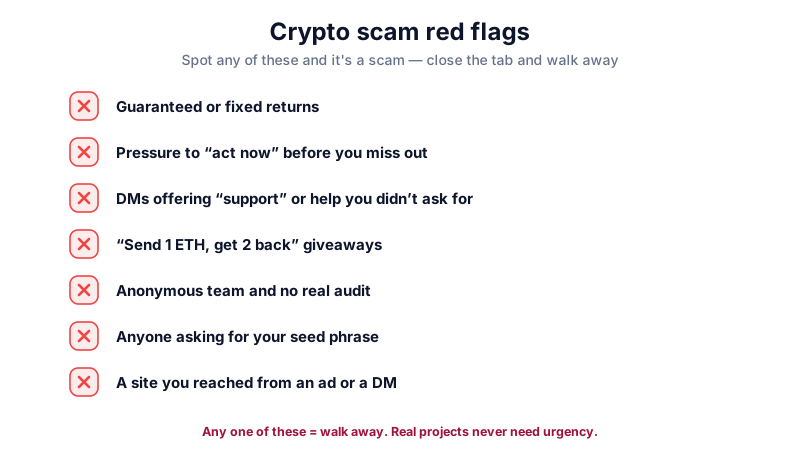
Common scam tactics around meme coins
Beyond the coins themselves, the meme-coin scene swarms with side-scams aimed at separating you from your wallet. These are worth memorising, because they reappear in slightly different costumes over and over.
- Fake giveaways — 'send 1 ETH, get 2 back'. The blockchain doesn't do magic; you never get anything back.
- Impersonation — fake accounts posing as founders, exchanges or celebrities, often replying instantly under real posts.
- Malicious links — a slick site that asks you to 'connect your wallet' and then drains it the moment you approve.
- Copycat tokens — a fake clone with a near-identical name and logo, riding the buzz of the real one.
- Paid shilling — influencers promoting coins they're being paid to push, almost always without disclosing it.
Most of these aren't unique to meme coins, but the meme-coin scene attracts them in industrial volume because it's where the excitable, fast-moving money is. Our broader guide how to avoid crypto scams goes deeper, and its lessons apply everywhere in crypto, not just here.
If you still choose to proceed
We won't tell you to buy, and we won't tell you not to — that's genuinely your decision to make. But if you do choose to engage with meme coins, harm-reduction matters, and a few simple habits dramatically cut your exposure. However you play it, one rule keeps meme-coin damage survivable: your serious holdings live elsewhere, offline, on a hardware wallet like the SafePal S1.
- Only use money you could lose entirely without it affecting your rent, your bills or your sleep.
- Do the full due diligence in how to research a meme coin first — every single time, no shortcuts for the 'exciting' ones.
- Use a separate, throwaway wallet so a malicious contract can't reach your main holdings.
- Ignore urgency completely. Anything real will still be there in an hour, after you've checked it properly.
The slow-down rule
Scams rely on speed; honest opportunities can wait. If you feel rushed, that feeling is itself the warning. Step away, verify independently, and only act once nothing whatsoever is pressuring you to hurry.
Key takeaways
- Most meme coins go to near-zero, and many are outright scams.
- The biggest dangers are rug pulls, pump-and-dumps, honeypots and concentrated ownership.
- Guaranteed returns, anonymous teams, unlocked liquidity and urgency are walk-away signals.
- Never share your seed phrase, and only risk money you can afford to lose entirely.
Frequently asked questions
What's the single biggest meme-coin risk?
That you simply lose your money — the base rate is that most meme coins fall to near-zero, scam or no scam. On top of that, cons like rug pulls are common because the coins are anonymous and trivial to launch. The con is the second risk; the asset itself is the first.
How can I tell if a meme coin is a scam before buying?
Check for locked liquidity, a non-anonymous team, distributed ownership, and whether you can actually sell. Our how to spot a rug pull and how to research a meme coin lessons walk through exactly how, step by step.
An influencer I follow is promoting a coin — is it safe?
Promotion is not evidence of safety. Many influencers are paid to promote coins, often without disclosure, and some are knowingly part of pump-and-dumps. Do your own research regardless of who is talking about it, however much you trust them.
Keep reading
How to Spot a Rug Pull
A practical guide to spotting rug pulls before they happen: liquidity locks, ownership concentration, contract
How to Research a Meme Coin (Due-Diligence Checklist)
A step-by-step due-diligence checklist for vetting a meme coin: contract checks, liquidity, ownership, team an
What Are Meme Coins? A Plain-English Guide
A clear, no-hype explanation of what meme coins are, where they came from, why they're so risky, and how to th