XRP vs Traditional Payments: How Cross-Border Money Moves
XRP was designed with one main job in mind: moving money across borders faster and cheaper than the traditional banking system. This guide explains how international payments work today, where XRP fits in, and gives a fair, balanced view of both the promise and the open questions.
The 20-second version
Sending money between countries the traditional way can take days and stack up fees because it hops through several banks. XRP can act as a fast 'bridge' currency that settles in seconds for a tiny cost. Whether it becomes widely adopted for this is still an open question.
How cross-border payments work today
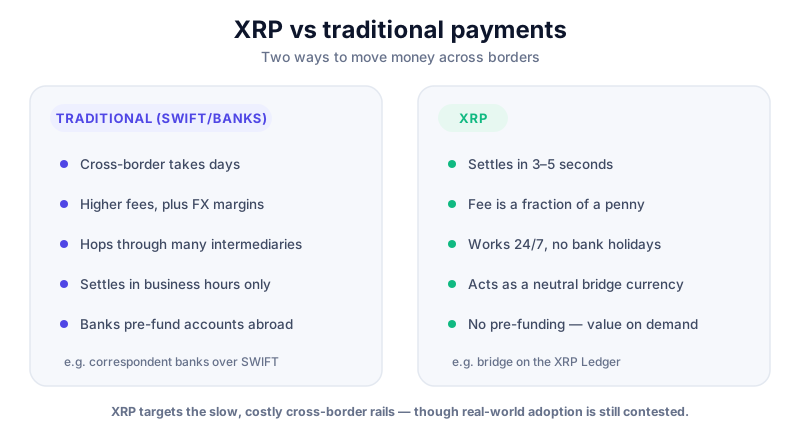
When you send money abroad, it rarely travels directly. It usually passes through a chain of 'correspondent' banks, each holding accounts with the next. Messaging systems like SWIFT coordinate the instructions, but the actual money settles slowly behind the scenes.
- Time — transfers can take one to five business days.
- Cost — multiple banks each take a cut, and exchange-rate margins add more.
- Pre-funding — banks often park money in foreign accounts in advance, tying up capital.
How XRP aims to help
The idea behind using XRP for payments is to replace that slow chain with a fast, neutral 'bridge'. Instead of pre-funding accounts around the world, an institution could convert one currency into XRP, send it across the XRP Ledger in seconds, and convert it to the destination currency at the other end.
- Speed — XRP transactions settle in 3–5 seconds.
- Cost — fees are a tiny fraction of a penny.
- No pre-funding — value can move on demand rather than sitting idle abroad.
Side by side
| Feature | Traditional banking | XRP-based transfer |
|---|---|---|
| Settlement time | 1–5 business days | 3–5 seconds |
| Typical cost | Multiple fees + FX margin | Fraction of a penny in network fees |
| Pre-funding needed | Often yes | No |
| Available 24/7 | No (bank hours/holidays) | Yes |
| Maturity & adoption | Universal, decades old | Limited and still growing |
A balanced view
The technology genuinely is fast and cheap — that part isn't disputed. The open questions are about adoption. The global banking system is deeply entrenched, and many institutions are cautious about using a volatile asset as a bridge. Some of Ripple's partners use its software without necessarily using XRP itself. Newer competing approaches, including bank-backed stablecoins and instant-payment networks, are also chasing the same problem. And however you weigh the trade-offs, keep meaningful holdings in cold storage — a Ledger Nano X — rather than on an exchange.
Technology isn't a price prediction
A useful technology does not automatically mean a rising price. XRP is highly volatile and its value depends on many factors beyond payment adoption. Only risk what you can afford to lose, never borrow to buy crypto, and treat this as education, not financial advice.
Key takeaways
- Traditional cross-border payments are slow and costly because they hop through several banks.
- XRP can act as a fast bridge currency, settling in seconds for a tiny fee.
- The speed is real, but wide adoption by banks is still an open question.
- Useful technology is not a guarantee of price — XRP remains volatile.
Frequently asked questions
Does XRP replace SWIFT?
Not today. SWIFT is a messaging network used worldwide, and XRP is one of several newer approaches trying to make settlement faster and cheaper. They are not a like-for-like swap, and adoption of XRP for this remains limited.
Do banks actually use XRP?
Some institutions use Ripple's software, but not all of them use the XRP asset itself. Real-world XRP usage for payments exists but is still relatively small compared with the traditional system.
Why use XRP instead of a stablecoin?
Both are being explored for payments. XRP is a freely traded asset, while a stablecoin holds a steady value. Each has trade-offs, and it's not yet clear which approach will win.
Keep reading
What Is XRP? A Plain-English Guide
A beginner-friendly explanation of what XRP is, how it differs from Bitcoin, its link to Ripple, and how to th
How to Buy XRP Safely (Step by Step)
A clear, safety-first guide to buying XRP: choosing a reputable exchange, verifying your account, placing your
The Ripple vs SEC Case, Explained
A factual, balanced explainer of the SEC's lawsuit against Ripple over XRP: the claims, the landmark 2023 ruli