The Avalanche Ecosystem: Subnets, DeFi & Real-World Use
This is the final lesson of the course, and it answers the 'so what?' question that ties everything together: a blockchain is only ever as useful as what people actually build on it. We'll tour the Avalanche ecosystem — subnets, DeFi, gaming, NFTs and institutional experiments — and, as ever, look honestly at the risks that come bundled with each. By the end you'll be able to read the ecosystem with clear eyes instead of marketing goggles, which is a skill that'll serve you on every chain, not just this one.
The 20-second version
Avalanche hosts a range of apps: DeFi protocols, NFT and gaming projects, and custom 'subnets' built by teams and institutions. The C-Chain's Ethereum compatibility makes it easy to build on. But ecosystem 'activity' isn't a measure of safety — most of these apps carry smart-contract and project risk, and many will not last.
Subnets in the real world
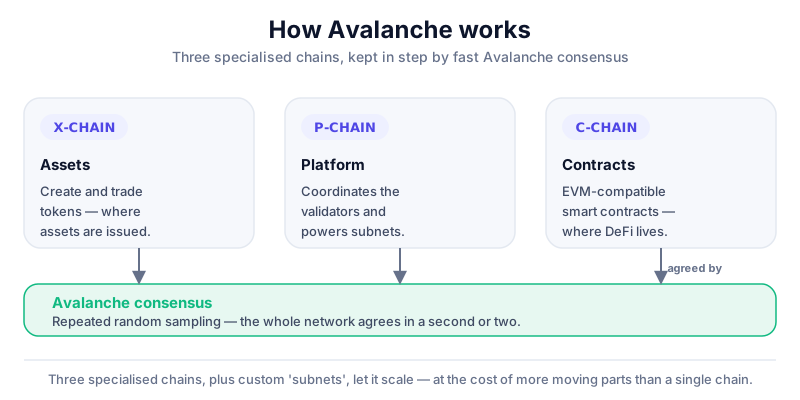
Back in how Avalanche works, we described subnets as private roads built off the shared motorway — custom blockchains with their own rules and their own traffic. That was the theory. So what have people actually built with them in practice? They tend to show up for a few recurring reasons, each one solving a genuine limitation of the shared main chains rather than just chasing a buzzword:
- Gaming — game studios launch a dedicated subnet so that a hit game's millions of tiny in-game transactions don't congest the main chain or spike fees for everyone else using Avalanche. The game gets its own lane and the rest of the network barely notices it.
- Institutions and compliance — some experiments use permissioned subnets where every participant is identity-verified, which traditional finance is often legally required to insist on. A fully open, anonymous network simply can't offer that, however much it might want the business.
- Specialised apps — projects that want their own fee token, or performance tuned to their exact needs, run a subnet rather than bend themselves awkwardly to fit the constraints of the shared chains.
Subnets are independent
A subnet's security rests on its own validators and its own rules, not automatically on Avalanche's full main network. A smaller, newer subnet can be far less battle-tested than the core chain — so 'it's on Avalanche' tells you almost nothing about how safe a particular subnet actually is. Always worth checking before you rely on one with real money.
DeFi on Avalanche
Most DeFi activity happens on the C-Chain, for the reason we keep returning to throughout this course: it works with Ethereum's tooling, so builders don't have to start from a blank page. You'll find all the familiar building blocks — decentralised exchanges for swapping tokens, lending and borrowing protocols, stablecoins pegged to the dollar, and various yield products that pay you to deposit your funds. If you've poked around DeFi on Ethereum, all of this will feel reassuringly familiar, just noticeably cheaper to use day to day.
Those lower fees compared with Ethereum make Avalanche genuinely attractive for smaller trades, where Ethereum's gas costs can swallow the entire point of a modest transaction in one gulp. But — and it's a big but — the cheaper home doesn't change DeFi's golden rule one bit: eye-watering advertised yields almost always signal eye-watering risk hiding just behind them, and every single protocol you touch is another lump of code that could contain a bug or be drained by an attacker overnight. Cheaper fees, exactly the same dangers underneath. Don't let the low cost lull you into lowering your guard.
Yield is not interest
Double-digit DeFi 'yields' are not bank interest, however neatly they're dressed up to look like it. They can come from token rewards that quietly collapse in value, and the underlying protocol can be hacked or simply fail overnight with no recourse. Treat eye-catching returns as a warning sign to investigate, not an opportunity to grab. This is education, not financial advice.
Gaming, NFTs and consumer apps
Avalanche has pushed hard into gaming and consumer apps — the areas where fast, cheap transactions matter most, and where a one-second finality genuinely changes the experience. NFTs and in-game items sit naturally on a low-fee chain, because nobody on earth wants to pay a hefty network fee just to pick up a virtual sword or trade a collectible card. Dedicated subnets let popular games scale without dragging down the rest of the network. On paper, it's a sensible technical fit, and you can see why the pitch is attractive.
Now the honest picture, because this is the corner of the ecosystem where the hype is thickest and the marketing budgets are biggest. This whole space is early, and it is deeply speculative. Many blockchain games and NFT projects launch with glossy trailers and grand promises, pull in a wave of excited attention and money, and then quietly fade away the moment the novelty wears off and the token incentives dry up. Headline 'player numbers' and announced 'partnerships' are very often marketing dressed as evidence, not proof of anything lasting or valuable. Enjoy this space if it interests you — but treat the excitement as entertainment, not as proof of value, and certainly not as a reason to invest money you'd miss.
Reading the ecosystem honestly
Here's the one idea to carry away from this whole course, if you remember nothing else: it's dangerously easy to mistake a busy ecosystem for a safe one. They are not the same thing, not even close, and quietly conflating them is precisely how a lot of people end up getting hurt. When you look at what's built on Avalanche — or on any chain at all — keep these four points firmly in mind: Whichever way you lean, the storage rule doesn't change: serious amounts belong offline, on a hardware wallet like the Keystone 3 Pro.
- Activity ≠ safety. A long list of apps and a big 'total value locked' number tell you about interest and hype, not about soundness or your odds of keeping your money intact.
- Smart-contract risk is everywhere. Each protocol is separate code that can hide bugs or be exploited, no matter how rock-solid the base chain underneath it happens to be.
- Incentives fade. Many users only ever showed up for token rewards or airdrops and vanish the instant those stop — so headline activity can be hollow, rented, and temporary.
- Concentration and competition. Avalanche competes fiercely with Ethereum, Solana and a crowd of others, and there's no guarantee any one platform stays ahead. Don't assume today's momentum is permanent or that the leaderboard is fixed.
If you do decide to explore the ecosystem, do it the careful, sceptical way: start tiny, use a wallet you control, and never approve a transaction you don't fully understand. The security habits from how to store AVAX safely and the red flags in how to avoid crypto scams are genuinely your best protection out there in the wild. And that wraps up the Avalanche course — you've gone from 'what even is this?' all the way through buying, storing, staking, and now reading the ecosystem like a healthy sceptic. The best next step isn't rushing off to chase another coin; it's deepening the fundamentals, like layer-1 vs layer-2, so that every new project you meet from here makes a little more sense than the last.
Protect yourself
No legitimate app, airdrop, or 'support' agent will ever ask for your seed phrase — not once, not for any reason, no matter how official it looks. Anyone who does is trying to steal from you. Stay sceptical, keep your keys offline, and only ever risk what you can comfortably afford to lose.
Key takeaways
- Avalanche hosts DeFi, gaming, NFTs and custom subnets, mostly via the C-Chain.
- Subnets power gaming and compliance-focused, permissioned use cases.
- A busy ecosystem signals interest, not safety — each app carries its own risk.
- Start small, self-custody, and never approve what you don't understand.
Frequently asked questions
What can you actually do on Avalanche?
Swap and lend tokens in DeFi, hold stablecoins, mint or trade NFTs, play blockchain games, and use apps built on subnets. The large majority of it runs on the C-Chain, the Ethereum-compatible part you've met throughout this course.
Is high DeFi yield on Avalanche safe?
No yield anywhere is 'safe'. High advertised returns usually reflect high risk — token rewards that can fall to nothing, or protocols that can be exploited. The bigger the number, the harder you should look at why it's being offered to you.
Are Avalanche subnets risky?
Each subnet runs on its own validators and rules, so its security can differ a lot from Avalanche's main network. Smaller, newer subnets are generally less tested and therefore riskier — being 'on Avalanche' is not a safety guarantee.
Keep reading
What Is Avalanche (AVAX)? A Plain-English Guide
A beginner-friendly explanation of Avalanche and its AVAX token: what it is, how it's structured, what it's us
How Avalanche Works: Three Chains, Subnets & Consensus
A clear look under the hood of Avalanche: the X, C and P chains, what subnets are, and how Avalanche consensus
Avalanche Staking Explained (AVAX)
How staking AVAX works: validating vs delegating, rewards and lock-up periods, the risks involved, and how it