Ethereum DeFi and Dapps Explained
We've reached the deep end of the course. Most of what people find exciting — and dangerous — about Ethereum lives in its apps: DeFi, NFTs and other dapps. This final lesson explains what they are, the main categories, and the serious, irreversible risks you must understand before you ever connect a wallet. With the basics from earlier lessons under your belt — smart contracts, gas, self-custody, token approvals — you're finally ready to look at this clearly, instead of through the fog of hype that surrounds it.
The 20-second version
Dapps are apps that run on smart contracts instead of a company's servers. DeFi is the financial slice of that — lending, trading and saving without a bank. The upside is openness; the downside is real, irreversible risk. Tread carefully.
What are dapps?
A dapp (short for decentralised app) runs on Ethereum's smart contracts rather than on a company's private servers. Instead of creating an account with a username and password, you interact with it by connecting a wallet like MetaMask and signing transactions yourself. Your wallet is your login, your account and your signature all at once — there's no 'sign up' form and no company holding a database of your details.
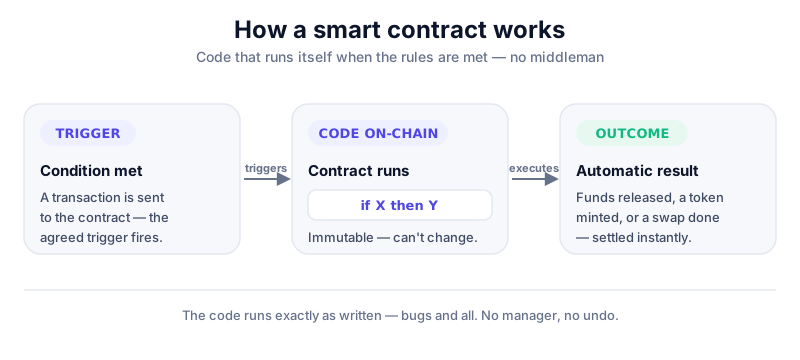
Because the logic lives in public, automatic contracts, a dapp can keep running even with no company in charge of it — there's no head office that can shut it down, censor you, or change the terms overnight to suit itself. That openness is the genuine appeal, and it's a real one. It's also exactly why there's usually no support desk to call when something goes wrong, no password reset, and no one with the power to reverse a mistake. The very same property that makes dapps powerful and uncensorable makes them completely unforgiving. Hold both of those facts in your head at once and you'll understand DeFi better than most.
What is DeFi?
DeFi — short for decentralised finance — is the financial corner of the dapp world: services like lending, borrowing, trading and saving that run on smart contracts instead of through a bank or broker. The pitch is that anyone with a wallet can use them, with no application form, no credit check and no gatekeeper deciding whether you're allowed in. For the full primer, see what is DeFi. The main building blocks look like this:
- Decentralised exchanges let you swap one token for another directly from your wallet, without handing your coins to a company first — you trade against a shared pool of funds rather than a counterparty.
- Lending and borrowing apps let users lend out tokens to earn a return, or borrow against tokens they already hold as collateral, all enforced automatically by code.
- Stablecoins provide tokens designed to hold a steady value, which act as the 'cash' that flows around the rest of DeFi — the unit everything else is priced in.
- Yield products offer rewards for supplying funds — almost always in exchange for real, and sometimes very well-hidden, risk. A high advertised yield is a warning label, not a free lunch.
How all this compares to ordinary, company-run platforms — and which suits which kind of user — is covered in centralised vs decentralised exchanges. The short version: DeFi gives you control and removes gatekeepers, but it also removes the safety nets, and you have to decide whether that trade is worth it for what you're trying to do.
The risks are serious
DeFi can be genuinely powerful, but it strips away nearly every safety net you're used to in traditional finance. There's no chargeback, no deposit insurance, no regulator on speed-dial, and often no one accountable when things fail — sometimes literally no one, because the team is anonymous. And these risks aren't theoretical or rare: large sums are lost to them regularly, sometimes hundreds of millions of dollars in a single afternoon. Go in clear-eyed about what can go wrong:
- Smart-contract bugs. A single flaw can be exploited to drain an entire protocol in minutes, and the irreversibility that protects you from censorship also means the stolen funds can't be clawed back. 'Audited' lowers the odds but is never a guarantee.
- Malicious approvals. Signing the wrong transaction can hand a contract permission to empty your wallet — revisit storing ETH safely on token approvals, because this is the single most common way ordinary users lose funds.
- Scams and rug pulls. Many 'DeFi' projects exist only to take your money and vanish. Fake sites, copycat tokens and impersonator support accounts are everywhere, and they're very good at looking legitimate.
- Volatility and liquidation. Borrow against crypto and a price drop can force-sell your collateral automatically, often at the worst possible moment. Advertised yields can collapse just as fast as they appeared.
- No recourse. Transactions are irreversible by design. If funds are gone, they are almost always gone for good — there is no fraud department to call and no insurer to make you whole.
This is the riskiest part of crypto
DeFi and dapps are experimental and frequently exploited. This is education, not financial advice — never financial, legal or tax advice. Only ever risk what you can afford to lose entirely, and never invest money you actually need. If something promises high, guaranteed returns, assume it is a scam, because it almost certainly is.
How to explore safely
If, with all that said, you decide to look around, do it cautiously. The goal in the early days isn't to make money — it's to learn how things work without putting meaningful funds at risk. Treat your first steps as paying a small tuition fee to understand the mechanics, the way you'd practise driving in an empty car park before the motorway:
- Read first and start tiny. Understand what an app does before you connect, and use amounts so small you could lose them entirely without it mattering to your week.
- Use a separate 'burner' wallet for experimenting, kept completely apart from the main wallet holding your savings, so a bad approval can only ever reach the small stuff.
- Reach apps only via official, bookmarked links — never from DMs, ads or search results, which are frequently fakes designed purely to drain you the moment you connect.
- Read every wallet pop-up before signing, and if you're using a hardware wallet, confirm the details on its own screen rather than trusting whatever the website claims you're approving.
- Review and revoke old token approvals periodically with a reputable tool, so a permission you forgot you granted months ago can't come back to bite you.
If you interact with dapps, a hardware wallet like the Ledger Nano X keeps your keys off your computer and makes you confirm each transaction on the device itself. Buy direct from Ledger only. We may earn a commission at no cost to you, and it never changes our verdict.
Wrapping up the course
That's the whole journey: from what Ethereum is and how it works, through buying and safely storing ETH, to gas fees, staking, and now the deep end of DeFi and dapps. Each lesson built on the last on purpose, and if you've followed them in order, the whole picture should now hang together. You genuinely understand Ethereum better than most people who own it — including plenty who've owned it for years.
Before you connect your wallet to anything new, make the basics second nature: protect your seed phrase, keep larger holdings in cold storage, and read how to avoid crypto scams one more time. Take it slowly, stay sceptical of anything that sounds too good, and you'll be in the small minority who explore crypto without getting burned. That's exactly what we hope this free course has set you up to do — no hype, no pressure, just the honest version. Good luck out there.
Key takeaways
- Dapps run on smart contracts, not company servers — and usually have no support desk.
- DeFi is the financial slice: lending, trading and saving without a bank.
- The risks are serious and irreversible — bugs, bad approvals, scams and liquidation.
- If you explore, start tiny, use a burner wallet, and only risk what you can lose.
Frequently asked questions
What's the difference between a dapp and a normal app?
A dapp runs on public smart contracts and you connect a wallet to use it, rather than signing in with an account. That means more openness, but far fewer safety nets when something goes wrong.
Is DeFi safe?
It's the riskiest part of crypto. There's no insurance, no chargebacks and no one to call. Smart-contract bugs, scams and liquidations cause real, regular losses. Start tiny, if at all.
How do scammers target DeFi users?
Through fake app sites, malicious token approvals, and promises of high guaranteed yields. Use bookmarked official links, read every pop-up before signing, and never share your seed phrase.
Keep reading
What Is DeFi? Decentralised Finance Explained
A beginner's guide to decentralised finance: what DeFi is, how lending, trading and yield work without a bank
How Ethereum Works: Smart Contracts, the EVM and Gas
A clear, high-level look at how Ethereum works — smart contracts, the Ethereum Virtual Machine, gas fees, and
How to Store Ethereum Safely (Step by Step)
Keep your ETH safe from hackers and mistakes: hot vs cold wallets, hardware wallets, seed-phrase backups, toke