Layer 1 vs Layer 2: Blockchain Scaling Explained
Layer 1 is the base blockchain itself; layer 2 is a faster, cheaper network built on top of it. If you've ever wondered why the same transaction can cost £40 on one network and a few pennies on another, this is the answer. This guide explains the difference, why it exists, and what it actually means for you as a user.
The 20-second version
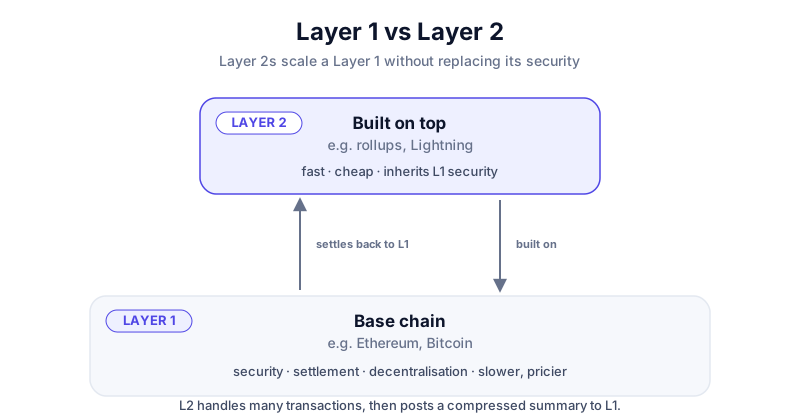
A layer 1 (like Bitcoin or Ethereum) is the foundational blockchain. A layer 2 sits on top to handle transactions more cheaply and quickly, then settles back to the layer 1. Layer 2s trade a little security or trust for big gains in speed and cost.
What 'layer 1' means
A layer 1 is a base blockchain that settles transactions entirely on its own — Bitcoin, Ethereum, Solana and Avalanche are all layer 1s. They run their own security and their own consensus, the agreement process covered in how blockchain works. Think of a layer 1 as the foundation and ground floor of a building: everything else is built on it, and it has to be rock solid because it's holding up the whole structure.
The challenge is something developers call the blockchain trilemma: it's genuinely hard to be secure, decentralised and fast all at the same time. Push hard on one and you tend to sacrifice another. Highly secure, deeply decentralised chains like Ethereum spread every transaction across thousands of computers — which is wonderful for trustlessness but means the network can become slow and expensive when lots of people want in at once. That bottleneck is exactly the problem layer 2 sets out to solve.
Why layer 2 exists
When a popular layer 1 gets congested, fees spike — Ethereum gas fees can climb sharply during busy periods, sometimes to the point where a simple swap costs more than the trade is worth. That's a terrible experience, and it prices ordinary users out entirely. A layer 2 is the response: a separate network that processes transactions off the main chain, then periodically posts a compressed summary back to the layer 1 for safekeeping.
The neat trick is in that word 'summary'. Instead of every transaction paying for its own expensive slot on the main chain, a layer 2 batches thousands of them together and pays for one combined entry. Imagine a group of friends running a tab at a bar instead of each tapping a card for every round — one settlement at the end, not fifty separate payments. The result is much lower fees and faster transactions, while still leaning on the underlying chain's security for final settlement.
Types of layer 2 (and lookalikes)
The term 'layer 2' covers a few different designs, and some related approaches get lumped in even though they don't strictly qualify. The key question to ask of any of them is: where does its security actually come from?
- Rollups bundle many transactions together off-chain and post proof or data back to the layer 1, inheriting its security. These are the dominant layer-2 approach on Ethereum, and the ones most people mean by 'layer 2' today.
- State channels let two parties transact privately off-chain as many times as they like, then settle only the final result on the main chain — ideal for fast, repeated payments between the same parties. Bitcoin's Lightning Network is the best-known example.
- Sidechains are separate blockchains with their own security that connect to a layer 1 via a bridge. Strictly speaking they aren't true layer 2s, because they don't inherit the base chain's security — they stand on their own, usually weaker, foundations.
Bridges add risk
Moving funds between a layer 1 and a layer 2 usually means using a bridge — a contract that locks your coins on one side and releases an equivalent on the other. Bridges hold huge pots of money and have been a frequent target of the largest hacks in crypto history, so treat them with care and stick to well-established ones.
The trade-offs for users
Layer 2s make crypto dramatically cheaper to use, and for everyday activity they're often the sensible default. But they aren't a free lunch, and it's worth knowing exactly what you're trading away when you move off the base chain.
- Speed and cost improve, often by a factor of ten or a hundred — this is the whole point.
- Security assumptions vary — a rollup leans heavily on the layer 1, while a sidechain relies on its own, usually thinner, set of validators.
- Withdrawal delays can apply on some rollups when you move funds back to the layer 1, sometimes hours or even days, as a built-in safety window.
- More moving parts means more places for bugs to hide, especially in the bridges connecting everything together.
Match the network to the address
Sending funds to the wrong network is a common and costly mistake — the very same address can exist on a layer 1 and a layer 2, so it 'looks' right while the coins vanish into the wrong place. Always confirm which network you're sending on, and send a small test amount first. This is education, not financial advice.
Where to go next
To see these ideas in action, read how Ethereum works and Ethereum gas fees explained to understand the congestion problem first-hand, or compare different base-layer designs in what is Solana and what is Avalanche — chains that took different swings at the trilemma. Whichever way you lean, the storage rule doesn't change: serious amounts belong offline, on a hardware wallet like the Ledger Nano X.
Key takeaways
- Layer 1 is the base blockchain; layer 2 sits on top for speed and lower fees.
- Layer 2s exist to ease congestion and high fees on busy layer 1s by batching transactions.
- Rollups, state channels and sidechains differ in how much security they inherit from the base chain.
- Bridges between layers add real risk — verify the network and test with a small amount.
Frequently asked questions
Is a layer 2 less safe than a layer 1?
It depends entirely on the design. A rollup inherits much of its security from the layer 1 it posts to, so it's close to the base chain's safety. A sidechain relies on its own, usually weaker, security. And bridges between any two layers are a recurring weak point, so a little caution goes a long way.
Why are layer 2 fees so much lower?
Layer 2s process many transactions off the main chain and post only a compressed summary back, spreading the base-chain cost across all of them. Instead of every transaction buying its own expensive slot, thousands share one — which is what makes each one so cheap.
Is Bitcoin a layer 1?
Yes. Bitcoin is a layer 1, and the Lightning Network is a well-known example of a layer 2 built on top of it to enable faster, cheaper everyday payments without clogging the base chain.
Keep reading
What Is Ethereum? A Plain-English Guide
A beginner-friendly explanation of Ethereum: what it is, how it differs from Bitcoin, what smart contracts do,
How Ethereum Works: Smart Contracts, the EVM and Gas
A clear, high-level look at how Ethereum works — smart contracts, the Ethereum Virtual Machine, gas fees, and
Ethereum Gas Fees Explained
What gas fees are, why they exist, what makes them rise and fall, and practical ways to pay less when using Et