Bull vs Bear Markets Explained
Spend any time around crypto and you'll hear people talk about 'bull runs' and 'bear markets'. The terms describe the mood and direction of a market — and knowing them helps you read the room without getting swept up in it.
The 20-second version
A bull market is a sustained period of rising prices and optimism. A bear market is a sustained period of falling prices and pessimism. Crypto tends to move in dramatic cycles between the two — but nobody can reliably time them.
Where the terms come from
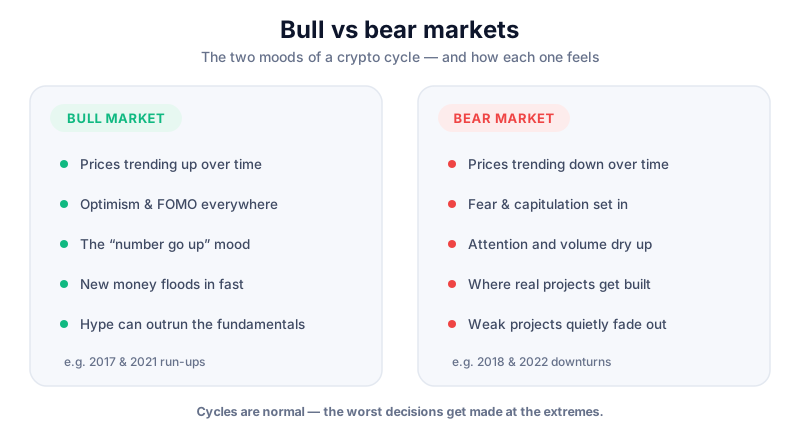
The names come from how each animal attacks: a bull thrusts its horns *up*, a bear swipes its paws *down*. So a bull market means prices trending up, and a bear market means prices trending down — usually a drop of 20% or more sustained over time.
These aren't precise scientific terms. They describe broad direction and sentiment, not a guarantee about tomorrow.
How crypto cycles tend to behave
Crypto has historically moved in big boom-and-bust cycles, with sharp rallies followed by long, painful declines. Sentiment plays a huge role: in bull markets, optimism and fear of missing out can push prices well beyond what fundamentals justify; in bear markets, fear can push them far below. Whichever way you lean, the storage rule doesn't change: serious amounts belong offline, on a hardware wallet like the Ledger Nano X.
- Bull phase — rising prices, heavy media coverage, new buyers piling in, FOMO.
- Bear phase — falling prices, projects failing, capitulation, and much quieter headlines.
- Sideways — long stretches where the market chops in a range with no clear trend.
The honest reality
You only know for sure that a top or bottom happened *after* it's passed. Plenty of confident predictions about cycle timing turn out wrong. Be especially wary of anyone claiming to know exactly when the next bull run starts — that's a common hook for hype and scams.
Cycles are not a crystal ball
Past cycles don't guarantee future ones, and timing the market is extremely hard even for professionals. Don't borrow to buy, only risk what you can afford to lose, and ignore anyone promising guaranteed returns. This is education, not financial advice.
Key takeaways
- Bull markets trend up with optimism; bear markets trend down with fear.
- Crypto has historically moved in dramatic boom-and-bust cycles.
- Sentiment can push prices far above or below fundamentals.
- Tops and bottoms are only obvious in hindsight — be wary of timing claims.
Frequently asked questions
How long do crypto bull and bear markets last?
There's no fixed length. Past cycles have run for months to a couple of years each, but every cycle is different and there's no guarantee history repeats.
Can I time the top or bottom?
Reliably, no. Even seasoned investors get it wrong. Anyone selling a guaranteed method to call tops and bottoms should be treated with suspicion.
Keep reading
Understanding Crypto Volatility
Why crypto prices swing so hard: the causes of volatility, what it means for you, and how to keep a level head
What Is Market Cap in Crypto?
Market capitalisation explained in plain English: how it's calculated, why it matters more than price, and the
How to Avoid Crypto Scams: The Cornerstone Safety Guide
The common crypto scams — fake support, phishing, giveaways, romance and rug pulls — and the simple habits tha