Chainlink Staking Explained
Chainlink staking lets LINK holders lock up their tokens to help secure the oracle network — and earn rewards for doing so. This guide explains how it works, what you can earn, and the risks to weigh before you ever consider it.
The 20-second version
Staking means locking up LINK as a security deposit that backs the honesty of Chainlink's oracle data. In return you earn rewards. It's not free money: tokens are locked, rewards vary, and the LINK price can fall while they're locked.
What is Chainlink staking?
Staking on Chainlink means committing LINK as a kind of security deposit behind the network's oracle services. The idea is simple: if operators and stakers have their own money on the line, they have a strong reason to make sure the data the network delivers is accurate and on time.
Chainlink Staking launched in stages from late 2022, with later versions widening access and increasing the pool. It's part of how the network aims to make its oracle data more trustworthy — and more costly to attack.
How it works
When you stake, your LINK is locked for a period and helps back the performance of oracle services. In exchange you earn rewards, typically paid in LINK. The deposit can be put at risk if the operators it backs fail to do their job properly — that threat is what gives staking its security value.
- Lock-up: staked LINK is committed and not freely available to sell.
- Rewards: earned over time, usually denominated in LINK.
- Accountability: stakes back honest, reliable oracle performance.
- Capacity limits: pools have caps, so space can be limited.
The risks to understand first
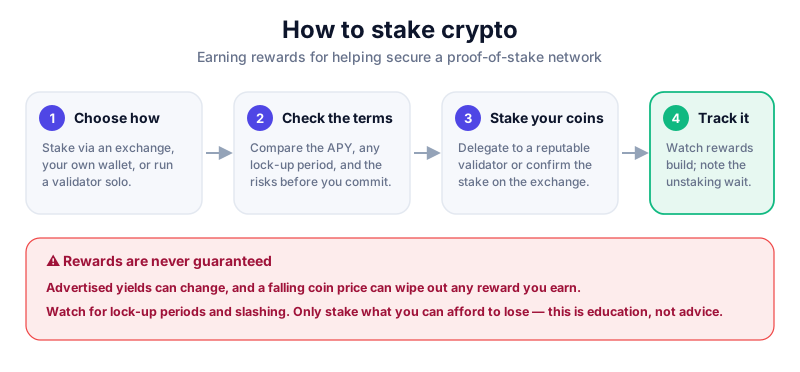
Staking is often described as 'earning interest', but that framing hides real risks. Rewards are usually paid in LINK, so their value rises and falls with the token. And while your LINK is locked, you can't sell it even if the price drops sharply. If you do stake, do it from cold storage — a hardware wallet like the OneKey lets you delegate while your keys stay offline.
- Price risk: LINK can fall in value while your tokens are locked.
- Lock-up risk: you may not be able to withdraw instantly.
- Reward variability: rates change and aren't guaranteed.
- Smart-contract risk: any staking system can carry technical bugs.
Rewards are not 'safe' returns
A reward rate is not interest from a bank. You can earn LINK and still lose money overall if the price falls. Only stake what you can afford to lose, and never borrow to do it. This is education, not financial advice.
How to think about it
Whether staking suits you isn't a call we make. What matters is that you understand it: your tokens are locked, rewards are uncertain, and you're exposed to LINK's price the whole time. If you do explore it, use only the official Chainlink staking platform — and be deeply suspicious of any third-party site or DM promising higher 'guaranteed' returns, a hallmark of scams.
Protect your keys
Staking usually means connecting a wallet. Never share your seed phrase, double-check the website address, and consider using a hardware wallet for any meaningful amount.
Key takeaways
- Staking locks up LINK to help secure Chainlink's oracle network, earning rewards.
- Rewards are usually paid in LINK, so their value moves with the token.
- Your tokens are locked, so you can't sell freely while staked.
- Use only the official platform; reward rates are never guaranteed and 'guaranteed returns' signal a scam.
Frequently asked questions
How much can I earn staking LINK?
Reward rates vary over time and aren't fixed or guaranteed. Any figure you see is a snapshot, not a promise — and rewards in LINK can be worth less if the price falls.
Is staking LINK safe?
It carries real risks: price falls during lock-up, withdrawal delays, and technical bugs. It's not a risk-free savings account. Only stake what you can afford to lose.
Where do I stake Chainlink?
Only through the official Chainlink staking platform. Treat any third-party site, app, or message offering LINK staking with high 'guaranteed' returns as a likely scam.
Keep reading
What Is Chainlink (LINK)? A Plain-English Guide
A beginner-friendly explanation of Chainlink and the LINK token: what it does, how its oracle network works, a
What Are Blockchain Oracles? The Problem Chainlink Solves
A plain-English explanation of blockchain oracles: why smart contracts can't see the outside world, how oracle
What Is Staking? How It Works and What It Costs
A plain-English guide to crypto staking: how it secures proof-of-stake networks, how rewards work, and the loc