Crypto Narratives to Watch (And How to Read Them Without Getting Burned)
In crypto, a good story often moves money before anything is actually proven. That story is what people mean by a 'narrative' — a theme the whole market decides to care about at once, from DeFi to NFTs to AI agents. Narratives are worth understanding, because they tell you where attention (and liquidity) is flowing. But they are also how late buyers get trapped: by the time a narrative is obvious, the easy gains have usually already been priced in. This piece explains what a narrative really is, tours the ones shaping 2026, and — most importantly — shows you how to read them without getting burned.
The 20-second version
A crypto narrative is a dominant theme that becomes an investable story, pulling money in before real progress can be measured. That's exactly why narratives are a risk signal as much as an opportunity — the rally often happens ahead of the fundamentals, and 'narrative confirmed' frequently marks the top rather than the entry. Treat a narrative as a lens for understanding what's happening, never as a reason to buy.
What a 'narrative' actually is (and why crypto runs on them)
A narrative is simply a theme that the market agrees to treat as *the* thing right now. It could be a genuine technology shift, a new use case, or just a compelling story. What makes it a narrative rather than a footnote is that it captures attention — and in crypto, attention is the raw material that gets turned into price.
The chain of events is nearly always the same. Attention concentrates on a theme, liquidity follows the attention, and price moves — often well before there is anything real to measure. That ordering is the whole point. A stock usually moves after earnings; a crypto narrative frequently moves on the *promise* of earnings that may never arrive.
You can see it in how narratives rotate. DeFi Summer in 2020 gave way to the NFT mania of 2021, then blockchain gaming, then the AI-token wave. Each felt, at its peak, like the obvious future. Some genuinely mattered; others faded to almost nothing. If you want the mechanics of how attention and money rotate between sectors, our piece on what causes alt seasons covers the same engine from a different angle.
How narratives make money — and how they trap it
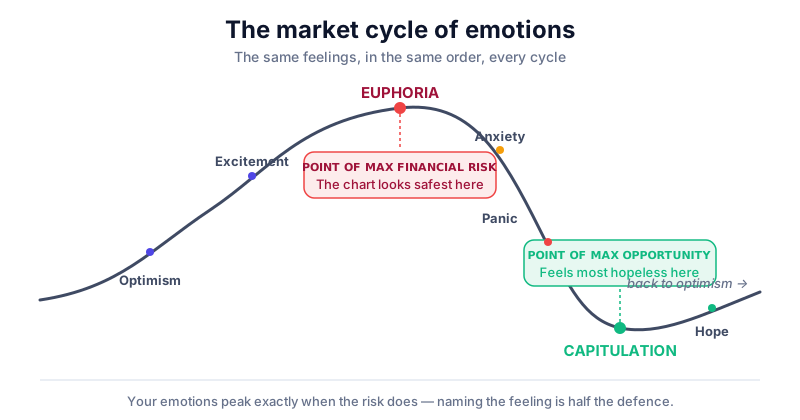
Because the rally comes before the proof, timing is everything and it is brutally unforgiving. Early participants are buying a story that most people haven't noticed yet. By the time a narrative is on every timeline and in every headline, the people who were early are often looking for someone to sell to. That someone is usually the late buyer who just discovered the theme.
This is why 'the narrative is confirmed' can be one of the most dangerous phrases in the market. Confirmation means the story is now widely believed — which is precisely when the easy money has already been made and the risk is highest. Broad agreement is a late-stage signal, not an early one.
The trap in one sentence
A narrative pulls liquidity in before anything is proven, so the crowd that arrives when the story is 'obvious' is often the exit liquidity for the people who arrived when it wasn't.
There's a second trap: confusing the theme with the token. A narrative can be completely real while the specific coin you can buy is a poor way to express it — sometimes it's just a token bolted onto a buzzword. A building sector earns revenue and ships products; narrative cosplay is a chart with a fashionable name attached. We'll come back to telling those apart.
The 2026 narratives worth understanding
Here's a quick tour of the themes shaping the market as of mid-2026. Every figure below moves — market caps, volumes and rankings can change within weeks, and several trackers openly disagree — so treat these as a snapshot to understand, not numbers to trade on. Where you want a current figure, check a live source yourself.
| Narrative | The gist (as of mid-2026) | The honest caveat |
|---|---|---|
| AI agents | Autonomous bots with wallets and tokens; sector ~$15bn cap, with a handful of platforms dominant | Heavy concentration in a few names; many 2025-peak tokens down 60–80% |
| RWAs / tokenisation | Real assets (Treasuries, credit) put on-chain; tens of billions and growing fast | Trackers disagree wildly on the total depending on whether stablecoins are counted |
| Stablecoins | Digital cash rails for payments and DeFi; total supply grew sharply through 2025–26 | The rails are real; the tokens themselves aren't a bet, they're plumbing |
| Prediction markets | Betting on real-world outcomes; monthly volumes jumped several-fold into 2026 | Regulatory scrutiny and insider-trading concerns emerged in 2026 |
| DePIN + AI | Decentralised compute, storage and data networks feeding AI workloads | Project-level revenue claims are hard to verify |
| Restaking | Reusing staked assets to secure more services for extra yield | Adds slashing, smart-contract and correlated-failure risk; TVL figures conflict badly |
| Bitcoin L2s | Layers aiming to bring DeFi to Bitcoin | Contracting, not booming — TVL fell sharply and at least one L2 announced a shutdown |
| Meme 'supercycle' | The debate over whether meme coins are a lasting force | Genuinely unresolved — both bulls and bears cite different windows |
A few deserve a closer look. AI agents — software given a wallet so it can act on-chain — solidified as a category rather than collapsing, but the gains concentrated heavily in a small number of platforms, and if a leader stumbles the whole theme takes the hit. We cover the mechanics and the froth in AI agents in crypto, and where it meets meme mechanics in the rise of AI meme coins.
Real-world assets — tokenising Treasuries, credit and funds — is arguably the most 'serious' narrative, with tokenised US Treasuries the standout class. But it's also the one where numbers are least reliable: one tracker excluding stablecoins showed tens of billions, another using a different method showed a very different figure, and including stablecoins pushes the total into the hundreds of billions. Read what real-world assets (RWAs) are before you trust any single headline number.
Stablecoins grew into genuine settlement rails for payments, remittances and DeFi collateral, with total supply rising steeply through 2025 and into 2026. Worth understanding as infrastructure — see what a stablecoin is — but remember a stablecoin is designed *not* to move in price, so it's plumbing, not a punt.
Prediction markets were one of the loudest 2026 stories, with combined monthly volumes on the big platforms rising several-fold and mainstream finance sites beginning to embed live odds. The infrastructure question there overlaps with high-performance on-chain trading venues like the one in Hyperliquid, explained. And the meme 'supercycle' debate remains exactly that — a debate. Some data points to collapse (launch volumes down heavily, search interest fading); others to an early-2026 rebound. We lay out both sides in is the meme coin supercycle over?
Not every narrative points up
'Narrative' does not mean 'going up'. As of mid-2026, Bitcoin L2 total value locked had contracted sharply and at least one Bitcoin L2 announced it was shutting down, citing weak fee revenue. A theme can be talked about a lot while the underlying activity shrinks.
Real infrastructure vs. narrative cosplay
The single most useful skill here is telling a sector that's actually building from a token wearing a buzzword. The tells aren't subtle once you know to look.
- Revenue vs. incentives. Is a project earning real fees from real usage, or is the activity propped up by token rewards that vanish the moment the incentives stop? Some DePIN and compute networks are shifting from paying users in tokens toward genuine revenue — that's a healthy sign. Activity that only exists because the token is subsidising it is not.
- Concentration risk. When most of a narrative's value sits in one or two names, the theme is fragile. The AI-agent sector is a clear example — a large share concentrated in a couple of platforms means a single failure can drag everything down.
- Conflicting numbers. When trackers can't agree on the size of a sector — as with RWA totals and restaking TVL in 2026 — that's a sign the space is early, opaque, or measuring different things. Treat any single 'the sector is worth $X' headline with suspicion.
- Stacked risk. Some narratives layer new risks on top of old ones. Restaking, for instance, reuses staked assets to secure extra services — attractive yield, but it adds slashing, smart-contract bugs, correlated failures and often opaque reward sources. More yield almost always means more risk somewhere.
The deletion test
Ask: if you deleted the token entirely, would the underlying network or product still be useful to someone? If the whole point is the token, you're looking at speculation dressed as infrastructure.
How to read a narrative without getting burned
You can't reliably time these, and this isn't a formula for doing so — nothing here is a recommendation to buy anything. But there are honest questions that turn a narrative from a hype trigger into a risk lens. Run through them before a story ever tempts you to act.
- Who's actually early — builders or traders? A narrative worth respecting usually shows up first in developer activity and funding rounds, not just in prices going up. If the only evidence is a rising chart, you're late, not early. Our guide to finding promising crypto projects goes deeper on this.
- What is genuinely shipping? Separate working products and real revenue from press releases and roadmaps. Ask what exists today that would still matter if the price fell 80%.
- Where's the exit liquidity? If a narrative is already on every timeline, ask who is left to buy after you. Broad awareness is a late signal, and late buyers are frequently the exit for early ones.
- Is the token even the right expression? A real theme rarely has one obvious coin. Often the best way to 'play' a narrative is to keep learning and stay out of the token entirely.
- Have you sized it as if you're wrong? Narrative tokens are among the most volatile assets in an already volatile market. If you engage at all, assume you could lose everything you commit — because you can.
For narrative tokens specifically — meme coins, agent tokens, the fashionable launch of the week — the practical due-diligence steps in how to research a meme coin apply almost word for word. The buzzword changes; the questions don't.
The honest bottom line
Narratives are worth understanding because they genuinely map to where attention and money are moving, and most of them point at a real technology shift underneath. That's the useful part: a narrative is a lens for reading the market. Where people get hurt is treating it as a buy signal — chasing a story after it's obvious, mistaking a token for the sector it's named after, and assuming 'narrative' means 'up only' when Bitcoin L2s and restaking in 2026 show it clearly doesn't.
So read narratives closely, hold every number loosely (they move, and trackers disagree), and never let a good story do the job of due diligence. If you want the wider context on why attention prices in ahead of fundamentals, why Bitcoin lags while AI stocks soar is a useful companion. As always, none of this is financial advice — crypto is volatile, narrative-linked tokens especially so, and understanding a story is never the same as it being safe to buy.
Key takeaways
- A narrative is a theme the market prices before fundamentals catch up: attention concentrates, liquidity follows, and price moves ahead of any proof.
- 'Narrative confirmed' is a late signal, not an early one — by the time a story is obvious, early buyers are often selling to the crowd that just arrived.
- The 2026 themes (AI agents, RWAs, stablecoins, prediction markets, DePIN, restaking, Bitcoin L2s, memes) all move fast, and trackers disagree — hold every figure loosely.
- 'Narrative' doesn't mean 'up only': Bitcoin L2 TVL contracted and an L2 announced a shutdown in 2026, while restaking stacks extra, under-appreciated risk.
- Read narratives as a risk lens, not a buy signal — check who's early, what's shipping, where the exit liquidity is, and never let a good story replace due diligence.
Frequently asked questions
What's the difference between a narrative and a bubble?
They overlap heavily. A narrative is a theme the market believes in and prices ahead of proof; it becomes a bubble when the price fully detaches from what's actually shipping. Many narratives map to a genuine technology shift, but that doesn't stop the tokens attached to them from inflating far beyond anything the fundamentals justify — and then deflating just as hard.
How do I find the next narrative early?
Watch where builders go, not just traders — developer activity, funding rounds, and quiet infrastructure work usually precede the price. That said, early does not mean safe: being right about a theme and right about the specific token are two different things, and plenty of correct narratives still produced tokens that went to zero. Treat 'early' as higher risk, not lower.
Are narratives just hype, or are they fake?
Mostly neither. Most narratives map to a real shift in technology or usage — AI compute, tokenised assets and stablecoin rails are genuinely happening. The catch is that the token you can buy is rarely the best expression of the trend, and is often just a buzzword bolted onto a chart. The theme can be real while the coin is still a poor and risky bet.
Which 2026 narrative is the best one to invest in?
That's the wrong question, and we won't rank them as buys. Which narrative is 'best' depends entirely on risk you can't see and timing no one can reliably call, and picking a 'winner' is exactly the mistake that gets people burned. The better questions are about process: who's early, what's actually shipping, and whether you could afford to be completely wrong. None of this is financial advice.
Keep reading
Is the Meme Coin Supercycle Over?
Was there ever a meme coin 'supercycle', and is it ending? We weigh the signs of cooling against signs of life
What Actually Causes Alt Seasons?
What an alt season is, why money rotates from Bitcoin into altcoins, the liquidity and risk-appetite drivers b
AI Agents in Cryptocurrency, Explained
What AI agents in crypto actually are: autonomous bots that hold wallets, trade and even launch tokens. How th