AI Agents in Cryptocurrency, Explained
Sometime in late 2024, crypto fell in love with the phrase 'AI agent'. Suddenly there were bots with their own wallets, their own tokens and their own social media accounts, posting jokes and apparently trading on their own. This piece explains what an AI agent really is in a crypto context, how the plumbing works, and — just as importantly — where the marketing ends and the risk begins.
The 20-second version
An AI agent is software that can make decisions and act on its own, and a crypto AI agent is one given control of a wallet so it can trade, transfer funds or call smart contracts without a human pressing the button each time. The idea is genuinely useful, but most 'AI agent' tokens are speculative and many are barely more than a chatbot bolted onto a meme coin.
What an 'AI agent' actually means
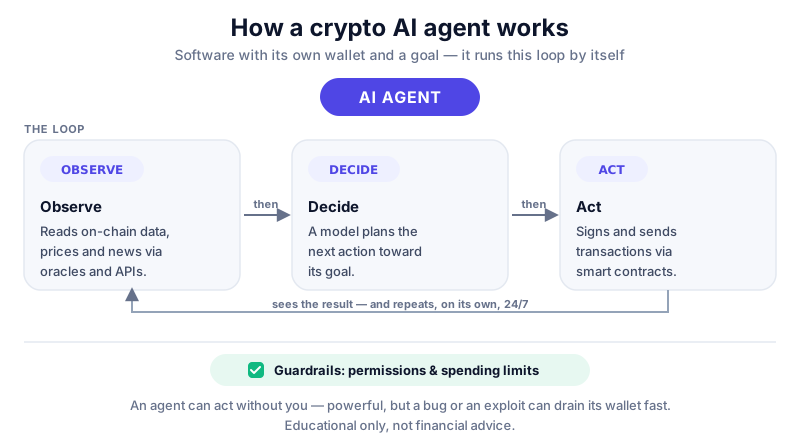
Strip away the hype and an AI agent is just a program built around a language model that can take actions, not only produce text. A normal chatbot answers a question and stops. An agent is given a goal, a set of tools it is allowed to use, and the freedom to decide which tool to use and when. Tell it to 'keep this portfolio balanced' and it can read prices, decide a trade is needed, and execute it — looping on its own rather than waiting for you.
The crypto twist is the wallet. Once you hand an agent a private key, or scoped permission to spend from a wallet, it can do anything a person could do on-chain: swap tokens on a decentralised exchange, send funds, stake, vote in a DAO, or interact with any smart contract. That is the leap that made 'AI agents' a crypto category rather than a general-tech one — software that holds money and moves it without asking.
Agent versus bot versus chatbot
- Trading bot — follows fixed rules you set ('buy if price drops 5%'). No real decision-making; it just executes a strategy you wrote.
- Chatbot — answers questions in natural language but takes no action in the world. It can tell you about a trade, not make one.
- AI agent — combines the two: it reasons about a goal in natural language and can act on-chain through tools, adapting as conditions change.
How a crypto AI agent works under the hood
Most on-chain agents share four moving parts. Understanding them is the fastest way to see both the appeal and the danger.
| Part | What it does | Why it matters |
|---|---|---|
| The model | The 'brain' — usually a large language model that interprets the goal and decides what to do next | It can be wrong, biased or manipulated by cleverly crafted inputs |
| Tools / plugins | Connectors that let the agent read prices, post online, or call contracts | Each tool widens what the agent can do — and what can go wrong |
| Memory | A store of past actions and context so the agent behaves consistently over time | Lets it pursue goals across many steps, not just one reply |
| A wallet | The keys or permissions that let it actually move funds | This is where money is genuinely at stake |
A growing approach is to never give the agent your full private key. Instead it gets a session key or a scoped permission: time-limited, capped authority to spend up to a set amount on specific actions. Ethereum's account-abstraction work has made this far easier, letting a normal account briefly behave like a smart contract so it can grant an agent narrow, revocable powers. It is the difference between handing someone your bank card and PIN versus a prepaid card with a £50 limit.
An agent with your keys is an attack surface
A language model can be tricked by malicious instructions hidden in a webpage, a token name or a chat message — a trick called prompt injection. If that agent controls a wallet, a successful trick can become a real, irreversible transaction. Treat any agent with spending power like a junior employee you would not give unlimited access to.
The frameworks and platforms behind the boom
The 2024–25 wave was driven by open-source frameworks that made spinning up an agent a weekend project rather than a research effort. The best-known is ElizaOS (originally launched under the ai16z name), a framework for building agents that can hold wallets, interact with contracts and post to social media. Platforms such as Virtuals Protocol went further, letting people create, tokenise and co-own agents — so an agent could have its own tradable token from day one.
By 2026 the big players had joined in. Several major exchanges and wallet providers shipped 'agent kits' — developer toolkits that let an agent execute trades, transfers and contract calls within permission limits the developer or user sets. The trend is clear: the rails for autonomous on-chain software are being built quickly. What is far less clear is how much of the activity is genuinely useful versus speculation dressed up as innovation.
It is worth separating the framework from the token. A framework like ElizaOS is real software many developers use. A token attached to an agent or platform is a separate thing — a speculative asset whose price reflects hype and demand, not the quality of the code. Conflating the two is how a lot of people lose money.
Hype versus reality
Two stories often get told at once. The optimistic one: autonomous agents will run treasuries, manage liquidity, and transact with each other in a 'machine economy' that never sleeps. The cynical one: 'AI agent' became a marketing sticker slapped onto ordinary meme coins to make them sound sophisticated. Both contain truth.
What is genuinely real
- Agents that automate dull, well-defined on-chain chores — rebalancing, claiming rewards, monitoring positions — are practical and already in use.
- Permissioned 'agentic wallets' with spending caps are a sensible piece of infrastructure, whatever happens to the hype.
- The frameworks are real, open-source and actively developed.
What is mostly froth
- An agent posting jokes on social media does not make its token valuable. Many launches are closer to a meme coin with a chatbot than a working business.
- 'The agent is trading and making money' claims are rarely verifiable. You usually cannot see the strategy, the full track record, or who really controls the wallet.
- Some projects are deliberately misleading — the 'AI' is a thin wrapper, and the real product is selling you a token. The overlap with the rise of AI meme coins is large.
A useful test
Ask: if you deleted the token entirely, would the agent still be useful to someone? If the answer is no — if the whole point is the token — you are almost certainly looking at speculation, not technology.
The risks, plainly stated
AI agents stack two of crypto's riskiest ingredients on top of each other: autonomous software making decisions, and irreversible transactions with real money. When they fail, they can fail fast and silently.
- Bugs and bad decisions — an agent can misread a situation and drain a position, and there is no 'undo' on a blockchain.
- Prompt injection and manipulation — attackers craft inputs designed to hijack the agent's behaviour, turning its wallet against you.
- Smart-contract risk — agents lean heavily on contracts, inheriting every flaw in them. Our guide to smart contract risk applies in full.
- Opaque control — you often cannot tell who can override the agent or withdraw its funds. The team behind it may be anonymous.
- Token speculation — even if the agent works, its token can collapse like any other speculative asset. The same rug pull playbook applies.
If you ever let an agent touch a wallet
Use a fresh, separate wallet funded with only what you can afford to lose, grant the narrowest permissions possible, set spending caps, and know how to revoke access. Our guide on how to revoke token approvals is a good place to start.
The bottom line
AI agents are a real and interesting development: software that can reason about a goal and act on-chain to pursue it. The infrastructure being built around them — scoped permissions, agent kits, session keys — is sensible and likely to stick around. But the gap between that quiet, useful reality and the loud, token-fuelled hype is enormous, and most of what trends under the 'AI agent' banner is closer to speculation than to working technology.
If you want to go deeper, see how this connects to AI meme coins and to the broader question of where AI and blockchain genuinely intersect. As always, none of this is financial advice. Crypto is volatile, agent-linked tokens especially so, and you can lose everything you put in — so treat anything in this space as something to understand carefully rather than chase.
Key takeaways
- An AI agent is software that decides and acts on its own; a crypto agent is one given a wallet so it can transact without a human in the loop.
- Under the hood: a model (the brain), tools, memory and a wallet — increasingly with scoped, capped permissions rather than full key access.
- Frameworks like ElizaOS are real software, but an agent's token is a separate, speculative thing — don't confuse the two.
- Most 'AI agent' tokens are closer to meme coins with a chatbot than to working products. A good test: would the agent matter if you deleted its token?
- The risks stack up: bad decisions, prompt injection, smart-contract flaws, opaque control and token collapse — all on irreversible rails.
Frequently asked questions
Are AI agents in crypto a scam?
Not inherently — the underlying idea (software that acts on-chain) is real and useful, and the frameworks are genuine open-source projects. But many 'AI agent' tokens are speculative and some are outright misleading, using a thin layer of 'AI' to sell a coin. Judge each one on whether the agent would be useful without its token, and treat the token itself as high-risk.
Can an AI agent really trade on its own?
Technically yes — once an agent has a wallet and a connection to a DEX, it can execute swaps without a human pressing the button. Whether it trades well is another matter. Claims of profitable autonomous trading are rarely verifiable, because you usually cannot see the full strategy, the real track record, or who controls the wallet.
Is it safe to give an AI agent my wallet?
Giving any software your full private key is risky, and a language model can be manipulated into making transactions you never intended. If you experiment at all, use a brand-new wallet with only money you can afford to lose, grant the narrowest spending permissions possible, and make sure you can revoke access — see how to revoke token approvals.
Keep reading
The Rise of AI Meme Coins
AI meme coins fuse the artificial-intelligence narrative with meme-coin culture — AI agents that launch and sh
The Future of AI and Blockchain Together
Where AI and crypto genuinely overlap — compute markets, provenance, autonomous agents and data marketplaces —
What Is a Smart Contract? A Plain-English Guide
A beginner-friendly explanation of smart contracts: what they are, how they run on a blockchain, where they're