UK Crypto Tax Deadlines, Penalties & HMRC's 'Nudge' Letters
If you owe tax on crypto in the UK, missing a deadline can turn a manageable bill into a larger one through penalties and interest. This is a general explainer of how the Self Assessment timeline works, what being late broadly costs, and why HMRC is increasingly writing to crypto holders — not personal tax advice, because your own dates and position can differ.
The 20-second version
Self Assessment runs on a fixed calendar: you usually register first, then file (paper and online have different deadlines) and pay any tax due. Filing or paying late can trigger penalties and interest that grow over time. HMRC also receives data from exchanges and sends 'nudge' letters to people it thinks may owe tax. The exact dates, penalty figures and interest rates change, so always check HMRC's current guidance or a qualified accountant.
Read this first
This is education, not tax advice
Tax deadlines, penalty amounts, interest rates and allowances change, and your circumstances are unique. Nothing here is personal advice. Always check the current official HMRC guidance (the Cryptoassets Manual and the Self Assessment deadlines pages) or speak to a qualified accountant before you register, file or pay.
The Self Assessment timeline at a glance
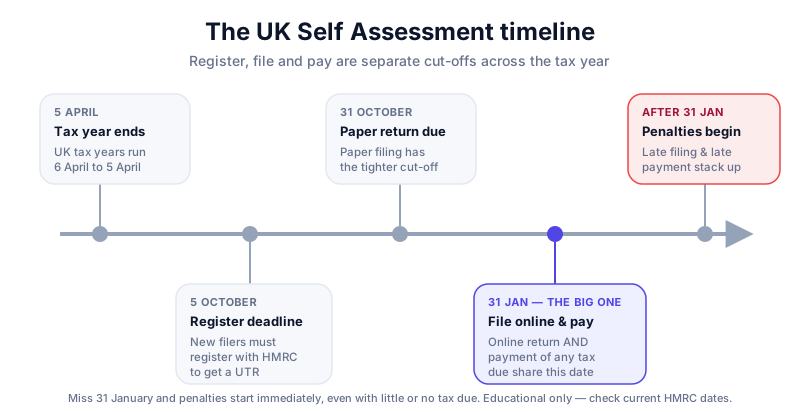
UK tax years run from 6 April to 5 April. If you have crypto gains or income that need reporting, you generally do so through Self Assessment for the year in which the disposal or income happened. For the wider picture of how crypto is taxed here, start with our UK crypto tax overview.
There are really three separate things with their own cut-off points: registering, filing the return, and paying what you owe. They are not the same date, and treating them as one deadline is a common and avoidable mistake.
| Stage | Roughly when | Why it matters |
|---|---|---|
| Register for Self Assessment | Earlier in the year after the tax year ends, if you've not filed before | No Unique Taxpayer Reference means you can't file — and the reference can take time to arrive by post |
| File a paper return | Earlier in the cycle than the online deadline | Paper has the tighter cut-off, so most crypto holders file online |
| File online | The well-known January deadline after the tax year | This is the date most people mean by 'the deadline' |
| Pay the tax due | Aligned with the online filing deadline, with possible payments on account | Filing on time but paying late still triggers interest and possible penalties |
Because the precise dates shift and depend on your circumstances, treat the table as the shape of the cycle rather than a calendar. Confirm your actual deadlines on HMRC's website, and if you're filing yourself, our walkthrough of how to report crypto on Self Assessment covers where the figures go.
Why registration is the deadline people forget
If you've never filed a return, you usually have to register for Self Assessment before you can submit one. HMRC then issues a Unique Taxpayer Reference (UTR) by post, and you activate your online account separately. None of this is instant.
- Check on HMRC's site whether your crypto activity means you need to register and file for the year in question.
- Register through your HMRC online account well before the registration cut-off — leaving it late risks the UTR not arriving in time.
- Wait for the UTR and any activation code to arrive by post, then activate your account.
- Note that the registration deadline falls earlier than the filing deadline, so an early start protects you on both.
Registration has its own cut-off
The deadline to register for Self Assessment usually falls months before the January online filing deadline. Missing it can cause problems even if you later intend to file on time, so don't assume registration and filing share a date — check both on HMRC's site.
What being late broadly costs
There are two separate ways to be late, and they're penalised separately: filing the return late, and paying the tax late. You can be on time for one and late for the other.
Late filing
Filing your return after the deadline can trigger an initial fixed penalty, with further charges building up the longer the return stays outstanding. Because the structure and figures are set by HMRC and change over time, we won't quote specific numbers here — the important point is that the cost tends to escalate the longer you leave it, so a return that's a little late is far cheaper to resolve than one that's months overdue.
Late payment
Paying the tax late is a separate matter. HMRC generally charges interest on overdue tax from the due date until you pay, and can add late-payment penalties on top once the balance has been outstanding for a while. Interest rates are reviewed periodically, so check the current figure on HMRC's site rather than relying on an old one.
| Situation | What broadly applies |
|---|---|
| Return filed late | An initial penalty, with further charges that can grow the longer it's outstanding |
| Tax paid late | Interest from the due date, plus possible late-payment penalties over time |
| A genuine, evidenced reasonable excuse | HMRC may reduce or cancel a penalty — but the bar and process are theirs to set |
Penalties and interest can stack
Because filing and payment are penalised separately, a single late return that also goes unpaid can attract more than one type of charge at once. This is why acting early — even with an estimate you later refine — usually costs less than waiting.
HMRC 'nudge' letters and exchange data
A growing number of UK crypto holders are receiving so-called 'nudge' letters from HMRC. These are not penalty notices. They are prompts — HMRC effectively saying it has reason to think you may have crypto activity you haven't reported, and inviting you to check your position and put things right.
The reason HMRC can do this is data. Under international and domestic reporting frameworks, crypto exchanges and platforms increasingly share customer information with tax authorities, including HMRC. So the old assumption that on-chain or exchange activity is invisible to the taxman is no longer safe — and is becoming less so each year.
- A nudge letter is a prompt to review and, if needed, disclose — not an accusation or an automatic fine.
- Ignoring one is rarely a good idea; HMRC has signalled it will follow up, and unprompted disclosures are generally treated more favourably than ones HMRC has to chase.
- HMRC operates voluntary disclosure routes for people who realise they owe tax from earlier years — the detail and terms are set by HMRC.
- Even if you think the letter is mistaken, it's worth checking your records carefully before responding.
Treat a nudge letter as a deadline of its own
If a letter lands, don't file it under 'later'. Gather your records, work out whether you actually owe anything, and take advice if it's unclear. Coming forward voluntarily generally puts you in a better position than waiting for HMRC to come back.
The safest assumption now is that HMRC can already see the exchange side of your activity — the question is whether your return matches it.
Staying ahead of the deadlines
Most deadline trouble comes down to two things: starting too late, and not having clean records to file from. Both are fixable well before January.
- Keep complete records across every exchange, wallet and chain as you go, not in a panic at year end — our record-keeping guide covers what to retain.
- Register for Self Assessment early if it's your first time, so a slow-arriving UTR can't make you late.
- Work out your figures in good time — pooling plus the Same-Day and 30-day rules make hand calculations error-prone, as our capital gains walkthrough explains.
- Don't forget income events such as some staking rewards, which follow their own treatment in our staking and mining tax guide.
If you realise you've missed something from an earlier year, the worst response is to do nothing. Check HMRC's current guidance on disclosures, consider a qualified accountant, and remember that the longer a problem sits, the more interest and potential penalty it can attract. Keeping your crypto itself secure — see how to store Bitcoin safely — is part of the same good housekeeping.
Koinly connects to your exchanges and wallets and applies HMRC's pooling plus the Same-Day and 30-day rules automatically, so you're not reconstructing a year of trades against the clock. It's free to preview your numbers — you only pay to download the SA108-ready report.
Key takeaways
- Registering, filing and paying are three separate stages with different cut-offs — they are not one deadline.
- Paper and online filing have different deadlines; most crypto holders file online by the January cut-off.
- Filing late and paying late are penalised separately, and the cost tends to grow the longer you leave it.
- HMRC receives data from exchanges and sends 'nudge' letters; ignoring one is rarely wise.
- Exact dates, penalty amounts and interest rates change, so always check HMRC's current guidance or an accountant.
Frequently asked questions
What is an HMRC crypto 'nudge' letter?
It's a prompt, not a fine. HMRC sends nudge letters to people it believes may have crypto activity they haven't reported, inviting them to check their position and disclose anything owed. It's generally better to review your records and respond than to ignore it. Check HMRC's current guidance or an accountant if you're unsure.
Does HMRC actually know about my crypto?
Increasingly, yes. Under international and UK reporting frameworks, exchanges and platforms share customer data with tax authorities including HMRC. The old idea that crypto activity is invisible to the taxman is no longer a safe assumption, which is why nudge letters have become more common.
What happens if I file my crypto tax return late?
Filing late can trigger an initial penalty, with further charges building the longer the return stays outstanding, and paying late adds interest and possible penalties on top. The exact figures are set by HMRC and change, so check the current amounts on HMRC's site or with an accountant.
I think I missed crypto tax from a previous year — what now?
Doing nothing is usually the costliest option, since interest and potential penalties tend to grow over time. HMRC operates voluntary disclosure routes, and coming forward is generally treated more favourably than being chased. This is a good point to check HMRC's guidance or speak to a qualified accountant — nothing here is personal advice.
Keep reading
Crypto Taxes in the UK: A Plain-English Overview (HMRC)
How HMRC generally treats crypto for UK taxpayers — capital gains, income, record-keeping and allowances — exp
Koinly Review (2026): The Best Crypto Tax Software for UK Users?
Our Koinly review: the most HMRC-ready crypto tax software we've used, with Same-Day and Bed-and-Breakfasting
How to Report Crypto on a UK Self Assessment (SA100 & SA108)
A plain-English walkthrough of reporting crypto gains and income to HMRC through Self Assessment, including th