Crypto Taxes in the UK: A Plain-English Overview (HMRC)
In the UK, crypto isn't a tax-free zone — HMRC has clear guidance on how it's taxed, and most people who buy, sell or earn crypto have something to think about. This is a plain-English overview of the general principles, not personal tax advice.
The 20-second version
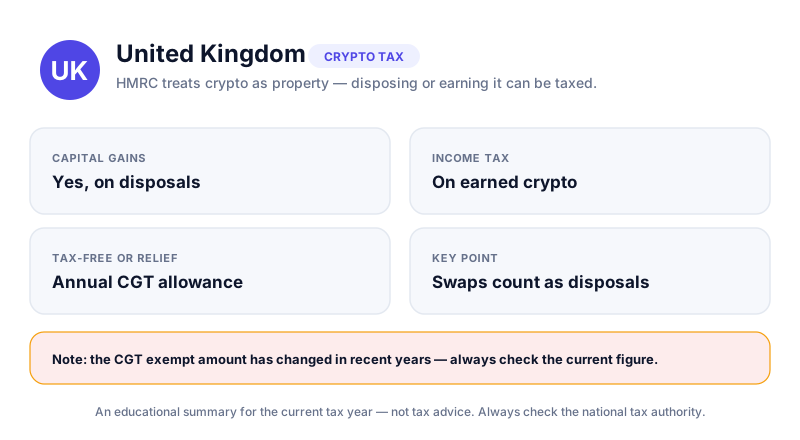
HMRC generally treats crypto as property, not currency. Selling, swapping or spending it can trigger Capital Gains Tax on any profit; earning it (mining, staking, some airdrops, getting paid) is usually Income Tax. Keep detailed records of every transaction. Always check HMRC's current guidance or a qualified accountant — rules and allowances change.
Read this first
This is education, not tax advice
Tax rules, rates and allowances change, and your situation is unique. Nothing here is personal advice. Always check the current official HMRC guidance (the Cryptoassets Manual) or speak to a qualified accountant before filing.
How HMRC views crypto
HMRC does not treat most cryptoassets as money or currency. For tax purposes they're generally treated as property — closer to shares than to cash. That has one big consequence: disposing of crypto can be a taxable event, even if you never convert it back to pounds.
Broadly, crypto activity falls into two tax buckets: Capital Gains Tax (CGT) when you dispose of crypto you hold, and Income Tax when you earn crypto. Which applies depends on what you did, not what coin it was.
Capital Gains Tax: disposing of crypto
A 'disposal' is broader than just cashing out. According to HMRC's general guidance, you typically dispose of crypto when you:
- Sell it for pounds (or any fiat currency).
- Swap one crypto for another — yes, crypto-to-crypto swaps can be taxable, even with no cash involved.
- Spend it on goods or services.
- Give it away to someone other than your spouse or civil partner.
The gain is roughly the value when you disposed of it minus what you paid (your 'cost basis'), with specific pooling rules for working out the cost of coins bought at different times. If your total gains for the year are within the annual CGT exempt amount, there may be no CGT to pay — but that allowance has changed over recent years, so check the current figure.
Swapping counts
A very common surprise: trading, say, Bitcoin for Ethereum is a disposal of the Bitcoin, even though you never touched cash. Each swap may need to be calculated for CGT.
Income Tax: earning crypto
Where you receive crypto rather than buy it, Income Tax (and possibly National Insurance) is more likely to apply, based on the value when you received it. HMRC's guidance generally points to Income Tax for things like:
- Being paid in crypto for work.
- Mining and, in many cases, staking rewards.
- Some airdrops — particularly where you did something to earn them.
- Certain DeFi rewards, where the treatment can be complex and fact-specific.
Note that crypto you earned and paid Income Tax on can also later be subject to CGT when you dispose of it — the gain is then measured from its value when you received it.
Record-keeping and filing
Because exchanges generally don't do this for you, the responsibility to track everything sits with you. HMRC expects you to keep records, and good records make filing far less painful.
- Log every transaction: date, type, amounts, the value in pounds at the time, and any fees.
- Keep records of wallet addresses and exchange statements where possible.
- Work out gains and income for the tax year, applying HMRC's pooling rules for cost basis.
- Report through Self Assessment if required, by the relevant deadlines.
- Consider crypto tax software or a qualified accountant if you have many transactions.
Keep records as you go
Reconstructing years of swaps after the fact is painful and error-prone. A simple running log — or reputable crypto tax software linked to your accounts — saves a lot of stress at filing time.
Go deeper on UK crypto tax
Once you've got the basics, these UK-specific guides walk through the trickier parts in plain English — all educational, none of it personal tax advice:
- How to calculate your capital gains — pooling, the same-day rule and the 30-day rule.
- Staking and mining tax — when rewards count as income versus capital gains.
- Reporting crypto on Self Assessment — the SA100 and SA108 forms.
- Do you pay tax when you swap crypto? — the crypto-to-crypto surprise, explained.
- DeFi and NFT tax — the hardest corners of the rules.
- Capital losses and tax-loss harvesting — how losses can offset gains.
- Allowances and rates — why you should always check the current figures.
- What records HMRC expects — keep these and filing is far easier.
- Deadlines, penalties and nudge letters — staying on the right side of HMRC.
- The best crypto tax software for UK investors — tools that do the maths for you.
Where to go next
Understanding tax is part of using crypto responsibly alongside keeping it secure and avoiding scams. If you're in the US instead, see our US crypto tax overview. And whatever your situation, confirm the details against current HMRC guidance or a professional.
Reconciling a year of trades by hand is miserable. Koinly connects your exchanges and wallets, applies the rules the taxman expects, and produces a ready-to-file report — free to preview, you only pay to download it.
Key takeaways
- HMRC generally treats crypto as property, not currency.
- Selling, swapping or spending crypto can trigger Capital Gains Tax.
- Earning crypto (pay, mining, staking, some airdrops) is usually Income Tax.
- Keep detailed records and check current HMRC guidance or an accountant — this isn't advice.
Frequently asked questions
Do I owe tax if I only swap one crypto for another?
Possibly, yes. HMRC generally treats a crypto-to-crypto swap as a disposal of the first asset, which can create a capital gain or loss even though no pounds changed hands. Keep a record of each swap's value.
Is there a tax-free amount?
There's an annual CGT exempt amount, and gains within it may not be taxed — but the figure has changed in recent years, so check the current allowance on HMRC's site rather than relying on an old number.
Do I need to report crypto if I made a loss?
It can still be worth reporting. Capital losses can sometimes be used to offset gains, but the rules and claim process are specific — check HMRC guidance or an accountant for your situation.
Keep reading
Crypto Taxes in the US: A Plain-English Overview (IRS)
How the IRS generally treats crypto for US taxpayers — capital gains, ordinary income, record-keeping and repo
How to Buy Bitcoin Safely (Step by Step)
A careful, beginner-friendly walk-through of buying Bitcoin on a regulated exchange — verifying your account,
What Is Staking? How It Works and What It Costs
A plain-English guide to crypto staking: how it secures proof-of-stake networks, how rewards work, and the loc