Crypto Tax-Loss Harvesting in the UK: How Capital Losses Work
If your crypto is worth less than you paid, a realised loss can sometimes be used to reduce a Capital Gains Tax bill — but only if you report it correctly and stay within HMRC's rules. This is a plain-English explainer of how capital losses work for UK taxpayers in general, not a strategy to follow or personal tax advice.
The 20-second version
When you dispose of crypto for less than it cost, you make a capital loss. Reported losses can generally be set against capital gains in the same year, and unused amounts can be carried forward — but you usually have to claim them. Selling purely to crystallise a loss and buying the same coin straight back runs into HMRC's 30-day 'bed-and-breakfasting' rule. Always check HMRC's Cryptoassets Manual or a qualified accountant for your own situation.
Read this first
This is education, not tax advice
Tax rules, rates and allowances change, and your circumstances are unique. Nothing here is personal advice, and 'tax-loss harvesting' is not a recommendation — deliberately engineering disposals to manage tax can carry its own risks. Always check the current official HMRC guidance (the Cryptoassets Manual) or speak to a qualified accountant before you act or file.
What counts as a capital loss
A capital loss is the mirror image of a capital gain. When you dispose of a cryptoasset for less than its cost basis, the difference is a loss. As with gains, a 'disposal' is broader than just cashing out to pounds — selling, swapping one coin for another, spending crypto and gifting it (other than to a spouse or civil partner) can all be disposals. For the mechanics of working out the figure, see how to calculate crypto capital gains in the UK.
The key word is realised. A coin that has merely fallen in value while you still hold it gives you a 'paper' loss, which does nothing for tax. The loss only becomes usable when you actually dispose of the asset and lock the loss in.
A swap can realise a loss too
Just as swapping Bitcoin for Ethereum can trigger a gain, it can equally trigger a loss if the coin you're giving up is worth less than you paid for it. The disposal rules cut both ways.
Setting losses against gains
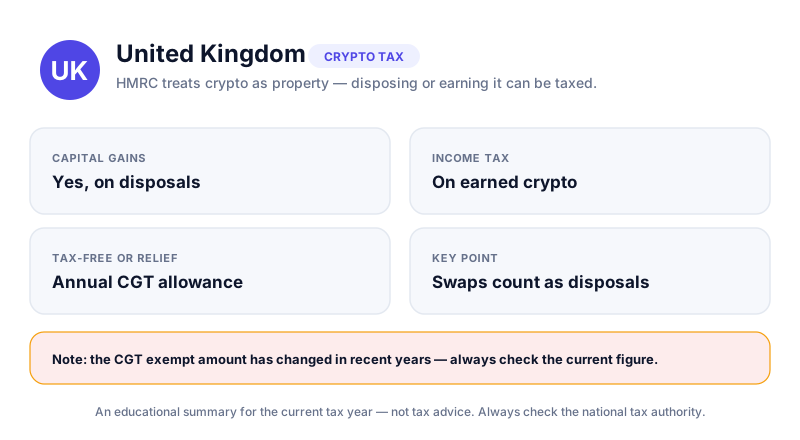
In general terms, HMRC allows capital losses to be offset against capital gains, which can reduce the total gain that's potentially taxable. The broad order of operations usually looks like this:
- Losses in a tax year are first set against gains in the same tax year.
- If losses exceed gains, the unused amount can generally be carried forward to future years.
- Carried-forward losses are then used only to the extent needed to bring gains down to the annual exempt amount — you don't have to waste them dropping below the allowance.
- There are time limits for claiming losses, so they need to be reported within the relevant window to stay usable.
That last point matters because of the annual CGT exempt amount. You generally use current-year losses in full against current-year gains, but brought-forward losses are restricted so they aren't squandered against gains already covered by your allowance. The exact figures and the precise interaction change over time, so check the current allowance on HMRC's site rather than relying on an old number.
Why reporting losses matters
Here's the part people miss: a capital loss is generally not automatic. You usually have to claim it, in writing, to HMRC — often through your Self Assessment return — for it to be available to offset gains, including in later years. Letting a loss go unreported can mean letting it go entirely once the claim window closes.
- Report losses even in a year you have no gains to use them against — claiming now is what preserves them for the future.
- Keep the same detailed records you would for a gain: dates, amounts, the value in pounds at the time, fees and which pool the asset came from.
- If you have a lot of transactions, reconciling losses by hand is where errors creep in — software or an accountant can help.
If you're filing through Self Assessment, our walkthrough of how to file crypto tax on Self Assessment in the UK covers where losses fit on the return.
Claim it to keep it
Treat a realised loss like any other tax position: record it and report it on time. An unclaimed loss is no help at all when you finally have a gain you'd love to reduce.
The 30-day 'bed-and-breakfasting' rule
This is the rule that most often trips people up. The old idea of 'bed and breakfasting' was to sell an asset to crystallise a loss (or reset a cost basis), then buy it straight back the next morning while keeping your position. HMRC's rules are specifically designed to limit that.
For crypto, the matching rules mean that if you dispose of a coin and reacquire the same coin within 30 days, the disposal is generally matched against that later purchase rather than against your main pool. In practice, that can blunt or remove the loss you were trying to bank, because you're treated as never really having left the position.
| What you did | How the matching tends to work |
|---|---|
| Sell a coin, rebuy the same coin within 30 days | Disposal generally matched to the new purchase — the loss may not land as expected |
| Sell a coin and do not rebuy it within 30 days | Disposal generally matched to your existing pool in the normal way |
| Sell a coin, buy a genuinely different coin | Different asset, so the 30-day same-asset rule does not apply |
The order HMRC applies for matching disposals is generally: same-day acquisitions first, then anything acquired in the following 30 days, then the main 'Section 104' pool. Because of this, simply selling and rebuying the identical asset to manufacture a loss often doesn't achieve what people expect.
Why this rule exists
The 30-day rule stops people resetting their tax position without taking any real market risk. It isn't unique to crypto — it mirrors long-standing share-matching rules — but it applies to cryptoassets on a coin-by-coin basis.
Lost, stolen and worthless crypto
Falling in value isn't the only way crypto can go wrong. The treatment of coins that are lost, stolen or effectively worthless is more nuanced, and it's an area where assumptions are risky.
- Stolen or scammed coins: HMRC generally does not treat theft as a disposal, so it may not create an allowable loss in the way people hope. Protecting your assets — see how to avoid crypto scams — matters far more than any tax angle.
- Lost access (e.g. lost keys): the asset usually still technically exists, so this isn't automatically a disposal either; a separate 'negligible value' claim may be relevant in narrow cases.
- Worthless tokens: where a coin has become of negligible value, there's a specific claim route, but it has conditions and is fact-specific.
These edge cases are exactly where the Cryptoassets Manual and a professional earn their keep. Don't assume a bad outcome automatically converts into a tidy tax loss.
Where to go next
Capital losses sit inside the wider UK picture covered in our crypto taxes in the UK overview, and they lean heavily on accurate figures from calculating your capital gains. Whatever you're weighing up, confirm the detail against current HMRC guidance or a qualified accountant before acting — and remember that nothing here is a recommendation to buy, sell or time anything for tax reasons.
Koinly connects your exchanges and wallets and applies HMRC's pooling, same-day and 30-day matching rules automatically, so realised losses are calculated rather than guessed. It's free to preview, and you only pay to download the SA108-ready report.
Key takeaways
- A capital loss only counts once it's realised by a disposal, not while you still hold a falling coin.
- Reported losses can generally offset gains in the same year, with unused amounts carried forward.
- Losses usually have to be claimed to HMRC, often via Self Assessment, within set time limits.
- The 30-day rule limits selling and rebuying the same coin just to crystallise a loss.
- Lost, stolen and worthless crypto follow special rules — check HMRC or an accountant, this isn't advice.
Frequently asked questions
Do I have to report crypto losses if I had no gains that year?
It's generally worth doing. Capital losses usually need to be claimed to be available, and reporting them in a loss-only year is what preserves them to offset gains in future years. There are time limits, so check the current rules on HMRC's site or with an accountant.
Can I sell a coin at a loss and buy it back the next day to bank the loss?
That's the classic 'bed-and-breakfasting' move, and HMRC's 30-day matching rule is designed to limit it. If you reacquire the same coin within 30 days, the disposal is generally matched to that purchase, which can remove the loss you were trying to crystallise.
Can I claim a loss if my crypto was stolen or I lost my keys?
Not straightforwardly. HMRC generally doesn't treat theft as a disposal, and losing access doesn't usually destroy the asset, so neither automatically creates an allowable loss. A 'negligible value' claim can apply in narrow cases — this is one to check carefully with HMRC guidance or a professional.
Can crypto losses be set against my income or salary?
For most people, capital losses are used against capital gains, not general income — the two sit in different parts of the tax system. The specifics depend on your circumstances, so confirm with HMRC's guidance or a qualified accountant rather than assuming.
Keep reading
Crypto Taxes in the UK: A Plain-English Overview (HMRC)
How HMRC generally treats crypto for UK taxpayers — capital gains, income, record-keeping and allowances — exp
How to Calculate Crypto Capital Gains in the UK (Pooling, Same-Day & 30-Day Rules)
A plain-English walkthrough of how HMRC works out crypto capital gains in the UK: the Section 104 pool, the Sa
How to Report Crypto on a UK Self Assessment (SA100 & SA108)
A plain-English walkthrough of reporting crypto gains and income to HMRC through Self Assessment, including th