Crypto Taxes in Singapore: A Plain-English Guide
Singapore is often described as crypto-friendly because it has no general capital gains tax. But that doesn't mean crypto is always tax-free — trading as a business and being paid in crypto can both be taxable. This guide explains the general rules in plain English. It's education, not tax advice.
The 60-second version
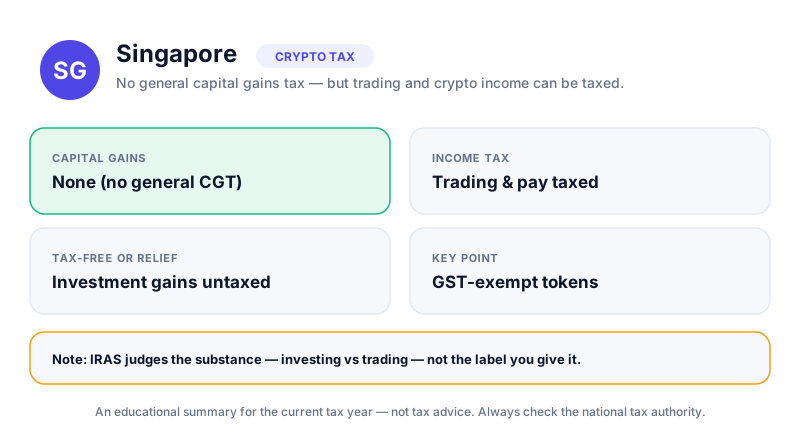
Singapore has no general capital gains tax, so an individual's long-term crypto gains are usually not taxed. But if you trade crypto as a business or trade, profits can be taxable income. Crypto received as payment for work or business is generally taxable. GST rules were updated to exempt many digital-payment-token transactions. Always confirm with IRAS.
No general capital gains tax
Singapore does not levy a broad capital gains tax. For an individual who buys crypto as a long-term investment and later sells at a profit, that gain is generally not taxed. This is the main reason Singapore has a reputation for being crypto-friendly.
Tax-free isn't automatic
The absence of capital gains tax applies to genuine investment gains. The moment your activity looks like a trade or business, different rules apply — so the label you give yourself matters less than how the Inland Revenue Authority of Singapore (IRAS) views the substance.
When crypto becomes taxable income
If you trade crypto as a business or in a way that amounts to carrying on a trade, your profits can be taxed as income. IRAS looks at the substance of your activity rather than the form.
- Frequency and volume of transactions.
- Holding periods and the intention behind buying.
- How organised and systematic the activity is.
- Whether crypto is central to a business you run.
Separately, being paid in crypto for goods, services or employment is generally taxable, valued at the time of receipt — much like income anywhere else.
GST and digital payment tokens
Singapore updated its Goods and Services Tax (GST) rules so that the use of qualifying digital payment tokens as a means of payment is generally exempt, rather than being treated as a taxable supply of goods. This removed an earlier 'double GST' problem when buying and spending crypto.
- Using a digital payment token to pay is generally not a taxable supply.
- Exchanging one digital payment token for another is generally exempt.
- Businesses dealing in crypto should still check how GST applies to their specific activities.
Records and reporting
Even where gains aren't taxed, good records help you demonstrate that your activity is investment rather than trading, and they're essential if any of your crypto activity is taxable. Koinly can keep those records tidy and flag anything taxable.
- Dates, amounts and SGD values of transactions.
- Your intention and holding pattern for each position.
- Records of any crypto received as income.
- Exchange statements and wallet records.
This is general information, not tax advice
Singapore's treatment depends heavily on whether you're investing or trading, and rules can change. Check current guidance at iras.gov.sg or consult a Singapore tax professional before filing.
Reconciling a year of trades by hand is miserable. Koinly connects your exchanges and wallets, applies the rules the taxman expects, and produces a ready-to-file report — free to preview, you only pay to download it.
Key takeaways
- Singapore has no general capital gains tax, so long-term investment gains are usually untaxed.
- Trading crypto as a business can make profits taxable as income.
- Crypto received as payment for work or business is generally taxable.
- Updated GST rules exempt many digital-payment-token transactions; keep records either way.
Frequently asked questions
Is crypto really tax-free in Singapore?
Genuine long-term investment gains are generally not taxed because Singapore has no broad capital gains tax. But trading as a business, or receiving crypto as income, can be taxable. Confirm with IRAS.
When would my crypto profits be taxed in Singapore?
If IRAS considers your activity a trade or business — based on frequency, volume, holding periods and intention — your profits can be taxed as income rather than treated as tax-free capital gains.
Do I pay GST when I spend crypto in Singapore?
Generally no. Singapore updated its GST rules so that using qualifying digital payment tokens as a means of payment is exempt rather than a taxable supply. Check IRAS for specifics.
Keep reading
Crypto Taxes in India: A Plain-English Guide
How crypto is taxed in India: the 30% flat tax on gains, the 1% TDS, the no-loss-offset rule, and where to fin
Crypto Taxes in Australia: A Plain-English Guide
How crypto is taxed in Australia: capital gains tax, the CGT discount, income from staking and airdrops, recor
What Is a Stablecoin? How the Peg Works (and Fails)
A clear guide to stablecoins: how they aim to hold a steady value, the different types, and the very real peg