Do You Pay Tax When You Swap One Crypto for Another? (UK)
One of the biggest surprises for UK crypto users is that swapping one coin for another can be a taxable event, even though no pounds ever hit your bank account. This is a plain-English explainer of how HMRC generally treats swaps, spending and gifts. It's general information, not personal tax advice.
The 20-second version
HMRC generally treats a crypto-to-crypto swap as a 'disposal' of the coin you gave up, which can create a Capital Gains Tax event even with no cash out. Spending crypto usually counts too, and gifting does as well — except to a spouse or civil partner. Work out the gain in pounds at the moment of the swap, and always check HMRC's Cryptoassets Manual or a qualified accountant before filing.
Read this first
This is education, not tax advice
Tax rules, rates and allowances change, and your circumstances are unique. Nothing here is personal advice. Always check the current official HMRC guidance (the Cryptoassets Manual) or speak to a qualified accountant before you file.
The short answer: usually, yes
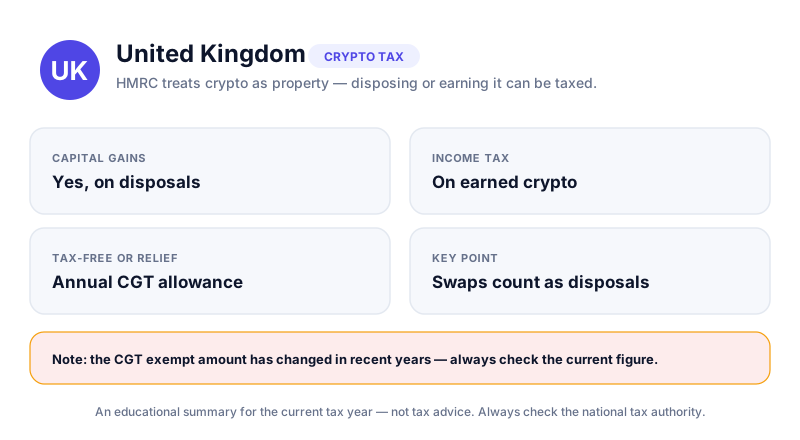
If you swap, say, Bitcoin for Ethereum, HMRC generally treats that as disposing of the Bitcoin — even though you never converted it to pounds. A disposal is what potentially triggers Capital Gains Tax (CGT), so a crypto-to-crypto swap can be taxable in exactly the same way as selling for cash.
The logic comes from how HMRC views crypto: for most people it's treated as property, closer to shares than to money. When you exchange one asset for another, you've effectively sold the first at its market value and bought the second, and that 'sale' is the moment a gain or loss is crystallised. There's more in our UK crypto tax overview and the maths in how to calculate crypto capital gains.
Why 'no cash out' doesn't help
It feels like nothing happened because no pounds moved. But HMRC measures the gain in pounds at the time of the swap, regardless of whether you ever touch fiat. The taxable event is the disposal, not the cash-out.
What HMRC counts as a disposal
Swapping is just one of several things that can count as a disposal. According to HMRC's general guidance, you typically dispose of crypto when you:
- Sell it for pounds or any other fiat currency.
- Swap one crypto for another — including stablecoins, and including a token swap on a DEX.
- Spend it on goods or services.
- Give it away to anyone other than your spouse or civil partner.
Simply buying crypto with pounds is not a disposal, and neither is moving coins between your own wallets. It's the act of parting with one asset in exchange for value that matters — which is why a swap, a purchase made in crypto, and a gift can all land in the CGT net.
A worked mini-example
Numbers below are illustrative only — they're round figures to show the mechanics, not real prices or current law. Suppose you bought £2,000 of Bitcoin, and some months later you swap all of it for Ethereum when your Bitcoin is worth £3,000.
| Step | Figure | What it means |
|---|---|---|
| Cost of the Bitcoin | £2,000 | What you originally paid (your cost basis). |
| Value at the swap | £3,000 | The pound value of the Bitcoin at the moment you swapped it. |
| Gain on disposal | £1,000 | £3,000 minus £2,000 — this is the figure CGT looks at. |
| New cost basis for the ETH | £3,000 | Your Ethereum now 'starts' at £3,000 for any future disposal. |
So even with no pounds in hand, you've potentially realised a £1,000 gain on the Bitcoin. Whether any tax is actually due depends on your total gains for the year versus the annual CGT exempt amount, plus the pooling and Same-Day / 30-day rules HMRC uses when you've bought the same coin at different times — all covered in how to calculate crypto capital gains.
Record the pound value at the swap
The hardest number to reconstruct later is the market value in pounds at the exact moment of each swap. Capture it as you go — it's the foundation of every gain calculation and it's nearly impossible to rebuild accurately months afterwards.
Spending crypto, and gifting it
Spending counts as a disposal
Paying for something directly in crypto is treated much like a swap: you're disposing of the coin at its pound value at the point of sale. If that value is higher than what you paid for the coin, there may be a gain to account for — buying a £40 item with crypto that has appreciated can quietly create a small CGT entry.
Gifting — and the spouse exemption
Giving crypto away is generally a disposal too, usually measured at the asset's market value on the day of the gift even though no money changes hands. There's one widely used carve-out: transfers between spouses or civil partners are normally treated as 'no gain, no loss', so they don't typically crystallise a gain at the point of transfer.
The spouse exemption isn't a loophole
A no-gain-no-loss transfer doesn't make the gain disappear — your partner inherits your original cost basis, so any gain may simply surface when they later dispose of it. Other taxes, such as Inheritance Tax, can also come into play. Check the current rules or an accountant before relying on it.
What this means for you
The practical upshot: every swap, crypto purchase and non-spouse gift is potentially a line in your CGT calculation, so the volume of small trades matters far more than people expect. A few steps keep it manageable:
- Log every swap, spend and gift with the date and the pound value at the time.
- Keep your original purchase records so you can work out the gain or loss on each disposal.
- Add up your gains for the tax year and compare against the current annual exempt amount — check the figure on HMRC's site, as it has changed in recent years.
- Report through Self Assessment if required, and consider crypto tax software or an accountant if you have lots of transactions.
If your swaps left you sitting on losses rather than gains, those losses aren't necessarily wasted — see crypto tax loss harvesting. And when it's time to actually submit the numbers, filing crypto on Self Assessment walks through the process.
Counting up crypto-to-crypto swaps by hand is where most people come unstuck. Koinly connects your exchanges and wallets, applies HMRC's pooling and Same-Day / 30-day rules automatically, and is free to preview — you only pay to download the SA108-ready report.
Key takeaways
- HMRC generally treats a crypto-to-crypto swap as a disposal, so it can trigger CGT even with no cash out.
- The gain is measured in pounds at the moment of the swap, using your original cost basis.
- Spending crypto usually counts as a disposal too; gifting does as well, except to a spouse or civil partner.
- A spouse transfer is no-gain-no-loss — the gain isn't erased, it just moves with the asset.
- Track every swap as it happens, and check current HMRC guidance or an accountant — this isn't advice.
Frequently asked questions
Do I really owe tax if I only swapped coins and never cashed out?
Possibly, yes. HMRC generally treats a crypto-to-crypto swap as a disposal of the coin you gave up, which can create a capital gain or loss even though no pounds changed hands. Whether tax is actually due depends on your total gains for the year against the current allowance — check HMRC's guidance or an accountant.
Is swapping into a stablecoin like USDT taxable?
It's still a crypto-to-crypto swap, so HMRC's general approach is to treat it as a disposal of the original coin at its pound value. The fact the new coin is a stablecoin doesn't exempt the disposal of the asset you gave up.
What about moving crypto between my own wallets?
Transferring coins between wallets you control is generally not a disposal, because you haven't parted with the asset — you still own it. Keep records anyway, since fees or any swap involved in the move could have their own treatment.
Can I avoid tax by gifting crypto to my partner?
Transfers to a spouse or civil partner are normally no-gain-no-loss, so they don't usually crystallise a gain at the point of transfer. But your partner inherits your cost basis, so the gain can resurface when they dispose of it, and other taxes may apply. Check the current rules before relying on it.
Keep reading
Crypto Taxes in the UK: A Plain-English Overview (HMRC)
How HMRC generally treats crypto for UK taxpayers — capital gains, income, record-keeping and allowances — exp
How to Calculate Crypto Capital Gains in the UK (Pooling, Same-Day & 30-Day Rules)
A plain-English walkthrough of how HMRC works out crypto capital gains in the UK: the Section 104 pool, the Sa
How to Report Crypto on a UK Self Assessment (SA100 & SA108)
A plain-English walkthrough of reporting crypto gains and income to HMRC through Self Assessment, including th