Ethereum Gas Fees Explained
Now that your ETH is bought and safely stored, you'll meet a running cost every time you use it: gas. If you've ever tried to do something on Ethereum and seen an extra charge tacked on — sometimes a few pence, sometimes more than the thing you were buying — that's gas. This lesson explains what gas fees are, why they exist, what makes them spike, and the practical, no-nonsense ways people pay less.
The 20-second version
Gas is the fee you pay in ETH to use the Ethereum network. It funds the computing power your transaction uses. Fees rise when the network is busy and fall when it's quiet — and layer-2 networks can make them much cheaper.
What is gas?
As we saw in how Ethereum works, Ethereum is a shared computer. Running anything on it uses real computing power across thousands of machines, so each action carries a fee called gas, paid in ETH. The fee does two jobs at once: it compensates the validators who process and secure your transaction, and it keeps the network from being flooded with junk. If using the network were free, spammers would grind it to a halt within hours by firing off endless pointless transactions — gas is the modest price that keeps it usable for everyone. Think of it as a small toll that keeps the road moving.
The name itself is the analogy, and it's a good one. Just as a car burns more fuel on a long, hilly drive than a quick trip to the shops, a transaction burns more gas the more work it asks the network to do. Sending plain ETH is the quick trip; a complex DeFi interaction that touches several contracts is the long haul over the mountains. The more work, the more gas — simple as that. Once that clicks, the rest of the topic stops being mysterious.
How gas is priced
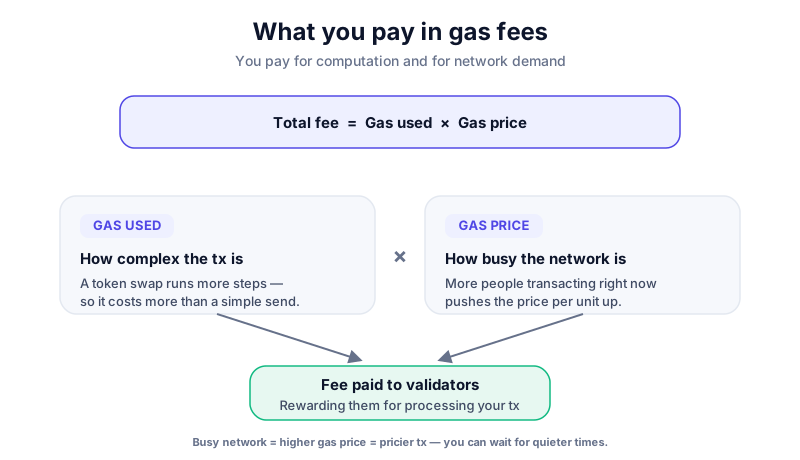
Your total fee comes down to two things multiplied together: how much work your transaction does, and the price per unit of work at that moment. Gas amounts are measured in units, and the price per unit is quoted in a tiny denomination of ETH called gwei (one gwei is a billionth of an ETH). You'll see gwei figures in your wallet before you confirm, and now you'll know what they mean.
- Gas used depends on the action and is fairly predictable — a simple transfer uses little, a token send uses more, a swap or NFT mint uses more again. This part doesn't change much from minute to minute.
- Gas price (gwei) is the variable bit, and the one that surprises people. It moves with demand: when lots of people want to transact at once, the price climbs as everyone competes for limited space in the next block.
- Total fee = gas used × gas price. So a busy network can make even a simple, small-gas action surprisingly pricey, because the price per unit has shot up — the work didn't change, the going rate did.
Why fees swing so much
Each block only has room for so many transactions. When demand spikes — a popular NFT launch, a sudden market move — people bid higher gas prices to get in first, like an auction for the next seat, and fees jump. When things quiet down, the bidding cools and fees fall again.
How to pay less gas
You can't avoid gas entirely on Ethereum's main network — it's the cost of using shared infrastructure, the same way you can't drive on a toll road for free. But you can keep it sensible with a few simple habits that, between them, save a surprising amount over time:
- Transact when it's quiet. Fees are often much lower at off-peak times. Many wallets show the current fee level before you confirm, so you can wait an hour or a day if it looks high and there's no rush. Patience is genuinely a money-saver here.
- Don't overpay for speed. Wallets usually offer 'fast', 'standard' and 'slow' options. Unless something is genuinely time-sensitive, standard confirms fine — paying for the fastest lane is money you rarely need to spend, like paying for next-day delivery on something you don't need until next week.
- Use a layer-2 network. This is the big one, and it's covered just below.
- Batch your activity. Doing several things in one transaction can be cheaper than firing off many separate ones, since each transaction carries its own base cost regardless of size.
Keep some ETH spare
You always need a little ETH on hand to pay gas — even just to move your other tokens out of a wallet. If your ETH balance hits zero, you can get stuck, unable to pay the fee to do anything, including rescuing the rest. This guide is education, not financial advice; only ever risk what you can afford to lose.
Layer-2: the cheaper lane
The single most effective way to cut fees is to use a layer-2 network. These are separate chains that handle transactions cheaply in bulk and then settle the results back to Ethereum for security. The mental model: layer-2s are express lanes that bundle lots of traffic together and merge it onto the main road efficiently, so each rider pays a fraction of what they would alone on the main highway. The maths of sharing one settlement across thousands of users is what makes the savings so dramatic — often a few pence where mainnet would cost pounds.
On a layer-2, the same kinds of apps you'd use on Ethereum run for a small fraction of the gas cost, while still leaning on Ethereum's security underneath, so you're not giving up much to save a lot. There are trade-offs — moving funds between layers takes an extra step, and you're trusting some extra machinery — and how layer-2s relate to the main chain is covered in layer-1 vs layer-2. Many people now do most of their everyday Ethereum activity on layer-2s for exactly this reason: it's simply far cheaper, and for small, frequent transactions it's the obvious choice.
Where to go next
Gas is a running cost of everything you do on Ethereum, from staking to exploring DeFi and dapps, so understanding it helps you avoid nasty surprises and pick smarter moments to transact. The headline to remember: fee equals work times the going rate, the rate swings with demand, and layer-2 is your friend. Next we look at a way to put your ETH to work helping secure the network — and earn a modest reward for it: Ethereum staking. Whichever way you lean, the storage rule doesn't change: serious amounts belong offline, on a hardware wallet like the Keystone 3 Pro.
Key takeaways
- Gas is the fee, paid in ETH, for using Ethereum's shared computing power.
- Your fee = how much work the transaction does × the price per unit (gwei).
- Fees rise when the network is busy and fall when it's quiet.
- Layer-2 networks are the most effective way to pay far less gas.
Frequently asked questions
Why are Ethereum fees sometimes so high?
Block space is limited, so when lots of people want to transact at once they bid higher gas prices to get in, pushing fees up. Quieter periods are much cheaper, and layer-2 networks cheaper still.
Can I pay gas in something other than ETH?
On Ethereum's main network, gas is paid in ETH — which is why you should always keep a little spare. Some layer-2s and newer wallet features offer alternatives, but ETH is the default you should plan around.
How do I avoid high fees entirely?
Transact at quiet times, don't overpay for speed, batch actions where you can, and consider a layer-2 network, where the same actions cost a fraction of mainnet gas.
Keep reading
How Ethereum Works: Smart Contracts, the EVM and Gas
A clear, high-level look at how Ethereum works — smart contracts, the Ethereum Virtual Machine, gas fees, and
Ethereum Staking Explained
How Ethereum staking works, the main ways to take part, the real risks involved, and why staking rewards are n
Ethereum DeFi and Dapps Explained
What decentralised apps and DeFi are on Ethereum, the main categories, the serious risks involved, and how to