How Solana Works: Proof of History Explained
In lesson one we said Solana is built for speed. Now let's see how it actually pulls that off — because the trick is genuinely clever, and the same design explains its real reliability problems. We'll cover Proof of History, validators and stake, why it's so fast, and an honest account of the outages. No equations, just clear pictures.
The 20-second version
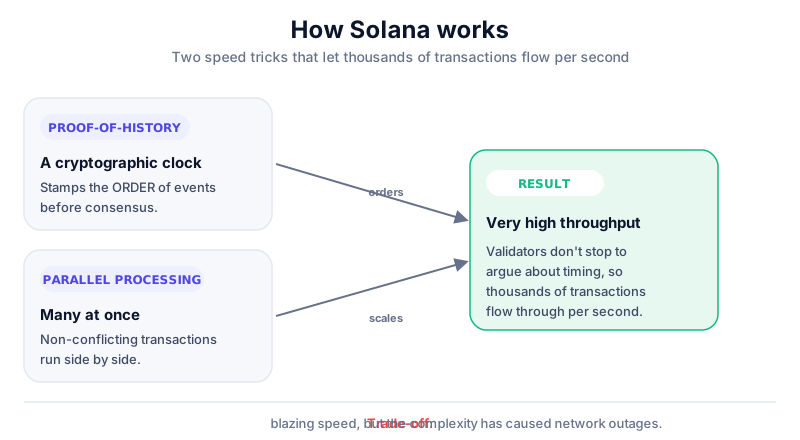
Solana uses a trick called Proof of History — a verifiable clock — so validators don't have to stop and argue about the order and timing of transactions. That lets thousands of transactions flow through per second. The cost is complexity and demanding hardware, which has contributed to several network outages.
Why Solana is so fast
Here's something that surprises people: most blockchains are slow on purpose. Every validator — every computer helping run the network — has to agree on the exact order of transactions, and that back-and-forth negotiation takes time. It's the price of having no central referee. Bitcoin adds a new block roughly every ten minutes. Ethereum's base layer manages a few dozen transactions per second. Solana is engineered to do thousands.
It gets there by combining several techniques, but the headline one is Proof of History. Now, a common mix-up: Proof of History is *not* a new way of choosing who validates — that part is still staking-based, which we'll come to. Instead, Proof of History solves a narrower but crucial problem: agreeing on *when* things happened, without every computer having to compare clocks first. Solve the 'when', and a huge amount of coordination overhead simply disappears.
What Proof of History actually is
Picture a room full of people trying to agree on the order events happened in. Normally they'd have to stop, compare notes and vote — slow and bickery. Now imagine instead there's a single clock on the wall that everyone trusts completely and that nobody can fake. Suddenly you don't need to argue: you just check the timestamp. Proof of History is that trusted clock, built out of maths.
Technically, Solana runs a continuous cryptographic calculation where each step depends on the one before it. You can't skip ahead, you can't fake an earlier step, and you can't compute it faster than real time — but anyone can quickly *verify* it's genuine afterwards. The result is like a tamper-proof timestamped tape running through the network. Because the order is baked right into the calculation, transactions can be slotted into a verifiable timeline without validators stopping to negotiate that order first.
Proof of History is not the security model
This is the point people miss most often. Proof of History *orders* transactions; it doesn't decide who gets to validate or stop a cheat. Solana still relies on Proof of Stake — validators lock up SOL as a stake they'd lose for misbehaving — to actually secure the chain. The clock and the security work together; one without the other wouldn't be safe.
The practical upshot: less time spent coordinating means more transactions can be processed in parallel. That's the core reason fees on Solana usually come to a fraction of a penny rather than the pounds you can pay elsewhere at busy times.
Validators, stake and consensus
So who runs all this? Validators — computers that process transactions, produce blocks and vote on which version of the chain is the real one. They're chosen to take the lead in proportion to how much SOL is staked with them: more stake, more turns at the wheel. Crucially, you don't need to run a validator yourself to take part. Ordinary holders can *delegate* (stake) their SOL to a validator, sharing in the rewards without buying any hardware.
- Validators run powerful servers, process transactions and vote on the canonical chain.
- Stakers lock SOL with a validator to help secure the network and earn a share of rewards.
- Misbehaviour or poor performance costs a validator rewards, which keeps their incentives lined up with keeping the chain healthy and honest.
That alignment of incentives is the quiet genius of Proof of Stake: the people securing the network have real money on the line. A validator who tries to cheat, or simply runs sloppy hardware that keeps falling offline, earns less and risks their stake — so the rational move is to behave. We explain the rewards side in full, and how to do it safely, in Solana staking explained later in this course.
An honest account of outages
Now the part the hype crowd skips. Speed has come at a cost. Solana has suffered several network outages and major slowdowns, especially in 2021 and 2022, where the chain stopped producing blocks for hours at a time. Imagine a motorway so popular it occasionally gridlocks completely — that's roughly what happened. Common causes included surges of automated transactions (for example, bots stampeding into a popular token launch) overwhelming validators, plus bugs in the software itself.
To be fair, reliability has improved a lot since. The network has gone long stretches without a full outage and added safeguards and fee mechanisms to handle congestion more gracefully. But it would be dishonest to pretend the risk is gone — a high-speed, highly complex system is harder to keep perfectly stable than a deliberately simple one. A blockchain that *can* halt is a genuine consideration if you ever need to rely on it in a hurry.
Reliability is a real risk
Past outages mean you might occasionally be unable to send a transaction or react to a fast-moving market for a period. Factor that in, never assume you'll always be able to move funds instantly, and remember this is education, not financial advice.
Where to go next
You now understand the engine: a verifiable clock for ordering, stake for security, and the speed-versus-reliability trade-off that defines Solana. With the mechanics clear, the practical lessons come next — how to buy SOL sensibly, how to store it safely, and how staking rewards actually work once you hold some. Onward. And however you weigh the trade-offs, keep meaningful holdings in cold storage — a SafePal S1 — rather than on an exchange.
Key takeaways
- Proof of History is a verifiable clock that orders transactions efficiently.
- Solana still uses Proof of Stake — validators lock up SOL to secure the chain.
- That design enables thousands of transactions per second at very low fees.
- It has suffered network outages; reliability has improved but is a genuine risk.
Frequently asked questions
Is Proof of History a type of mining?
No. Mining (Proof of Work, as Bitcoin uses) burns large amounts of energy to secure a chain. Proof of History is just a clever way of ordering and timestamping transactions — it's not how Solana is secured. That job belongs to Proof of Stake.
Has Solana fixed its outage problem?
It has improved a great deal, with new safeguards and much longer stretches of uptime. But no one can honestly guarantee a complex, high-speed network will never halt again. Treat reliability as a real, if reduced, risk rather than a solved problem.
Can I run a Solana validator at home?
Technically yes, but it demands powerful, costly hardware and a fast, reliable connection — one reason critics say the network is more concentrated than older chains. Most people take part by delegating (staking) to an existing validator instead, which needs no hardware at all.
Keep reading
What Is Solana? A Plain-English Guide
A beginner-friendly explanation of Solana (SOL): what it is, how it differs from Bitcoin and Ethereum, what it
How to Buy Solana (SOL) Safely: Step by Step
A careful, step-by-step guide to buying Solana (SOL): choosing a reputable exchange, verifying your account, p
Solana Staking Explained (Beginner's Guide)
How staking SOL works in plain English: delegating to validators, where rewards come from, the real risks like