How to Do a Test Transaction (and Avoid Costly Mistakes)
Crypto transfers can't be undone, so the smartest habit in the whole space is also the simplest: before moving a large amount, send a tiny bit first and confirm it arrives. A test transaction costs pennies and a few minutes — and it has saved countless people from sending a fortune to the wrong place.
The 20-second version
Before any large or first-time transfer, send a small amount, confirm it lands at the destination, then send the rest. It costs an extra fee but protects against wrong addresses, wrong networks, and clipboard malware. Use it every time the stakes are high.
Why test transactions matter
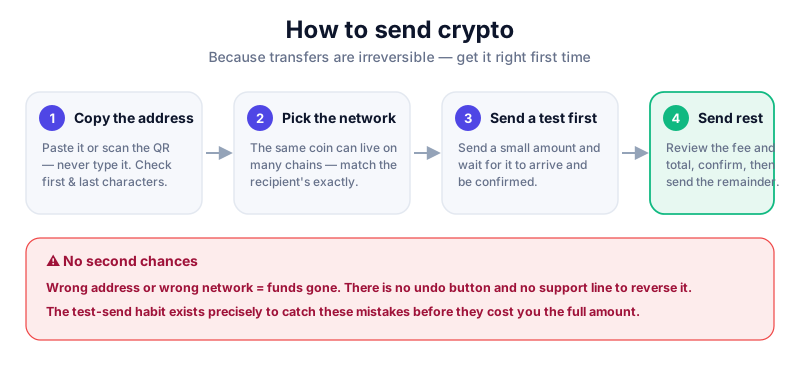
There is no 'undo' on a blockchain and no support line that can reverse a send. If you send to the wrong address or the wrong network, the funds are almost always gone for good. A test transaction is your safety net: it proves the whole path works before you commit the real amount.
Clipboard malware is real
Some malware silently replaces a copied crypto address with the attacker's. The address looks right at a glance but isn't. A small test send — and checking it actually arrives — catches exactly this kind of attack before it's catastrophic.
When to do one
You don't need to test every tiny transfer, but a test pays for itself whenever the stakes or the uncertainty are high.
- The first time you send to a new address.
- Any large transfer you'd be upset to lose.
- Moving funds to a new wallet or hardware wallet.
- Sending across networks or anything involving a bridge.
- Withdrawing from an exchange to self-custody for the first time.
How to do a test transaction
- Confirm the recipient address and network exactly as you would for the full send.
- Send a small amount — enough to be worth confirming, small enough that a mistake wouldn't hurt.
- Copy the transaction ID and look it up on a block explorer.
- Confirm it reaches the correct destination address and shows as confirmed.
- Only then send the remaining amount to the same verified address.
- Keep both transaction IDs in case you need a record later.
Is the extra fee worth it?
A test transaction means paying the network fee twice. On most networks that's a small price; on a congested chain it can add up, so weigh the fee against the amount at stake. For anything meaningful, the cost of one extra fee is trivial next to the cost of an irreversible mistake.
Don't let urgency rush you
Scammers manufacture pressure to skip safety steps. If anyone insists you must send a large amount immediately without testing, that pressure itself is the red flag. Slow down — see how to avoid crypto scams.
Key takeaways
- Transfers are irreversible, so test before you commit a large amount.
- A test send catches wrong addresses, wrong networks, and clipboard malware.
- Confirm the test arrives on a block explorer before sending the rest.
- The extra fee is trivial next to the cost of a permanent mistake.
Frequently asked questions
How small should a test transaction be?
Small enough that losing it wouldn't matter, but large enough to clearly confirm on a block explorer. A few pounds' worth is usually plenty.
Do I need to test every transaction?
No — for tiny, routine sends it's overkill. Save it for first-time addresses, large amounts, cross-network transfers, and moving funds to a new wallet.
What if the test transaction doesn't arrive?
Stop and investigate before sending anything more. Recheck the address and network, and look the transaction up on a block explorer to see whether it's pending, failed, or went somewhere unexpected.
Keep reading
How to Send Crypto (Step by Step)
A plain-English guide to sending cryptocurrency: copying the right address, picking the correct network, fees,
How to Receive Crypto (Step by Step)
How to receive cryptocurrency safely: finding your receive address, sharing it the right way, matching network
How to Read a Block Explorer
A beginner's guide to block explorers: how to look up a transaction, read confirmations and fees, check an add