How Meme Coins Work (Under the Hood)
In lesson one we covered what meme coins are and why they pull people in. Now we lift the bonnet. Behind the dog mascots and jokes, meme coins run on the same plumbing as the rest of crypto — and understanding that plumbing is the fastest way to see why prices swing so wildly and where the risks actually hide. You don't need to be technical; you just need the four ideas in this lesson.
The 20-second version
Most meme coins are tokens created on a chain like Ethereum or Solana and traded on decentralised exchanges against a pool of money called liquidity. Price moves based on what people pay into or pull out of that pool. Thin liquidity means tiny trades cause huge price swings.
Meme coins are usually tokens
Most meme coins aren't their own blockchain — they're tokens that live on top of an existing one, most often Ethereum or Solana. A token is created by deploying a small program called a smart contract that simply defines the coin's name, its total supply, and the rules for moving it around. Think of the blockchain as the operating system and the token as an app installed on it: the app didn't build the phone, it just runs on it.
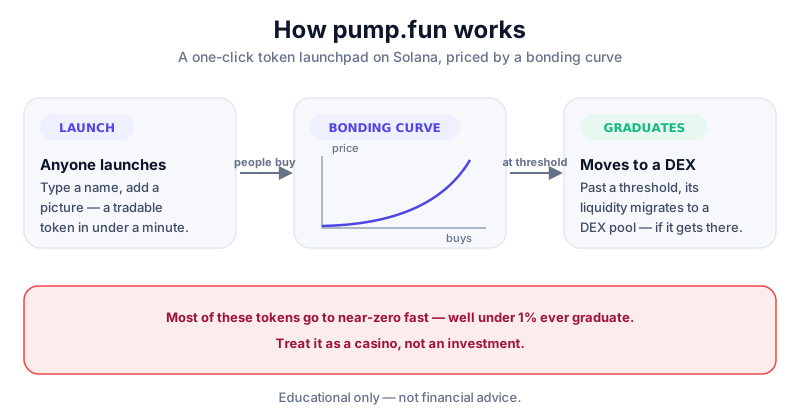
Because deploying a token contract is cheap and takes minutes, the barrier to creating a meme coin is almost nothing. There are even 'launchpad' websites that spit out a brand-new coin from a template with a few clicks. That's central to understanding the risk: the person who launched the coin you're looking at may have done so this morning, anonymously, for a few dollars in gas fees. There's no factory, no headquarters, no staff — often just one pseudonymous wallet and a logo.
Liquidity pools and DEXes
Brand-new meme coins almost never start on a big exchange like the ones you'd use to buy Bitcoin. Instead they trade on a decentralised exchange (DEX) through something called a liquidity pool — a shared pot holding two assets, for example the meme coin and a mainstream coin like ETH or SOL. There's no order book and no market maker matching buyers to sellers; you simply trade against the pot.
Here's the bit that surprises people. When you 'buy', you add the mainstream coin to the pool and take meme coins out, which pushes the price up. When you 'sell', you do the reverse, pushing it down. The price is just a ratio set by what's left in the pool — there's no company, no earnings and no fundamentals behind it. It's a see-saw: every purchase tilts the price up for the next buyer, every sale tilts it back down.
- Deep liquidity (a large pool) means prices move gradually and you can sell a reasonable amount without crashing the market.
- Thin liquidity (a small pool) means even modest trades cause violent price swings — and when everyone heads for the exit at once, you may not be able to sell at all without collapsing the price.
- Locked vs unlocked liquidity matters enormously: if the creator can withdraw the pool, they can drain it and leave holders with worthless tokens in seconds. This is the single most important check, and we cover it in how to spot a rug pull.
Thin markets cut both ways
The same thin liquidity that lets a meme coin rocket up can trap you on the way down. An 'up only' chart hides the fact that there may be no buyers at all when you want out — and a price means nothing if you can't actually sell at it.
Market cap, supply and 'cheap' prices
A coin priced at $0.0001 is not 'cheaper' than one priced at $100. This trips up almost every beginner, so it's worth slowing down. What matters is the market capitalisation — the price multiplied by the number of coins in circulation. That total is what you're really comparing.
Many meme coins have supplies in the trillions, which mathematically forces each token down to a fraction of a cent. Picture a pizza: cutting it into a trillion slices doesn't give you more pizza, it just makes each slice microscopic. That tiny unit price feels affordable and fuels dreams of '1000x', but a coin already valued at billions in total has very limited room to grow and an awful lot of room to fall. A coin can never reach Bitcoin's price if it would need to be worth more than every company on Earth combined to get there.
Always check the market cap
Before judging whether a price is 'low', look up the fully diluted market cap, not the per-token price. The per-token figure is engineered to look appealing and tells you almost nothing about whether the coin is over- or under-valued.
Tokenomics: who holds what
Tokenomics is just a portmanteau of 'token' and 'economics' — it describes how a coin's supply is distributed and what rules govern it. With meme coins, this is very often where the danger lives, because the rules are written by whoever deployed the contract and they're under no obligation to be fair.
- Concentration — if a handful of wallets hold most of the supply, those holders can crash the price by selling all at once. A coin where the top ten wallets own 80% is a loaded gun pointed at everyone else.
- Taxes — some tokens charge a fee on every buy or sell, which can quietly drain holders or be cranked up to trap them after launch.
- Mint functions — if the contract lets the creator print more coins on demand, your stake can be diluted toward nothing without you doing anything wrong.
- Honeypots — some contracts are coded so you can buy but never sell. The chart looks like it's only going up because no one is allowed out. We explain how to check for this in how to research a meme coin.
This is the key mental shift for the whole course: due diligence on a meme coin is really due diligence on a smart contract and a holder list — not on a 'business', because there usually isn't one. However you play it, one rule keeps meme-coin damage survivable: your serious holdings live elsewhere, offline, on a hardware wallet like the SafePal S1.
Where to go next
You now understand the machinery: tokens deployed in minutes, prices set by a pool of money on a DEX, market caps that the per-token price disguises, and tokenomics that can be quietly rigged. With that under your belt, the next two lessons are the most important in the course — the safety ones. Read meme coin risks and red flags to learn what goes wrong, then how to spot a rug pull to learn how to see it coming. When you're ready to vet a specific coin, the how to research a meme coin checklist puts all of this into practice.
Key takeaways
- Most meme coins are tokens on chains like Ethereum or Solana, cheap to create.
- They trade on DEXes against a liquidity pool that sets the price.
- Thin liquidity causes huge swings and can trap you when you try to sell.
- Per-token price is meaningless on its own — always check market cap and tokenomics.
Frequently asked questions
Why is a meme coin so cheap per token?
Because the total supply is often in the billions or trillions. A fraction-of-a-cent price is a function of huge supply, not a sign the coin is undervalued. Always look at the full market cap instead — that's the figure that actually compares one coin to another.
What is a liquidity pool?
A shared pot of two assets on a decentralised exchange that lets people trade a token. The ratio of assets in the pool sets the price. If liquidity is thin or can be withdrawn by the creator, the risk is severe.
Can the creator make more coins after launch?
If the smart contract includes a mint function, yes — and that can dilute existing holders toward nothing. Checking whether minting is disabled is part of how to research a meme coin.
Keep reading
What Are Meme Coins? A Plain-English Guide
A clear, no-hype explanation of what meme coins are, where they came from, why they're so risky, and how to th
Meme Coin Risks and Red Flags
The core safety lesson on meme coins: the real risks, the warning signs to look for, and the scams that separa
How to Spot a Rug Pull
A practical guide to spotting rug pulls before they happen: liquidity locks, ownership concentration, contract