MetaMask vs Rabby (2026): Which Web3 Wallet Wins?
MetaMask and Rabby are two popular browser wallets for interacting with Ethereum, DeFi and Web3 apps. MetaMask is the long-standing default that most people meet first; Rabby is a newer challenger built around safer transactions. This guide compares them fairly so you can see which suits how you use crypto — neither is a place to store large savings on its own.
The short version
MetaMask is the most widely supported Web3 wallet, accepted almost everywhere. Rabby is newer and focuses on safety, showing you a clear preview of what a transaction will do before you sign. Both are 'hot' wallets — for serious holdings, pair either with a hardware wallet.
MetaMask vs Rabby at a glance
| Feature | MetaMask | Rabby |
|---|---|---|
| Type | Hot (browser/mobile) | Hot (browser/mobile) |
| Best for | Maximum compatibility | Safer transactions |
| Multi-chain | Yes (manual networks) | Yes (auto-detects chain) |
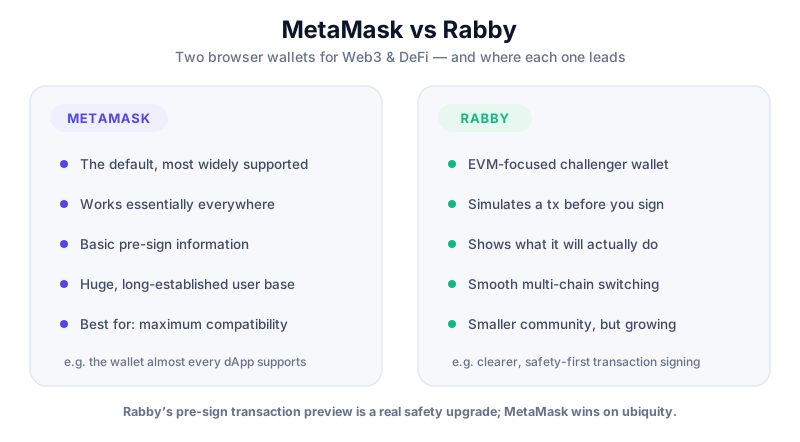
| Transaction preview | Basic | Detailed pre-sign simulation |
| Scam/risk warnings | Improving | Built-in, prominent |
| dApp support | Universal | Very broad |
| Hardware wallet support | Yes | Yes |
| Open source | Partial | Yes |
| Maturity | Long-established | Newer, fast-moving |
Both are free, self-custody wallets — meaning you alone hold the keys, and there's no support line to recover funds if you lose your seed phrase or approve a malicious contract.
The case for MetaMask
MetaMask is the most established Web3 wallet and works with essentially every dApp. If a site supports browser wallets at all, it supports MetaMask. That ubiquity makes it a safe default for compatibility.
- Strengths: universal dApp support, huge user base, well-documented, works with hardware wallets.
- Trade-offs: transaction previews are basic, adding networks can be fiddly, and the interface can confuse newcomers about what they're signing.
The case for Rabby
Rabby was designed to reduce the most common cause of lost funds: signing a transaction you didn't understand. Before you approve anything, it simulates the result and shows expected balance changes and risk flags — a genuinely useful safety layer.
- Strengths: clear pre-sign transaction simulations, automatic chain switching, prominent risk warnings, fully open source.
- Trade-offs: newer and less battle-tested than MetaMask, smaller community, occasionally a site expects MetaMask specifically.
The rule that applies to both
Hot wallets are for using, not for storing
Both MetaMask and Rabby are connected to the internet, which makes them more exposed than cold storage. Never share your seed phrase with anyone, never type it into a website, and for any meaningful savings pair your wallet with a hardware wallet. Learn how to avoid crypto scams before connecting to unfamiliar apps. This is education, not financial advice.
A nice middle ground: use Rabby's clearer warnings for day-to-day DeFi, and connect a hardware wallet to it (or to MetaMask) so the actual signing keys stay offline.
Whichever you pick, a browser wallet keeps your keys on an online device. If you're moving serious amounts, an open-source hardware wallet like OneKey signs transactions offline while keeping the app experience you're used to.
Key takeaways
- MetaMask wins on universal compatibility; Rabby wins on transaction safety previews.
- Rabby simulates transactions before you sign — a strong defence against costly mistakes.
- Both are hot wallets — never store large amounts in them alone.
- Pair either with a hardware wallet and never share your seed phrase.
Frequently asked questions
Is Rabby safer than MetaMask?
Rabby's pre-sign simulations and risk warnings can help you avoid approving harmful transactions, which is a real safety advantage. But no wallet protects you if you share your seed phrase or ignore the warnings — security ultimately depends on your habits.
Can I use both wallets?
Yes. They can run side by side in the same browser, each with its own seed phrase. Some people keep MetaMask for maximum compatibility and Rabby for its safer signing experience.
Do these wallets work with a Ledger?
Yes. Both support connecting a hardware wallet, so you get the convenience of a browser wallet with the keys kept offline on the device. See our hardware vs software wallets guide.
Keep reading
Hardware vs Software Wallets (2026): Which Should You Use?
Hardware vs software wallets compared: security, convenience, cost and the right use for each — so you can pro
Hot vs Cold Wallets: What's the Difference?
A plain-English hot vs cold wallets comparison — how each works, the security trade-offs, and how to combine b
What Is a Seed Phrase? (And Why You Must Never Share It)
A plain-English guide to seed phrases: what they are, how they back up your crypto wallet, how to store one sa