NEAR Staking Explained
Staking is one of the main things people do with NEAR beyond holding it. This guide explains in plain English how NEAR staking works, where the rewards come from, the real risks involved, and how to approach it more safely — without any hype about 'passive income'.
The 20-second version
NEAR is a proof-of-stake chain, so tokens are locked up by validators to secure the network and earn rewards. Most people 'delegate' their NEAR to a validator rather than running one. Rewards are real, but so are the risks — lock-up periods, validator performance and price volatility.
What staking actually is
Because NEAR uses proof-of-stake, the network is secured by validators who lock up NEAR tokens as a kind of security deposit. In return for processing transactions honestly, they earn newly issued tokens. This is the same broad idea covered in what is staking, applied to NEAR.
You don't have to run a validator yourself — that takes technical skill and a large stake. Instead, most holders delegate: you assign your NEAR to a validator, they do the work, and you share in the rewards (minus a fee they charge).
How to stake NEAR
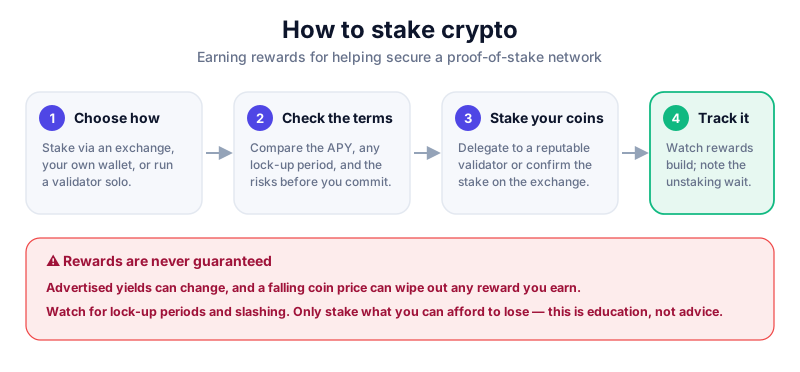
- Delegating from a wallet: pick a validator in a NEAR-compatible wallet and delegate your tokens. Your NEAR stays in your control; you're only assigning its 'voting power'.
- Exchange staking: some exchanges offer one-click NEAR staking. It's simple, but the exchange holds your keys — that's custodial, not self-custody.
- Liquid staking: some services give you a token representing your staked NEAR so you can use it elsewhere while it earns. This adds extra smart-contract risk.
Rewards rates change over time with network conditions and the validator's fee, so don't treat any advertised yield as guaranteed. Always check the current figures yourself.
You can delegate NEAR while your keys stay on a hardware wallet, keeping signing offline. The Ledger Nano X is our top beginner pick — read our review first. We may earn a commission at no cost to you, and it never changes our verdict.
The risks people overlook
Staking is not free money. The main risks to understand:
- Lock-up / unbonding: when you unstake, there's a delay (typically a few days on NEAR) before tokens are liquid again. You can't sell instantly.
- Validator risk: a poorly run or offline validator earns you less. Severe misbehaviour can in principle lead to penalties — choose reputable validators.
- Price volatility: rewards are paid in NEAR, and NEAR's price can fall faster than any yield. A '10% reward' means little if the token drops 40%.
- Custodial / smart-contract risk: exchange and liquid-staking routes add a third party or extra code that could fail or be hacked.
Yield is not a free lunch
Staking rewards are compensation for real risk and for locking up your tokens. They are not guaranteed, and the underlying NEAR is volatile. Only stake what you can afford to lose, and never borrow to do it. This is education, not financial advice.
Key takeaways
- NEAR is proof-of-stake, so staking secures the network and earns rewards.
- Most people delegate to a validator rather than running one themselves.
- Unstaking has a delay, and rewards are paid in volatile NEAR — not guaranteed income.
- Choose reputable validators, understand the risks, and only stake what you can afford to lose.
Frequently asked questions
Can I lose my NEAR by staking it?
Your delegated tokens aren't handed away, but you face risks: an unbonding delay before you can sell, reduced rewards from poor validators, possible penalties for serious validator misbehaviour, and — above all — NEAR's price volatility.
How long does it take to unstake NEAR?
There's an unbonding period (commonly a few days) before unstaked tokens become liquid again. Check the current figure, as protocol parameters can change.
Is staking on an exchange safe?
It's convenient, but the exchange holds your keys, so it's custodial rather than self-custody. Delegating from your own wallet keeps you in control. Weigh convenience against that trade-off.
Keep reading
What Is NEAR Protocol? A Plain-English Guide
A beginner-friendly explanation of NEAR Protocol: what NEAR is, how its sharded blockchain works, what the NEA
What Is Staking? How It Works and What It Costs
A plain-English guide to crypto staking: how it secures proof-of-stake networks, how rewards work, and the loc
How to Store NEAR Protocol Safely (Step by Step)
Keep your NEAR safe from hackers and mistakes: custodial vs self-custody wallets, hardware wallets, seed-phras