NEAR vs Ethereum: A Fair Comparison
NEAR and Ethereum are both layer-1 blockchains that run smart contracts — but they took different routes to get there. This is a fair, balanced comparison of how they differ in design, speed, cost, security and ecosystem, so you can understand the trade-offs rather than pick a 'winner'.
The 20-second version
Ethereum is the original smart-contract platform — by far the largest, most decentralised and most battle-tested, but historically slower with higher fees. NEAR is newer and built for speed and low cost via sharding, with a much smaller (but growing) ecosystem. Neither is simply 'better'.
Different designs, same goal
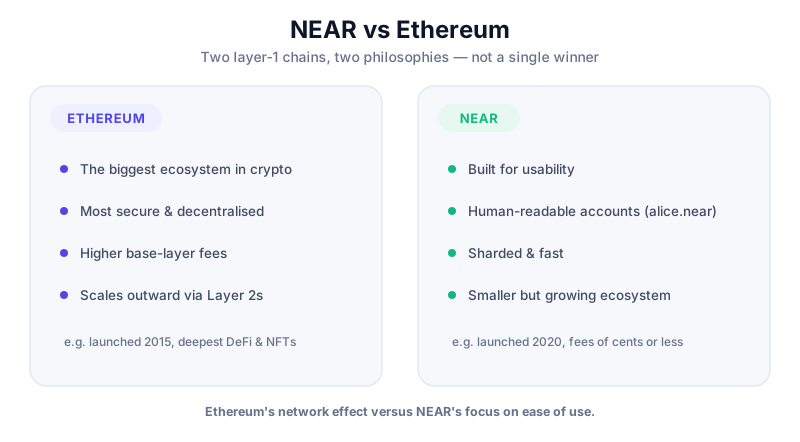
Both networks let developers deploy smart contracts and both use proof-of-stake. The headline difference is how they scale. Ethereum keeps a single, deliberately conservative base layer and pushes scaling onto 'layer-2' networks built on top. NEAR instead builds scaling into the base layer itself using Nightshade sharding, splitting transactions across parallel shards.
In short: Ethereum scales *outward* (more layers), NEAR scales *within* (more shards). Both are valid philosophies with different trade-offs.
Side by side
Figures move over time and depend on network conditions, so treat the table as a general picture rather than a live quote.
| Feature | Ethereum | NEAR Protocol |
|---|---|---|
| Launched | 2015 | 2020 |
| Scaling approach | Layer-2 rollups | Built-in sharding (Nightshade) |
| Typical base-layer fees | Higher, variable | Very low (cents or less) |
| Account names | Hex addresses | Human-readable (alice.near) |
| Ecosystem size | Largest in crypto | Smaller but growing |
| Token supply | No fixed cap | No fixed cap (inflationary) |
The honest trade-offs
Ethereum's strengths are maturity, the largest developer community, the deepest DeFi and NFT ecosystems, and a long track record of security and decentralisation. Its weaknesses have been higher base-layer fees and the added complexity of choosing between many layer-2 networks.
NEAR's strengths are speed, very low fees, and a strong focus on usability — human-readable accounts and smoother onboarding. Its weaknesses are a much smaller ecosystem, fewer apps and integrations, and a shorter track record. Sharding is also more complex to get right, though it has run in production for years.
Not investment advice
Both NEAR and ETH are volatile, and a faster or cheaper chain is not automatically a better investment. We're comparing technology and trade-offs, not telling you what to buy. Only ever risk what you can afford to lose, and never borrow to buy crypto.
How to think about it
This isn't really a contest with a single winner. Many developers and users engage with both, and the chains often borrow ideas from each other. If you're researching, focus on what you'd actually use a chain for, the security and decentralisation you need, and the costs involved — not on price predictions or hype.
Whichever you explore, the safety basics are identical: buy from reputable exchanges, move serious holdings to self-custody, and never share your seed phrase. Whichever way you lean, the storage rule doesn't change: serious amounts belong offline, on a hardware wallet like the SafePal S1.
Key takeaways
- Ethereum is the largest, most battle-tested smart-contract chain; NEAR is newer and built for speed and low fees.
- Ethereum scales with layer-2s; NEAR scales with built-in sharding.
- NEAR's human-readable accounts and low costs aid usability; Ethereum wins on ecosystem depth and track record.
- Neither is simply 'better' — and faster or cheaper does not mean a better investment.
Frequently asked questions
Is NEAR a competitor to Ethereum?
It's often described as an 'Ethereum alternative', but the two coexist and the broader market is large. NEAR competes on speed and cost; Ethereum leads on ecosystem and maturity.
Are NEAR fees really cheaper than Ethereum's?
On the base layer, generally yes — NEAR fees are typically a fraction of a cent. Ethereum fees vary with demand, and its layer-2 networks can also be cheap. Always check current conditions.
Which is more secure?
Ethereum has the longer track record and the most decentralised validator set, which many see as the security gold standard. NEAR's sharded proof-of-stake has run in production for years. Both are credible; maturity differs.
Keep reading
What Is NEAR Protocol? A Plain-English Guide
A beginner-friendly explanation of NEAR Protocol: what NEAR is, how its sharded blockchain works, what the NEA
What Is Ethereum? A Plain-English Guide
A beginner-friendly explanation of Ethereum: what it is, how it differs from Bitcoin, what smart contracts do,
How to Buy NEAR Protocol Safely (Step by Step)
A safe, beginner-friendly walkthrough for buying NEAR Protocol: choosing a reputable exchange, verifying your