NFT Utility Explained
Early NFTs were mostly about owning an image. 'Utility' is the buzzword for everything an NFT can actually do beyond that — the access, perks or functions ownership unlocks. This guide explains the main types of utility and, just as importantly, how to spot when there's no real utility at all.
The 20-second version
NFT utility means the practical benefits that owning a token unlocks — like members-only access, in-game items, event tickets or rewards. Genuine utility is rare; a lot of 'utility' promised at mint never materialises.
What does 'utility' mean?
Utility is anything an NFT gives you besides the artwork. Because ownership is verifiable on-chain, projects can use an NFT as a key: hold the token, unlock the benefit. This is often called token gating.
The benefit might be digital (a private community, a game item) or physical (event entry, merchandise). The common thread is that the token controls access.
Common types of NFT utility
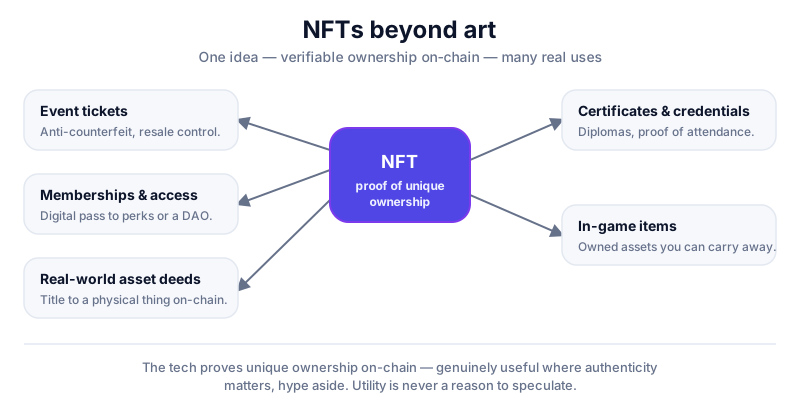
- Access and membership: token-gated communities, content or apps reserved for holders.
- Gaming: NFTs as characters, items or land you can use inside a game.
- Ticketing: event tickets that are harder to counterfeit and can be checked on-chain.
- Rewards and discounts: perks, allowlists or future drops for holders.
- Identity and credentials: overlapping with soulbound tokens, proving you belong to a group.
Real utility vs marketing hype
Many projects promise elaborate roadmaps — games, metaverses, staking rewards — to justify a mint price. Most never ship. A useful test: does the utility exist today, or is it a promise for 'later'? And treat valuable NFTs like any other asset: they can sit behind a hardware wallet like the Trezor Safe 5, safely offline.
Don't pay for promises
Future utility is not guaranteed, and an NFT's price can fall to near zero whether or not the roadmap is delivered. Never buy expecting promised features to arrive. This is education, not financial advice — only spend what you can afford to lose.
How to assess utility sensibly
- Working now? Prefer utility you can use today over roadmap promises.
- Who provides it? A named team with a track record beats anonymous accounts.
- Does it need the NFT? If the same perk is available without the token, the 'utility' is thin.
- Ongoing cost? Some benefits depend on the team funding them indefinitely — what happens if they stop?
Stay safe while exploring
Token gating means connecting your wallet to sites and signing messages. Use a low-value wallet for this, keep serious holdings on a hardware wallet, and read how to avoid crypto scams first.
Key takeaways
- Utility is what an NFT lets you do beyond owning the image.
- Common forms include access, gaming items, ticketing and rewards.
- A lot of promised utility never ships — favour what works today.
- Never buy on the strength of a roadmap alone; prices can still go to zero.
Frequently asked questions
Does every NFT have utility?
No. Many NFTs are purely collectible or speculative with no functional benefit. Utility is a feature some projects add, not a built-in property of all NFTs.
Is utility a sign an NFT is a good buy?
Not necessarily. Even genuine, working utility doesn't make an NFT a sound purchase, and prices remain highly volatile. We don't give buying advice — utility is just one factor to understand.
What is token gating?
Token gating restricts access to content, communities or features so that only wallets holding a specific NFT can get in. It's the mechanism behind most membership-style utility.
Keep reading
What Is an NFT? A Clear Beginner's Guide
What NFTs actually are, how they work as proof of ownership on a blockchain, what they're used for, and the ri
What Is an NFT Collection?
A plain-English guide to NFT collections: what they are, how minting and supply work, what gives them value, a
What Is a Soulbound Token (SBT)?
Soulbound tokens explained in plain English: non-transferable NFTs for credentials and identity, how they work