Optimistic vs ZK Rollups: What's the Difference?
Most Ethereum layer 2 networks are 'rollups', and they come in two main flavours: optimistic and zero-knowledge (ZK). Both make Ethereum cheaper to use, but they prove their honesty in very different ways. This guide compares them in plain English.
The 20-second version
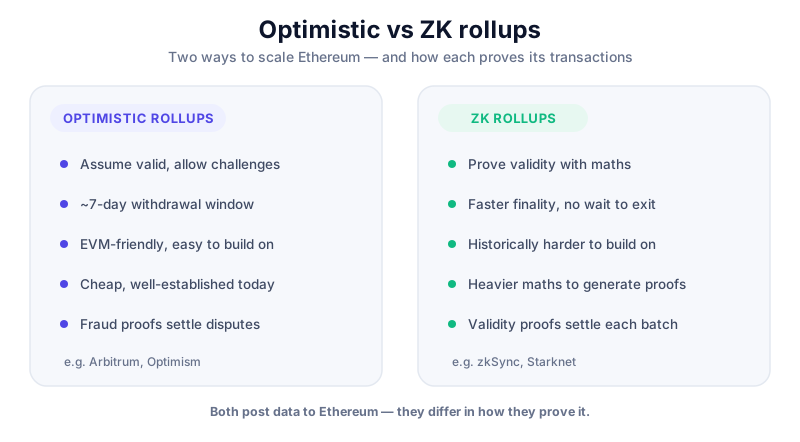
Optimistic rollups assume batches are honest and allow a challenge period. ZK rollups prove each batch is valid up front with cryptography. ZK can finalise withdrawals faster; optimistic rollups have been simpler to build and run.
What they have in common
Both kinds of rollup do the same core job: they bundle many transactions into a batch, process them away from Ethereum to keep fees low, and then post the result back to Ethereum, which acts as the secure final record. The difference is in how they convince Ethereum the batch is honest.
Optimistic rollups
An optimistic rollup assumes a batch is valid by default. It opens a 'challenge window' during which anyone can submit a fraud proof to flag a bad batch. If no one challenges in time, the batch is finalised.
- Pro: simpler and cheaper to build; broadly compatible with Ethereum tooling.
- Con: withdrawing to Ethereum involves waiting out the challenge window.
- Examples: Arbitrum, Optimism and Base.
ZK rollups
A zero-knowledge (ZK) rollup proves a batch is valid up front using a cryptographic 'validity proof'. Ethereum simply checks the proof. Because validity is proven rather than assumed, there's no challenge window to wait through. And however you weigh the trade-offs, keep meaningful holdings in cold storage — a Keystone 3 Pro — rather than on an exchange.
- Pro: faster finality for withdrawals; strong cryptographic guarantees.
- Con: more complex to build and more computationally heavy.
- Examples: zkSync and other ZK-based networks.
Side by side
| Feature | Optimistic rollup | ZK rollup |
|---|---|---|
| Core idea | Assume valid, challenge if needed | Prove valid with cryptography |
| Fraud / validity check | Fraud proofs (after the fact) | Validity proofs (up front) |
| Withdrawal to Ethereum | Waiting period (challenge window) | Faster, no challenge window |
| Complexity | Simpler to build | More complex / compute-heavy |
| Examples | Arbitrum, Optimism, Base | zkSync and others |
Education, not advice
Neither design is universally 'better', and the tokens linked to these networks are volatile. This is a technology explainer, not financial advice — only risk what you can afford to lose and never borrow to buy crypto.
Key takeaways
- Both rollup types lower Ethereum fees and settle back to Ethereum.
- Optimistic rollups assume honesty and allow challenges; ZK rollups prove validity up front.
- ZK rollups can finalise withdrawals faster; optimistic ones have been simpler to build.
- Arbitrum, Optimism and Base are optimistic; zkSync is a ZK rollup.
Frequently asked questions
Which is better, optimistic or ZK?
Neither is universally better. ZK rollups offer faster finality and strong cryptographic proofs; optimistic rollups have been simpler and very widely adopted. The best choice depends on the use case.
Why do optimistic rollup withdrawals take longer?
Because of the challenge window. The network must allow time for anyone to dispute a fraudulent batch before a withdrawal to Ethereum finalises.
Are ZK rollups completely private?
Not necessarily. 'Zero-knowledge' here refers to the validity-proof maths, not to hiding your transactions. Most ZK rollups are not designed for privacy by default.
Keep reading
What Is Arbitrum? A Plain-English Guide to the Ethereum Layer 2
A beginner-friendly explanation of Arbitrum: what it is, how its optimistic rollup makes Ethereum cheaper and
What Is Optimism? A Plain-English Guide to the OP Mainnet Layer 2
A beginner-friendly explanation of Optimism: what it is, how its optimistic rollup and the OP Stack work, the
What Is Base? Coinbase's Ethereum Layer 2 Explained
A clear, beginner-friendly guide to Base: the Ethereum layer 2 built by Coinbase on the OP Stack, how it works