What Is Arbitrum? A Plain-English Guide to the Ethereum Layer 2
Arbitrum is one of the most widely used 'layer 2' networks built on top of Ethereum. It exists to make Ethereum cheaper and faster to use, while still leaning on Ethereum for security. This guide explains what Arbitrum is in plain English, how its technology works, and how to think about it without the hype.
The 20-second version
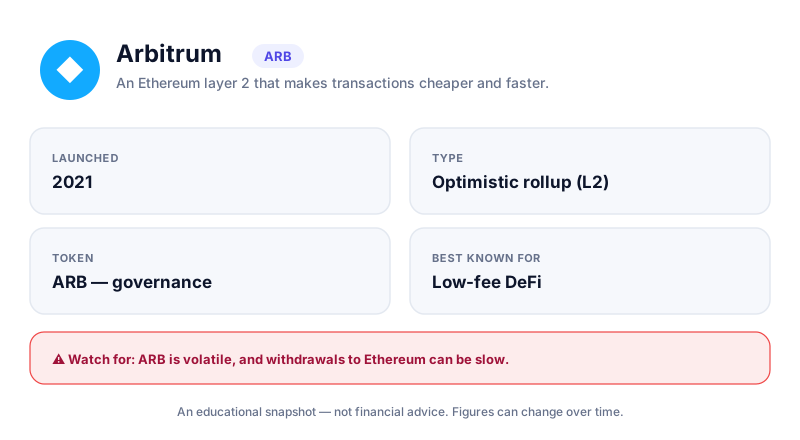
Arbitrum is an extension of Ethereum that processes transactions off to the side and then posts the results back to Ethereum. That makes fees much lower while keeping Ethereum-grade security. ARB is its governance token.
What is Arbitrum?
Arbitrum is a layer 2 network — software that sits on top of Ethereum to handle transactions more cheaply. Ethereum itself can get slow and expensive when lots of people use it at once. Arbitrum takes the load off by bundling many transactions together, processing them elsewhere, and then settling the final result back on Ethereum.
It was built by Offchain Labs and launched its main network in 2021. Today it hosts a large slice of Ethereum's decentralised-finance activity, from exchanges to lending apps, because doing the same thing on Arbitrum often costs a fraction of what it would on Ethereum directly.
How Arbitrum works
Arbitrum uses a design called an optimistic rollup. 'Rollup' means it rolls up hundreds of transactions into a single batch and posts that batch to Ethereum. 'Optimistic' means it assumes the batch is honest by default, rather than re-checking every transaction up front.
- Transactions run on Arbitrum, where they're fast and cheap.
- Batches are posted to Ethereum, which acts as the final record.
- A challenge window lets anyone flag a fraudulent batch. If a fraud proof succeeds, the bad batch is reverted.
That challenge window is why optimistic rollups exist — security comes from the threat of being caught, not from proving everything in advance. We compare this approach with the alternative in optimistic vs zk rollups.
The ARB token
ARB is Arbitrum's governance token. Holding it lets you vote on proposals that steer the network and its treasury through the Arbitrum DAO. Importantly, you do not need ARB to use Arbitrum — transaction fees are paid in ETH, the same as on Ethereum.
A fair warning
ARB's price is highly volatile, and a governance token is not the same as the network's success. Only ever risk what you can afford to lose, and never borrow to buy crypto. This guide is education, not financial advice.
Strengths and trade-offs
Arbitrum's big strengths are low fees, fast confirmation, and a large, established ecosystem of apps. Because it's broadly compatible with Ethereum's tooling, developers can move existing apps over with little friction. Whichever way you lean, the storage rule doesn't change: serious amounts belong offline, on a hardware wallet like the BitBox02.
- Strength: much cheaper than using Ethereum directly.
- Strength: inherits Ethereum's security as the settlement layer.
- Trade-off: withdrawing funds back to Ethereum can take time because of the challenge window.
- Trade-off: some components have historically relied on a limited set of operators, which the project has been progressively decentralising.
Where to go next
Now you know what Arbitrum is, it helps to understand the bigger picture: read layer 1 vs layer 2, compare the two main rollup styles in optimistic vs zk rollups, and see a close cousin in what is Optimism. To interact with any of these safely, learn how to store your crypto safely and how to avoid crypto scams.
Key takeaways
- Arbitrum is a layer 2 that makes Ethereum cheaper and faster.
- It uses an optimistic rollup — assume honest, challenge if needed.
- Fees are paid in ETH; ARB is a governance token, not a fee token.
- It's powerful but volatile — only risk what you can afford to lose.
Frequently asked questions
Is Arbitrum the same as Ethereum?
No, but it's tightly linked. Arbitrum is a separate network that settles back to Ethereum and uses Ethereum for security. You bridge assets between the two.
Do I need ARB tokens to use Arbitrum?
No. Transaction fees on Arbitrum are paid in ETH. ARB is purely a governance token for voting on the network's direction.
Why are Arbitrum fees so much lower than Ethereum's?
Because it bundles many transactions into one batch posted to Ethereum, the high cost of using Ethereum is shared across all of them, dramatically reducing the cost per transaction.
Keep reading
What Is Ethereum? A Plain-English Guide
A beginner-friendly explanation of Ethereum: what it is, how it differs from Bitcoin, what smart contracts do,
What Is Optimism? A Plain-English Guide to the OP Mainnet Layer 2
A beginner-friendly explanation of Optimism: what it is, how its optimistic rollup and the OP Stack work, the
What Is Base? Coinbase's Ethereum Layer 2 Explained
A clear, beginner-friendly guide to Base: the Ethereum layer 2 built by Coinbase on the OP Stack, how it works