Polygon vs Ethereum: What's the Difference?
People often ask whether to think about 'Polygon vs Ethereum' as a rivalry. It isn't quite that. Polygon is built to work with Ethereum, making it faster and cheaper to use. This guide compares the two fairly, so you understand what each one actually does.
The 20-second version
Ethereum is the secure base layer. Polygon is a scaling network that runs alongside it with much lower fees and faster transactions. They're partners more than competitors — though scaling networks make different security trade-offs.
How they relate
Ethereum is a large, highly secure blockchain that thousands of apps are built on. Its main drawback is that when it's busy, fees rise and transactions slow. Polygon was created to ease that pressure — handling activity cheaply on its own network while settling back to Ethereum for security.
So it's less 'either/or' and more 'Ethereum for the strongest security, Polygon when you want low fees'. Many people use both.
Side by side
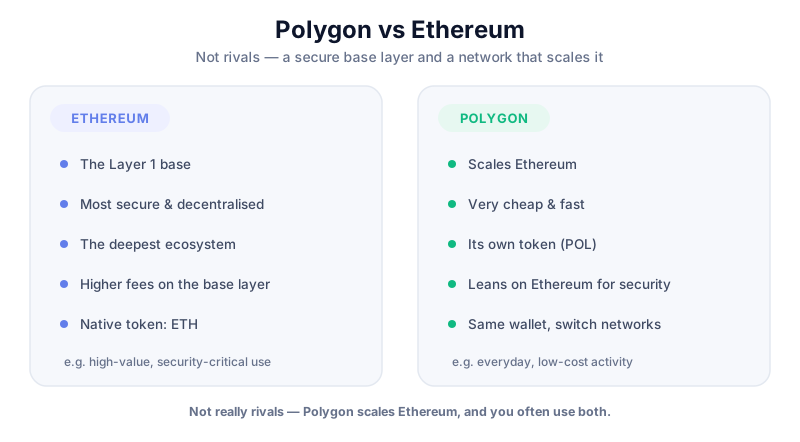
Here's how the two stack up on the points beginners care about most:
| Feature | Ethereum | Polygon |
|---|---|---|
| Role | Base-layer blockchain | Scaling network for Ethereum |
| Typical fees | Can be high when busy | Usually a tiny fraction of a penny |
| Speed | Solid, but slower when congested | Fast, often seconds |
| Security | Very high, fully decentralised | Strong, with different trade-offs |
| Native token | ETH | POL (formerly MATIC) |
| Best for | High-value, security-critical use | Everyday, low-cost activity |
The trade-offs that matter
Lower fees aren't free — they come from design choices. Some Polygon networks rely on a smaller validator set or external systems, which is a different security model than Ethereum's base layer. For most everyday amounts that's a perfectly reasonable trade; for very large, long-term holdings, many people prefer Ethereum's base-layer security.
Same wallet, two networks
Because Polygon is Ethereum-compatible, the same wallet usually works on both — you just switch networks. Always confirm which network you're sending on before you hit send.
Which should you use?
It depends on the task, not on which is 'better'. Use Ethereum when security matters most; use Polygon when you want cheap, fast transactions for everyday activity. Neither choice is investment advice. Whichever way you lean, the storage rule doesn't change: serious amounts belong offline, on a hardware wallet like the Keystone 3 Pro.
A fair warning
Both ETH and POL are volatile, and the scaling landscape changes quickly. Only ever risk what you can afford to lose, and never borrow to buy crypto. This guide is education, not financial advice.
Key takeaways
- Polygon works with Ethereum rather than simply competing with it.
- Polygon offers much lower fees and faster transactions for everyday use.
- Ethereum's base layer offers the strongest, most decentralised security.
- Both tokens are volatile — only risk what you can afford to lose.
Frequently asked questions
Is Polygon better than Ethereum?
Neither is simply 'better' — they do different jobs. Ethereum is the secure base layer; Polygon scales it with cheaper, faster transactions. The right one depends on your task.
Can I move funds between Ethereum and Polygon?
Yes, using a 'bridge'. Bridging carries its own risks, so use official, well-known bridges, double-check addresses, and test with a small amount first.
Do Polygon and Ethereum use the same wallet?
Usually yes. Polygon is Ethereum-compatible, so wallets like MetaMask handle both — you simply switch networks.
Keep reading
What Is Polygon (POL)? A Plain-English Guide
A beginner-friendly explanation of Polygon and its POL token: what it is, how it speeds up Ethereum, what it's
Polygon for Beginners: Cheap, Fast Transactions
A beginner's guide to using Polygon for low-cost crypto transactions: adding the network, getting POL for fees
How to Buy Polygon (POL) Safely: Step by Step
A safe, beginner-friendly walkthrough for buying Polygon's POL token: choosing an exchange, verifying your acc