What Is Polygon (POL)? A Plain-English Guide
Polygon is a network built to make using Ethereum faster and far cheaper. Its token, POL (which replaced the older MATIC), helps run and secure that network. This guide explains what Polygon is in plain English, how it works, and how to think about it without the hype.
The 20-second version
Polygon is a 'scaling' network that lets you move and use crypto with tiny fees instead of Ethereum's sometimes high ones. POL is the token that powers it. It's not a separate, isolated coin — it's designed to work alongside Ethereum.
What is Polygon?
Ethereum is powerful, but when it gets busy, fees can spike and transactions slow down. Polygon was created to solve that. Think of Ethereum as a busy motorway and Polygon as a network of fast, cheap side roads that still connect back to it.
Practically, that means you can send tokens, trade on DeFi apps, or mint an NFT on Polygon for a fraction of a penny in many cases, rather than paying several pounds on Ethereum itself.
Polygon isn't a single thing, either. It's a family of scaling technologies built by Polygon Labs, all sharing the goal of cheaper, faster blockchain activity.
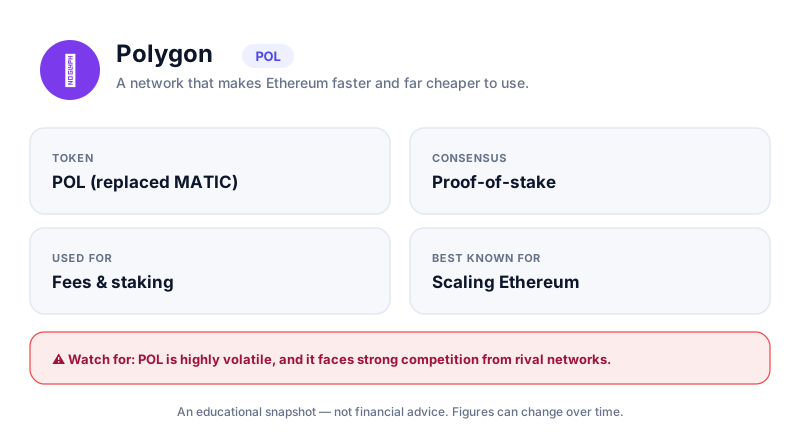
POL: the token that powers it
The native token of the network is POL. In 2024 the project migrated from its original token, MATIC, to POL as part of a broader upgrade plan branded 'Polygon 2.0'. If you held MATIC, it was designed to convert to POL.
- Paying fees — POL covers the (very small) transaction costs on the network.
- Staking — holders can stake POL to help secure the network and earn rewards.
- Coordination — POL is intended to support multiple Polygon chains under the newer design.
MATIC vs POL
You may still see the old 'MATIC' name on some apps and charts. POL is the current native token. Always double-check you're using up-to-date official sources when migrating or sending funds.
How Polygon works
Polygon's best-known network is its PoS (proof-of-stake) chain, which processes transactions itself and periodically settles back to Ethereum for security. More recent Polygon technology uses zero-knowledge (ZK) proofs — a clever bit of cryptography that bundles many transactions into a single compact proof, cutting costs further.
- Low fees — transactions typically cost a tiny fraction of Ethereum's.
- Fast confirmation — transfers usually settle in seconds.
- Ethereum-compatible — most Ethereum wallets and apps work on Polygon with minimal changes.
A hardware wallet keeps your keys offline and supports Polygon and Ethereum-based tokens. The Ledger Nano X is our top pick for beginners — read our full review first.
Why Polygon matters — and the trade-offs
Polygon became popular because it made Ethereum's ecosystem usable for everyday amounts. Brands, games and DeFi apps have built on it precisely because fees are low. That said, scaling networks make trade-offs: some rely partly on a smaller set of validators or external systems, which can mean different security assumptions than Ethereum's own base layer.
It also faces real competition. Other scaling networks like Arbitrum, Optimism and Solana are chasing the same goal, and the technology is evolving quickly.
A fair warning
POL's price is highly volatile, and the scaling landscape changes fast. Only ever risk what you can afford to lose, and never borrow to buy crypto. This guide is education, not financial advice.
Where to go next
Now you know what Polygon is, you might compare it directly with Polygon vs Ethereum, see how to use Polygon for cheap transactions, or learn how to buy POL safely and how to store it safely.
Key takeaways
- Polygon is a network that makes Ethereum faster and cheaper to use.
- POL is its native token, replacing the older MATIC.
- POL is used for fees, staking and securing the network.
- It's volatile and faces strong competition — only risk what you can afford to lose.
Frequently asked questions
Is Polygon the same as MATIC?
Polygon is the network; MATIC was its original token. In 2024 the project migrated to POL as the native token. You may still see 'MATIC' on older charts and apps.
Is Polygon part of Ethereum?
Polygon is a separate network designed to work closely with Ethereum, settling back to it for added security. Most Ethereum-compatible wallets and apps work on Polygon.
Do I need a whole POL token to start?
No. POL is divisible into very small fractions, so you can hold or use tiny amounts. Always start small while you learn.
Keep reading
Polygon vs Ethereum: What's the Difference?
A fair, jargon-light comparison of Polygon and Ethereum: how they relate, fees and speed, security trade-offs,
Polygon for Beginners: Cheap, Fast Transactions
A beginner's guide to using Polygon for low-cost crypto transactions: adding the network, getting POL for fees
How to Buy Polygon (POL) Safely: Step by Step
A safe, beginner-friendly walkthrough for buying Polygon's POL token: choosing an exchange, verifying your acc