Ponzi and HYIP Schemes in Crypto
Ponzi schemes and HYIPs (high-yield investment programs) are among the oldest scams in finance, and crypto gave them a fresh coat of paint. They promise steady, guaranteed returns, but there's no real business underneath — early investors are simply paid with money from later ones until the whole thing collapses. This guide shows you the unmistakable red flags.
The 20-second version
If something guarantees high, steady returns with little or no risk, it's a scam. Ponzis and HYIPs pay old investors with new deposits and collapse when growth slows. No legitimate investment guarantees returns. This is education, not financial advice — only risk what you can afford to lose.
How Ponzi and HYIP schemes work
A Ponzi scheme pays returns to existing investors using money from new investors rather than from any genuine profit. As long as fresh deposits keep flowing in, early participants get paid and tell their friends. When recruitment slows, there isn't enough new money to cover withdrawals, and it collapses — usually with the organisers gone.
A HYIP is a Ponzi dressed up as a slick online 'investment platform' offering eye-watering daily or weekly yields. In crypto these often hide behind buzzwords like 'arbitrage bot', 'AI trading', 'mining pool', or 'staking program', and lean heavily on referral commissions to fuel growth.
It has happened at huge scale
Crypto history is full of collapses with Ponzi-like dynamics. BitConnect, which promised outsized guaranteed returns through a secret 'trading bot', collapsed in 2018 and its promoters faced major legal action. OneCoin was a multi-billion-dollar fraud built around a coin that barely existed. These weren't fringe cases — they pulled in huge sums from ordinary people worldwide.
Guaranteed returns are the tell
Real investments fluctuate and can lose money. Any scheme promising fixed, high returns 'guaranteed' is misrepresenting reality. Never borrow to invest, and only ever risk what you can afford to lose.
Red flags to watch for
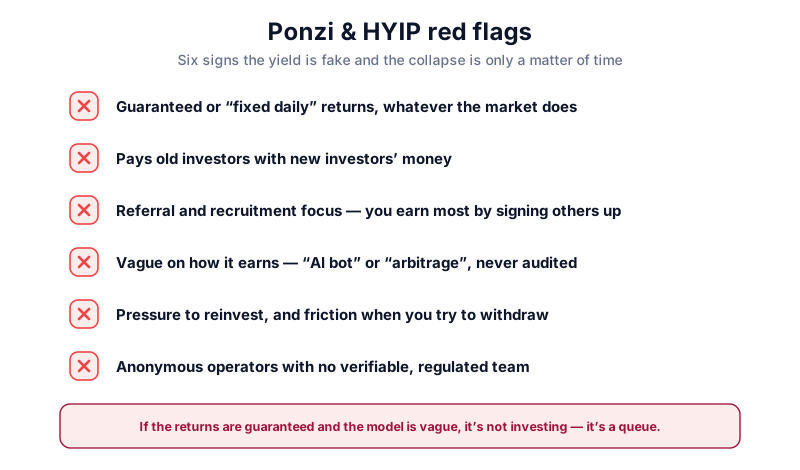
- Guaranteed or fixed high returns — especially 'X% per day/week', regardless of market conditions.
- Referral-driven — you earn most by recruiting others, the hallmark of a pyramid structure.
- Vague strategy — 'proprietary bot' or 'AI' with no verifiable, audited explanation of where profit comes from.
- Pressure and urgency — limited-time bonuses, countdowns, and 'get in before it's too late'.
- Withdrawal friction — delays, new 'fees', or rules that appear when you try to take money out.
If you can't see where the yield comes from, assume there isn't one
Legitimate yield has an explainable source. If a platform won't or can't clearly show how it earns the returns it pays, treat the returns as fake.
How to protect yourself
- Be sceptical of any guaranteed or unusually high return — the higher and 'safer' it sounds, the bigger the red flag.
- Ask exactly where the profit comes from and demand verifiable, independent evidence, not testimonials.
- Check whether the operator is registered and regulated where you live, and search for warnings or complaints.
- Ignore pressure to recruit friends and family; that's how these schemes spread the damage.
- Walk away from anything you don't fully understand. Missing out on a fake opportunity costs you nothing.
Key takeaways
- Ponzis and HYIPs pay old investors with new deposits, not real profit.
- Guaranteed, fixed, high returns are the single biggest red flag.
- Heavy referral incentives signal a pyramid structure.
- If you can't verify where the yield comes from, treat it as a scam.
Frequently asked questions
What's the difference between a Ponzi and a pyramid scheme?
A Ponzi pays 'returns' from new deposits and is usually run centrally. A pyramid pays you mainly for recruiting others. Crypto HYIPs often blend both, using referral commissions to keep new money flowing.
Is high staking yield always a scam?
No. Genuine staking has an explainable on-chain source of rewards. The warning sign is a fixed, guaranteed, sky-high yield with no clear, verifiable explanation of where it comes from.
Can I recover money from a collapsed scheme?
Rarely, and only sometimes through official legal processes. Beware 'recovery' services that ask for upfront fees — they are typically a follow-up scam.
Keep reading
Honeypot Tokens Explained
A honeypot token lets you buy but not sell. Learn how these rug-pull traps are built into smart contracts and
Fake Airdrop Scams Explained
Fake airdrops dangle free tokens to lure you onto a malicious site. Learn how the bait works and how to claim
How to Avoid Crypto Scams: The Cornerstone Safety Guide
The common crypto scams — fake support, phishing, giveaways, romance and rug pulls — and the simple habits tha