PulseChain Bridging Guide (Risks First)
In the last lesson you locked down your wallet. Now for the riskiest thing you might do with it. A bridge moves assets between blockchains — for example from Ethereum to PulseChain. Bridges are useful, but they're also among the most exploited targets in all of crypto. So this lesson does something unusual: it puts the risks first, then walks through doing it carefully if you decide you must. If a lesson was ever going to talk you out of rushing, it's this one.
The 20-second version
Bridges let you move tokens between Ethereum and PulseChain. They're convenient but historically a top hacking target — billions have been lost across crypto bridges. Use only official bridges, verify every URL character by character, test with tiny amounts first, sign with a hardware wallet, and never share your seed phrase.
Why we lead with the risks
We put risks first here on purpose, because most bridge guides bury them. Bridges are one of the highest-risk tools in crypto, full stop. Across the industry, billions of pounds have been stolen in bridge exploits — not because the people using them were reckless, but because of what a bridge *is*. To work, a bridge has to lock up a large pool of assets in one place, and a large pool in one place is exactly the kind of honeypot that draws the most determined attackers in the world. PulseChain bridging carries that same category of risk.
It's worth being clear that this isn't PulseChain-specific scaremongering. Some of the largest thefts in the history of crypto have been bridge hacks, hitting big, well-funded, well-audited bridges on major chains. The vulnerability is structural, not a sign that one particular team was careless. So when we say 'use bridges with extreme care', we're not singling PulseChain out — we'd say exactly the same about bridging anywhere. The category itself is the risk.
Think of a bridge as an armoured vault that holds everyone's deposits while issuing IOUs on the other side. The vault is enormously useful — and it's also the single most attractive thing in the building to rob. Every pound that flows in makes the prize bigger and the target juicier. That's not fear-mongering; it's the basic shape of the problem, and understanding it is what stops you treating a bridge like an ordinary transfer.
Bridge with extreme care
Treat any bridge transaction as higher-risk than a normal transfer. Use only official tools, verify URLs character by character, and never move more than you can comfortably afford to lose. This is education, not financial advice — and 'I read it was safe somewhere' is not a safety check.
What bridging actually does
Blockchains can't natively talk to each other — Ethereum has no idea PulseChain exists, and vice versa. They're like two countries with no shared language and no phone line between them. A bridge works around this. The common design locks your asset on the source chain (say, Ethereum) and issues a representation of it on the destination chain (PulseChain). When you bridge back, that representation is destroyed and the original is unlocked. It's a cloakroom ticket: you hand in your coat on one side, get a ticket, and redeem the ticket for the coat later.
That cloakroom analogy is worth taking seriously, because it explains where the danger lives. Your ticket is only as good as the cloakroom honouring it. If someone breaks into the cloakroom and walks off with all the coats, your ticket is suddenly a worthless slip of paper — even though it still looks perfectly valid in your hand. That's exactly what a bridge hack does: the locked originals get drained, and the 'representations' people are holding on the other chain can be left backed by nothing.
- Locked-and-minted assets on the destination chain are only ever as safe as the bridge holding the originals. If the vault is emptied, your 'ticket' may be worthless.
- Wrapped tokens can behave differently from the 'real' asset — different contract, different liquidity. Check exactly what you're receiving, not just its name.
- Smart-contract risk is ever-present: a single bug or exploit in the bridge's code can put all the locked funds at risk at once.
If smart contracts and DeFi are still new to you, read those foundations first. Bridging assumes you're already comfortable connecting a wallet and signing on-chain transactions, and understand that signed transactions can't be reversed — there's no 'undo', no chargeback, and no support line that can claw your funds back if it goes wrong.
Checks before you bridge
Here's the reassuring part, sort of. Most bridge losses suffered by ordinary users don't come from exotic, headline-grabbing hacks — they come from landing on a fake bridge or approving a malicious transaction. The big vault heists make the news, but the everyday losses are humbler and far more preventable. That means a handful of disciplined habits, costing nothing but a little patience, prevent the large majority of personal disasters:
- Reach the bridge only through an official, bookmarked link — never via an ad, a DM, or a search result you haven't verified. Scammers buy the top ad slot above the real site.
- Verify the website URL character by character. Look-alike domains swap an 'l' for a '1' or add a hyphen, and they're built to be indistinguishable at a glance.
- Check exactly what you'll receive on the other side, and confirm the contract address from an official source before you commit anything.
- Never share your seed phrase — no bridge ever needs it. A real bridge only asks you to *connect* and *sign*, never to type your words in.
Your hardware wallet still helps
Signing with a hardware wallet means you physically confirm each transaction on the device's own screen — a strong defence against a malicious site silently swapping out what you think you're approving. Read what the device shows you, not just what the website claims.
A careful step-by-step
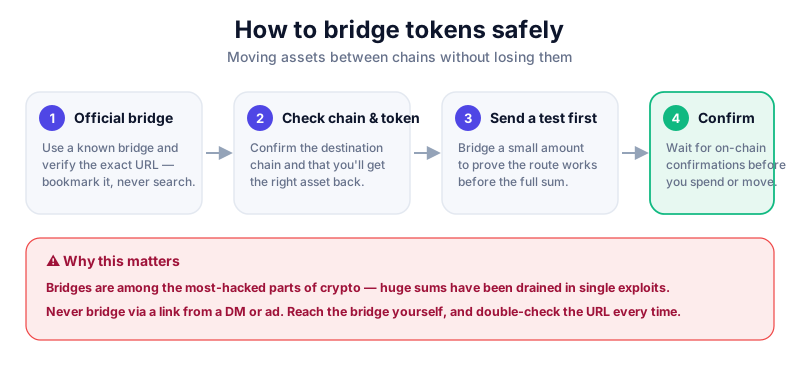
- First, confirm you actually need to bridge at all. Sometimes buying or swapping directly on an exchange is simpler and safer — don't take the risky road out of habit.
- Open the official bridge from your own bookmark, and double-check the URL before clicking anything on the page.
- Connect your wallet — ideally with a hardware wallet attached — and review exactly what the transaction will do before you approve it.
- Bridge a tiny test amount first. Wait for it to fully arrive on the other side and confirm you received precisely what you expected.
- Only then bridge the rest, in amounts you can afford to lose. Keep a note of the transaction hash for your own records.
- Afterwards, review and revoke any token approvals you no longer need, so a dormant permission can't be abused later.
Don't skip the test amount, however small and slow it feels. A test transfer is the cheapest insurance in all of crypto: for the price of a tiny fee and a few minutes' patience, you confirm that the route works, the destination is right, and you receive exactly the token you expected before you commit anything that would actually hurt to lose. If the test goes wrong, you've lost pennies and learned something vital. If it goes right, you proceed with real confidence rather than crossed fingers. Professionals do this every single time, and so should you.
If anything feels off, stop
Unexpected pop-ups, a URL that's a character out, any request for your seed phrase, or pressure to act fast — these are all reasons to abort, not to push through. Bridges never reward haste, and there's no prize for being quick. Walking away costs you nothing.
Where this leads next
You now know how to buy, store and bridge PLS as carefully as anyone can. There's one lesson left, and it's the one we'd genuinely read before risking a penny: the full, balanced risks and controversy behind PulseChain — the SEC complaint, the concentration concerns, and the cases for and against, laid out fairly so you can decide for yourself. With the practical skills in hand, it's the right moment to step back and weigh the project as a whole. Whichever way you lean, the storage rule doesn't change: serious amounts belong offline, on a hardware wallet like the Ledger Nano X.
Key takeaways
- Bridges move assets between chains by locking on one side and issuing a representation on the other.
- They're among the most exploited targets in crypto — billions have been lost industry-wide.
- Most user losses come from fake bridges and bad approvals, not exotic technical hacks.
- Use official tools only, verify URLs, test tiny amounts first, and never share your seed phrase.
Frequently asked questions
Is bridging to PulseChain safe?
It carries real, unavoidable risk. Bridges are a top target for hackers, and fake bridges are common. Done carefully — official links, tiny test amounts, a hardware wallet — you reduce the risk a lot, but you can't eliminate it entirely.
What's the safest way to bridge?
Use only official bridges, verify the URL character by character, sign with a hardware wallet, and move a tiny test amount before the rest. If anything looks even slightly off, stop.
Do I have to bridge to use PulseChain?
Not necessarily. Where PLS is available to buy or swap directly, that's usually simpler and safer than bridging. See how to buy PulseChain.
Keep reading
How to Buy PulseChain (PLS) — Carefully
A cautious, step-by-step look at how people buy PLS: limited exchange availability, thin liquidity, bridging r
How to Store PulseChain (PLS) Safely
Store PLS safely: add PulseChain to MetaMask as a custom network, pair it with a hardware wallet, protect your
PulseChain: Risks and Controversy (The Honest Picture)
A factual, balanced look at PulseChain's risks: the SEC complaint against Richard Heart, concentration concern