What Is PulseX? The Main DEX on PulseChain, Explained
PulseX is the main decentralised exchange on PulseChain — the place most PulseChain trading and liquidity actually happens. It's a fork of Uniswap, so if you understand one you largely understand the other, but it adds its own token (PLSX) and its own fee mechanics. Because PulseX sits inside one of crypto's most divisive ecosystems, we'll cover how it works plainly and point you to the risks without either boosting or bashing.
The 20-second version
PulseX is a Uniswap-style automated market maker on PulseChain: you swap tokens and provide liquidity directly from your own wallet. Its native token is PLSX, and a share of trading fees is used to buy back and burn PLSX while rewarding liquidity providers (partly in the separate INC token). It carries all the normal DEX risks plus the PulseChain ecosystem's specific controversies.
Where PulseX fits
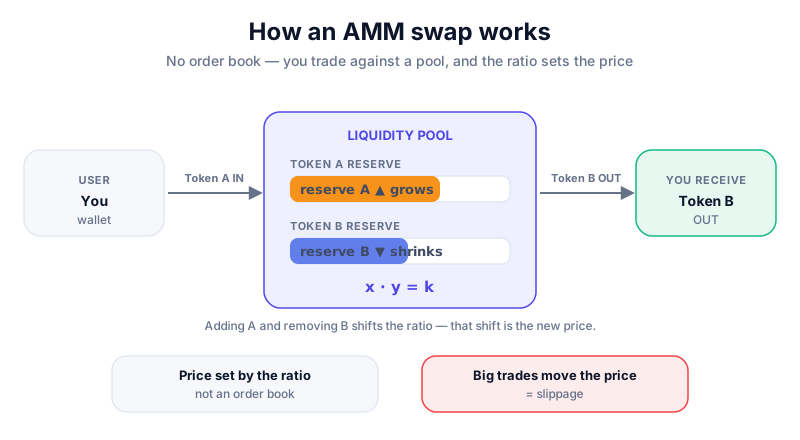
Every blockchain that hosts tokens needs somewhere to trade them. On Ethereum that's mostly Uniswap; on PulseChain it's mostly PulseX. It's an automated market maker — instead of matching buyers to sellers, you trade against pooled liquidity that other users have deposited, and prices adjust by formula. That's the same core design we cover in how a DEX works, because PulseX is a fork of Uniswap's code. If you've used one, the interface — connect wallet, pick two tokens, swap or add liquidity — will feel immediately familiar.
PLSX and the buy-and-burn idea
PulseX has its own token, PLSX, which was distributed to people who took part in PulseChain's 'sacrifice' fundraising phase (a model we explain, and scrutinise, in the risks and controversy guide). The economic hook PulseX is known for is a buy-and-burn mechanism: a portion of the fees generated by trading is used to buy PLSX on the open market and permanently destroy it, reducing supply over time.
Buy-and-burn is not free money
Reducing supply can support a token's price *if* demand holds — but burns are funded by trading volume, which rises and falls, and a shrinking supply means nothing if interest fades. Treat 'deflationary' as a design choice with trade-offs, not a guarantee of gains. Nothing here is a recommendation to buy PLSX or anything else.
Fees, liquidity and where INC comes in
Like any AMM, PulseX charges a small fee on each swap. That fee is split between the people who supply liquidity (their reward for taking on the risk of providing it) and the buy-and-burn mechanism above. PulseX also mints a separate incentive token — INC — to liquidity providers as an extra reward on top of fees. The exact fee percentage and how it's divided have varied between PulseX's versions, so check the current parameters in PulseX's own documentation rather than trusting a number in a promo post.
Providing liquidity is genuinely more advanced than simple swapping — it exposes you to impermanent loss (covered in our guide) and to the risk of the tokens themselves. It is not a 'savings account', however the yields are framed.
Using PulseX safely
The safety rules are the same as any decentralised exchange, and they matter more here because PulseChain's newer, faster-moving ecosystem is a favourite hunting ground for copycats:
- Reach the real site by bookmark, never a search ad or a DM link — fake PulseX front-ends exist to drain wallets.
- Select tokens by verified contract address, not by name — spotting fake tokens is the single most important habit on any DEX.
- Test-swap small, and try selling back, before committing real size.
- Keep long-term holdings in cold storage and trade from a low-balance hot wallet.
- Remember UK tax: every swap is a disposal for Capital Gains Tax, even crypto-to-crypto (details).
The honest bottom line
PulseX is a functional, widely-used DEX that does what a DEX does. Its distinctive tokenomics are interesting but come with the usual caveats, and — crucially — it is inseparable from PulseChain and its founder, which means the regulatory action and concentration concerns around the wider ecosystem apply to it too. We're not here to tell you it's good or bad; we're here to make sure that if you use it, you do so with your eyes open and your keys offline. As always: this is education, never financial advice.
Key takeaways
- PulseX is the main DEX on PulseChain — a Uniswap fork with its own PLSX token
- A share of trading fees buys back and burns PLSX; 'deflationary' is a design choice, not a promise
- It mints a separate token, INC, to reward liquidity providers on top of fees
- All standard DEX safety rules apply — verify token addresses, test small, keep keys offline
- It's inseparable from PulseChain's wider regulatory and concentration controversies
Frequently asked questions
Is PulseX the same as Uniswap?
It's built from Uniswap's code and works almost identically, but it runs on PulseChain rather than Ethereum, has its own PLSX token, and adds its own buy-and-burn and INC-reward mechanics. Same engine, different car and different neighbourhood.
What's the difference between PLSX and INC?
PLSX is PulseX's main token, subject to the buy-and-burn model. INC is a separate token minted to liquidity providers as an incentive reward. We cover INC in its own guide.
Is PulseX safe to use?
The protocol functions, but 'safe' depends on you: use the real front-end, verify every token by address, and understand you're operating inside an ecosystem with real, documented controversy. Read our PulseChain risks guide before going deep.
Keep reading
What Is PulseChain? A Plain-English Guide
A balanced, beginner-friendly explanation of PulseChain: what it is, who founded it, how it relates to Ethereu
What Is INC (Incentive)? PulseX's Reward Token, Explained
INC is the token PulseX mints to reward liquidity providers on PulseChain. How incentive tokens work, why they
PulseChain: Risks and Controversy (The Honest Picture)
A factual, balanced look at PulseChain's risks: the SEC complaint against Richard Heart, concentration concern