The Bitcoin Halving Explained
Roughly every four years, the reward for mining a Bitcoin block is cut in half. This event — the 'halving' — is built into Bitcoin's code and gradually slows the creation of new coins toward the 21 million cap. It's one of the most talked-about events in crypto, often surrounded by hype. Here's what it really is.
The 20-second version
About every four years (every 210,000 blocks), the new Bitcoin paid to miners per block is halved. This steadily reduces new supply on the way to Bitcoin's 21 million cap. The reward went 50 → 25 → 12.5 → 6.25 → 3.125 BTC (the 2024 halving), and continues until around 2140.
What is the halving?
When miners add a new block to the Bitcoin blockchain, they receive newly created bitcoin as a reward. The halving is a rule in Bitcoin's code that cuts this block reward in half every 210,000 blocks — which works out to roughly every four years.
This is how Bitcoin enforces its fixed supply. New coins enter circulation more and more slowly over time, until the last fraction of a bitcoin is mined around the year 2140 and no new coins are ever created again.
The halvings so far
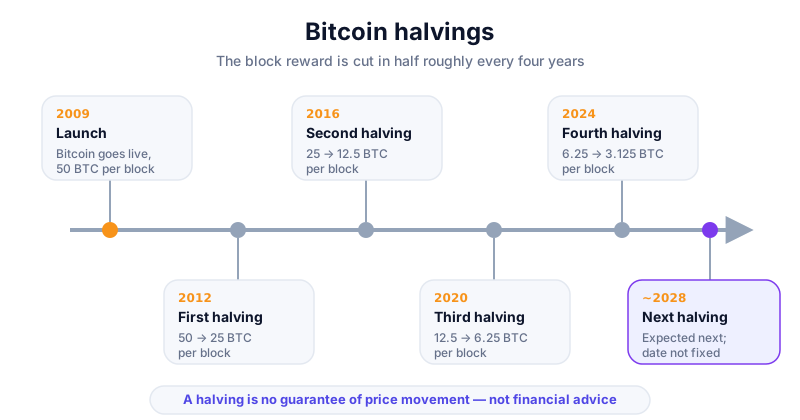
Bitcoin launched in 2009 with a block reward of 50 BTC. Each halving has cut that figure in half:
- 2012: 50 → 25 BTC per block.
- 2016: 25 → 12.5 BTC.
- 2020: 12.5 → 6.25 BTC.
- 2024: 6.25 → 3.125 BTC.
This predictable, transparent schedule is a core part of Bitcoin's design as a scarce, hard-to-inflate form of money — sometimes described as 'digital gold'.
Why people pay attention
The halving cuts the rate of new supply, and basic economics says reduced new supply *can* affect price if demand holds. Past halvings have been followed by major price moves, which is why they attract so much attention and speculation.
Past patterns are not predictions
A halving does NOT guarantee the price will rise. Markets are influenced by countless factors, halvings are widely known in advance (and may already be 'priced in'), and a handful of past cycles is a tiny sample. Never buy because of halving hype. Only risk what you can afford to lose, and never borrow to invest. This is education, not financial advice.
What it means for miners
Each halving cuts miners' revenue from block rewards overnight. Less efficient miners can become unprofitable and shut down, while transaction fees make up a growing share of miner income over time.
For everyday holders, nothing about your bitcoin changes at a halving — your coins and wallet are unaffected. To go deeper, read what is Bitcoin for how supply works, and compare with Bitcoin ETFs and the Ethereum Merge to see how different networks handle issuance.
Key takeaways
- The halving cuts the block reward in half about every four years.
- It steadily slows new supply toward Bitcoin's 21 million cap.
- Rewards have gone 50 → 25 → 12.5 → 6.25 → 3.125 BTC (2024).
- It is no guarantee of price movement — past cycles don't predict the future.
Frequently asked questions
When is the next Bitcoin halving?
Halvings happen every 210,000 blocks — roughly every four years. The 2024 halving cut the reward to 3.125 BTC, so the next is expected around 2028, though the exact date depends on how fast blocks are mined.
Does the halving make Bitcoin's price go up?
Not automatically. It reduces new supply, which can matter, but the price depends on many factors and the schedule is known years in advance. Treat any 'guaranteed pump' claim as a red flag, not a fact.
Do I need to do anything when a halving happens?
No. The halving affects miners' rewards, not your holdings. Your bitcoin and wallet are completely unaffected, and there's nothing to claim, migrate or upgrade.
Keep reading
What Is Bitcoin? A Plain-English Guide
A beginner-friendly explanation of what Bitcoin is, how it works, and how to think about it — with no hype and
Bitcoin ETFs Explained
What a spot Bitcoin ETF is, how the US approvals in January 2024 changed access, and the trade-offs versus hol
The Ethereum Merge Explained
What the September 2022 Ethereum Merge did, how the switch from proof-of-work to proof-of-stake cut energy use