What Are Governance Tokens? A Plain-English Guide
Governance tokens are the voting rights of the DeFi world. They let holders help decide how a protocol is run — from fees to upgrades — without any central company in charge. This guide explains what they are, what they can and can't do, and the common misunderstandings that get people into trouble.
The 20-second version
A governance token gives you a vote over how a crypto protocol is run. Tokens like UNI, AAVE and MKR steer their projects through community voting. They are not company shares, rarely pay dividends, and owning one is not a claim on profits.
What is a governance token?
Most DeFi projects aim to run without a traditional company in charge. So how do decisions get made? Through governance tokens. Holding one gives you the right to vote on proposals about the protocol's future — and usually, the more tokens you hold, the more voting weight you have.
These tokens power DAOs (decentralised autonomous organisations), where a community collectively manages a protocol. Examples include UNI for Uniswap, AAVE for Aave, and MKR for MakerDAO.
How governance actually works
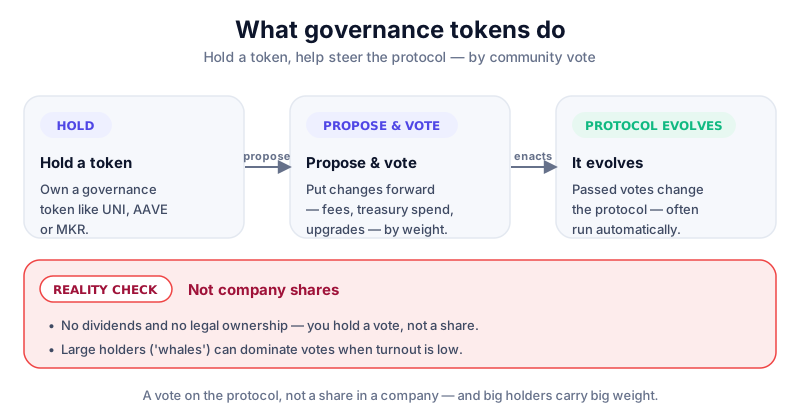
- Proposals are put forward to change something — a fee, a new feature, treasury spending.
- Voting happens with tokens; holders vote for or against, often after community discussion.
- Execution: if a vote passes, the change can be enacted, sometimes automatically by smart contract.
- Delegation: holders who don't want to vote directly can delegate their votes to others.
Some governance tokens come with extra roles — staking for rewards, acting as a system backstop, or sharing in fees — but those features vary hugely from project to project.
Why they aren't company shares
This is the most important point to grasp. A governance token looks a bit like a share, but it usually is not one. It typically gives you no legal ownership of a company, no claim on profits, and no dividend. Its value comes from the demand for influence over the protocol and from speculation — not from cash flows you are entitled to. Whichever way you lean, the storage rule doesn't change: serious amounts belong offline, on a hardware wallet like the BitBox02.
Don't confuse a vote with ownership
Buying a governance token does not make you a shareholder. Many trade far above any underlying utility, and voter turnout is often low — meaning a small number of large holders can dominate. Treat them as high-risk, speculative assets.
The risks
- Concentration: a few large holders ('whales') can control votes.
- Low participation: most holders never vote, weakening the 'decentralised' ideal.
- Volatility: prices can swing wildly and are often disconnected from any real use.
- Regulatory uncertainty: how these tokens are treated by law is still evolving.
Education, not financial advice
Governance tokens are speculative and volatile, and owning one is not an investment recommendation. Only risk what you can afford to lose, and never borrow to buy crypto. This guide explains how they work — nothing more.
Key takeaways
- Governance tokens give holders a vote over how a DeFi protocol is run.
- They power DAOs — community-run organisations behind protocols like Uniswap and Aave.
- They are not company shares: usually no ownership, profits or dividends.
- Risks include whale control, low turnout, volatility and regulatory uncertainty.
Frequently asked questions
Do governance tokens pay dividends?
Most do not. Some protocols share fees with stakers, but a governance token generally gives you voting rights, not a guaranteed income or a claim on profits.
Are governance tokens the same as shares?
No. They may resemble shares in giving you a say, but they typically confer no legal ownership of a company and no entitlement to its earnings. The legal treatment is still unsettled.
Do I have to vote if I hold one?
No. Voting is optional, and many holders never do. You can also delegate your votes to someone else. Low participation is a real weakness of token governance.
Keep reading
What Is DeFi? Decentralised Finance Explained
A beginner's guide to decentralised finance: what DeFi is, how lending, trading and yield work without a bank
What Is Uniswap? A Plain-English Guide to the DEX
A beginner-friendly guide to Uniswap: how the decentralised exchange works, what the UNI token does, automated
What Is Aave? DeFi Lending Explained Simply
A plain-English guide to Aave, the decentralised lending protocol: how lending and borrowing work, what the AA