What Is MakerDAO? The DAI Stablecoin Explained
MakerDAO is the protocol behind DAI, one of the oldest and most influential decentralised stablecoins. Instead of a company holding dollars in a bank, DAI is created by people locking up crypto as collateral. This guide explains how that works in plain English — and why a 'stable' coin still carries real risks.
The 20-second version
MakerDAO lets users lock crypto into 'vaults' to generate DAI, a stablecoin designed to stay near $1. The system is governed by holders of the MKR token. DAI aims to be stable, but it depends on collateral, code, and governance — none of which are risk-free.
What is MakerDAO?
MakerDAO is one of the founding projects of DeFi, launched in 2017. It is a decentralised system that issues DAI, a stablecoin designed to hold a value of roughly one US dollar. Unlike stablecoins backed by dollars in a company's bank account, DAI is created by users who lock up crypto collateral.
The whole thing is run as a DAO — a decentralised autonomous organisation — meaning decisions are made by token holders voting, not a board of directors. It runs on Ethereum.
How DAI is created
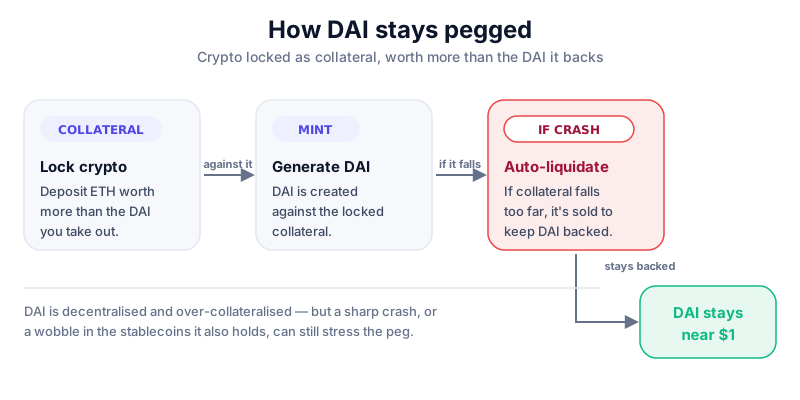
DAI comes into existence when someone borrows it against collateral, and disappears when they pay it back.
- You open a vault and deposit crypto (such as ETH) as collateral.
- You generate DAI against that collateral — always borrowing less than the collateral is worth.
- You repay the DAI plus a fee to unlock your collateral.
- Liquidation kicks in automatically if your collateral falls too far in value.
Over-collateralised, not free
Like Aave, Maker requires you to lock up more value than you borrow. If your collateral drops below the required ratio, it is sold off automatically — often at a penalty — to keep DAI backed.
What is the MKR token?
MKR is MakerDAO's governance token. Holders vote on the system's critical settings: which assets can be used as collateral, the fees charged, and the risk parameters that keep DAI stable. MKR also acts as a backstop — if the system ends up under-collateralised, new MKR can be created and sold to cover the shortfall, diluting existing holders.
You do not need MKR to use DAI or open a vault. MKR is about governing and ultimately underwriting the system. And however you weigh the trade-offs, keep meaningful holdings in cold storage — a Trezor Safe 5 — rather than on an exchange.
The risks
- De-peg risk: DAI is designed to track $1 but can drift, especially in market stress.
- Collateral and liquidation risk: a crash in collateral value can trigger forced sell-offs.
- Smart-contract risk: bugs in the code could threaten the system.
- Centralisation creep: DAI increasingly relies on centralised assets as collateral, which some argue undermines its 'decentralised' promise.
Education, not financial advice
No stablecoin is risk-free — the history of crypto includes stablecoins that collapsed entirely. DAI has a long track record but still depends on collateral, code and governance. Only risk what you can afford to lose, and never borrow to buy crypto.
Key takeaways
- MakerDAO issues DAI, a decentralised stablecoin backed by locked-up crypto collateral.
- Users mint DAI from over-collateralised vaults and can be liquidated if collateral falls.
- MKR is the governance token and a backstop — you don't need it to use DAI.
- Even a 'stable' coin carries de-peg, collateral, contract and centralisation risks.
Frequently asked questions
Is DAI the same as a dollar?
No. DAI is designed to track the value of one US dollar, but it is crypto backed by collateral, not actual dollars in a bank. It can drift from $1 and is not protected like a bank deposit.
How is DAI different from USDC or Tether?
USDC and Tether are issued by companies holding reserves. DAI is created in a decentralised way by users locking crypto collateral. Each model has different trust assumptions and risks.
What does MKR do?
MKR is the governance token used to vote on Maker's risk settings and collateral types. It also backstops the system: if it becomes under-collateralised, new MKR can be minted and sold, diluting holders.
Keep reading
What Is a Stablecoin? How the Peg Works (and Fails)
A clear guide to stablecoins: how they aim to hold a steady value, the different types, and the very real peg
What Is DeFi? Decentralised Finance Explained
A beginner's guide to decentralised finance: what DeFi is, how lending, trading and yield work without a bank
What Is Aave? DeFi Lending Explained Simply
A plain-English guide to Aave, the decentralised lending protocol: how lending and borrowing work, what the AA