What Is Aave? DeFi Lending Explained Simply
Aave is one of the largest lending protocols in DeFi — software that lets people lend out their crypto to earn interest, or borrow against crypto they already hold, all without a bank. This guide explains how it works in plain English and the risks that make it very different from a savings account.
The 20-second version
Aave is an app on Ethereum and other networks where users deposit crypto to earn interest or borrow against their holdings. Rates adjust automatically with supply and demand. Loans are over-collateralised, and if your collateral falls too far in value it can be sold off automatically.
What is Aave?
Aave is a decentralised lending protocol: a set of smart contracts that connect people who want to lend crypto with people who want to borrow it. There is no bank in the middle. Lenders deposit assets into shared pools and earn interest; borrowers take loans from those pools by putting up other crypto as collateral.
It runs on Ethereum and several other networks, and like Uniswap it is non-custodial — you interact directly from your own wallet and the code, not a company, enforces the rules.
How lending and borrowing work
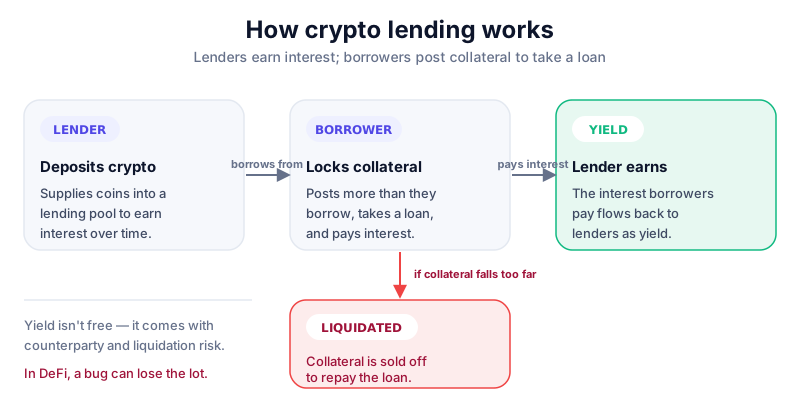
Everything on Aave is driven by pools and automatic interest rates that rise and fall with demand.
- Lending: you deposit crypto into a pool and earn interest, paid by borrowers. You can withdraw when liquidity allows.
- Borrowing: you lock up collateral worth *more* than you borrow, then take out a loan against it.
- Over-collateralisation: because crypto is volatile, you typically must post more value than you borrow — for example, depositing £150 of ETH to borrow £100 of a stablecoin.
Liquidation can wipe out your collateral
If the value of your collateral falls below a required threshold, Aave automatically sells part of it to repay the loan — often with a penalty. In a fast market this can happen quickly, and it is irreversible.
What is the AAVE token?
AAVE is the protocol's governance token. Holders can vote on changes to the protocol, and AAVE can be staked into a 'safety module' that helps backstop the system in exchange for rewards — but staking it also puts it at risk if that backstop is ever called upon.
You do not need AAVE to lend or borrow. As with most DeFi apps, the token is about governance and protocol economics, not access — and holding it is not a claim on profits. Whichever way you lean, the storage rule doesn't change: serious amounts belong offline, on a hardware wallet like the OneKey.
The risks
- Liquidation: a sharp drop in collateral value can trigger automatic, penalised sell-offs.
- Smart-contract risk: bugs or exploits in the code can lead to loss of funds.
- Variable rates: borrowing costs can spike unexpectedly when demand surges.
- Stablecoin and oracle risk: the system relies on price feeds and stablecoins that can themselves fail.
Education, not financial advice
DeFi lending is not a savings account — there is no protection scheme and your capital is at risk. Only risk what you can afford to lose, never borrow to buy crypto, and understand liquidation before you deposit a penny.
Key takeaways
- Aave is a decentralised protocol for lending and borrowing crypto without a bank.
- Loans are over-collateralised, and falling collateral can be liquidated automatically.
- AAVE is a governance token — you don't need it to use the protocol.
- It carries real risks (liquidation, bugs, rate spikes) and offers no deposit protection.
Frequently asked questions
Is lending on Aave like a savings account?
No. There is no deposit protection, rates change constantly, and your funds depend on the safety of smart contracts. The yield reflects real risk, not a guarantee.
Why would I borrow against my own crypto?
People do it to access cash without selling (and triggering a taxable event), or for strategies in DeFi. But it adds liquidation risk on top of normal volatility — it is advanced and risky.
What happens if my collateral drops in value?
If it falls below Aave's required threshold, part of your collateral is automatically sold to repay the loan, usually with a penalty. This is irreversible and can happen fast.
Keep reading
What Is DeFi? Decentralised Finance Explained
A beginner's guide to decentralised finance: what DeFi is, how lending, trading and yield work without a bank
What Is Uniswap? A Plain-English Guide to the DEX
A beginner-friendly guide to Uniswap: how the decentralised exchange works, what the UNI token does, automated
What Is MakerDAO? The DAI Stablecoin Explained
A plain-English guide to MakerDAO: how the DAI stablecoin is created, what collateral and vaults are, the role