What Are Liquidity Pools? A Beginner's Guide
A liquidity pool is the shared pot of tokens that makes swaps on a decentralised exchange possible. People deposit pairs of tokens, traders swap against the pool, and depositors earn a slice of the fees. It sounds like passive income — and sometimes it is — but pools also carry real risks. This guide explains how they work in plain English.
The 20-second version
A liquidity pool is two tokens locked in a smart contract so others can trade against them. Deposit into the pool and you become a 'liquidity provider', earning a share of trading fees — while taking on risks like impermanent loss and the chance the project is a scam.
Read this first
Earning fees is not free money
Providing liquidity can lose you money even when fees look attractive — through impermanent loss, smart-contract bugs, or outright scams. This guide is education, not financial advice. Never deposit funds you can't afford to lose.
What is a liquidity pool?
A liquidity pool is a smart contract holding a reserve of two (sometimes more) tokens. An automated market maker uses that reserve to price and settle trades. Without a pool, there would be nothing to swap against — so pools are the fuel that keeps a DEX running.
When you add tokens to a pool, you become a liquidity provider (LP). In return you receive LP tokens — a receipt that represents your share of the pool and lets you withdraw your portion (plus earned fees) later.
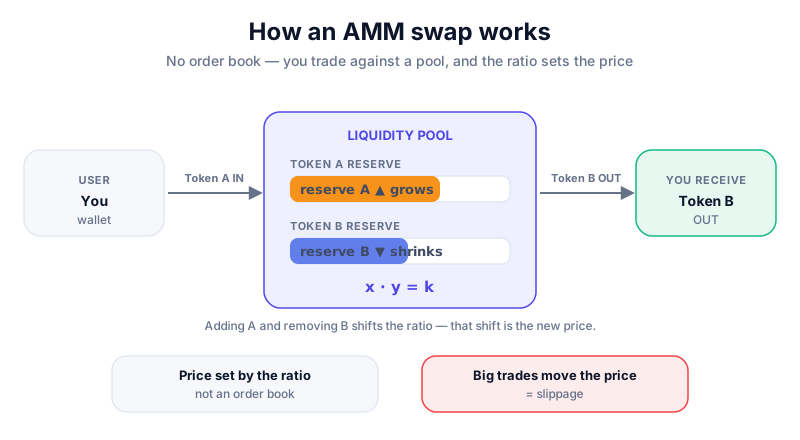
How providers earn
Every swap pays a small fee — often around 0.3% — that's split among all providers in proportion to their share. The more trading a pool sees, the more fees flow to depositors. A hardware wallet that displays exactly what you're approving — like the Keystone — turns most signing mistakes into near-misses.
- Deposit a pair — usually equal value of each token (e.g. ETH and a stablecoin).
- Receive LP tokens representing your share.
- Earn fees automatically as people trade.
- Withdraw any time by returning your LP tokens.
The risks you must understand
- Impermanent loss: if the two tokens' prices diverge, you can end up with less value than if you'd just held them.
- Smart-contract risk: a bug or exploit can drain the entire pool.
- Rug pulls: scam projects create a pool, attract deposits, then pull the liquidity and vanish.
- Scam tokens: a pool can contain a worthless token dressed up to look legitimate.
Favour established pools
Large, long-running pools on audited protocols are lower-risk than brand-new pools promising eye-watering returns. Sky-high advertised yields are usually a warning sign, not an opportunity.
Where to go next
Pools sit at the heart of DeFi. Understand the pricing engine in what is an AMM, the main risk in impermanent loss explained, and how people stack rewards on top in what is yield farming.
Key takeaways
- A liquidity pool is two or more tokens locked in a contract for traders to swap against.
- Deposit to become a liquidity provider and earn a share of trading fees.
- You receive LP tokens as a receipt for your share of the pool.
- Risks include impermanent loss, contract bugs, and rug pulls — only risk what you can afford to lose.
Frequently asked questions
Do I need both tokens to join a pool?
Usually yes — most pools require roughly equal value of each token in the pair. Some newer protocols offer single-sided deposits, but they handle the balancing for you behind the scenes.
Can I lose my deposit?
Yes. Through impermanent loss, a smart-contract exploit, or a scam project, it's possible to withdraw less than you put in — or nothing at all.
What are LP tokens?
They're a receipt proving your share of a pool. Keep them safe: in many protocols, losing them means losing access to your deposit.
Keep reading
What Is an AMM? Automated Market Makers Explained
How automated market makers (AMMs) price crypto trades without an order book — the x*y=k formula, slippage, an
Impermanent Loss Explained (With a Simple Example)
What impermanent loss really is, why it happens to liquidity providers, a worked example, and how to think abo
What Is Yield Farming? Rewards and Risks Explained
Yield farming explained for beginners: how DeFi reward programmes work, what APR and APY really mean, and why