What Is Bitcoin Mining? How New Coins Are Made
Mining is the process that creates new bitcoin and keeps the network secure — but it has nothing to do with digging. This guide explains what miners actually do, how proof-of-work protects Bitcoin from cheating, what the 'halving' means, and how to think honestly about mining's energy use.
The 20-second version
Miners are computers that compete to confirm Bitcoin transactions by solving a hard guessing puzzle. The winner adds the next block and earns newly created bitcoin plus fees. This 'proof-of-work' makes the network expensive to attack and is how new coins enter circulation.
What miners actually do
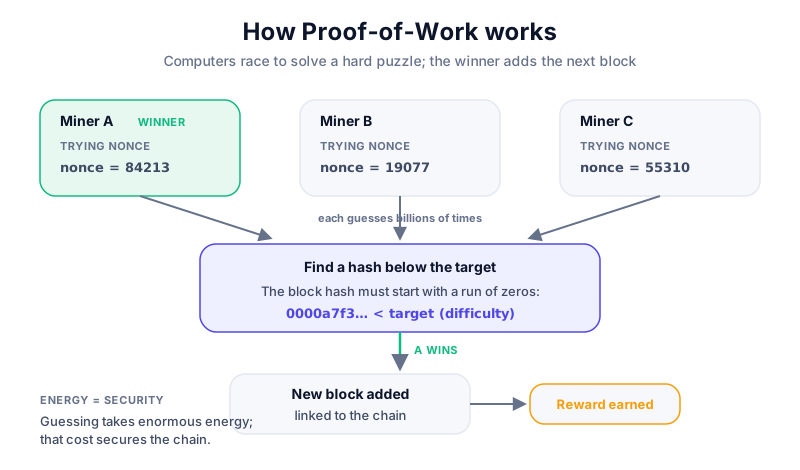
Roughly every ten minutes, the Bitcoin network bundles recent transactions into a block and adds it to the blockchain. Miners compete for the right to add that block. Whoever wins confirms the transactions and is rewarded with brand-new bitcoin plus the fees from those transactions.
To win, a miner must find a special number that makes the block's digital fingerprint meet a strict target. There's no clever shortcut — computers simply make trillions of guesses per second until one works. This is called proof-of-work.
Why proof-of-work secures the network
Because winning requires huge amounts of real-world electricity and hardware, cheating the network would cost more than it's worth. To rewrite history, an attacker would need to out-compute the entire honest network — a feat so expensive it's effectively impractical.
- Hash rate is the total guessing power of all miners combined — higher means a more secure network.
- Difficulty automatically adjusts about every two weeks to keep blocks coming roughly every ten minutes.
- Confirmations pile up as new blocks are added on top, making a transaction harder and harder to reverse.
The block reward and the halving
When Bitcoin launched in 2009, each block created 50 new bitcoin. About every four years that reward is cut in half — an event called the halving. The reward dropped to 3.125 BTC at the 2024 halving, and it will keep halving until the supply approaches its 21 million cap, expected around the year 2140.
Why the cap matters
The halving is what makes Bitcoin's supply predictable and finite. After the last coin is mined, miners will be paid entirely through transaction fees rather than new coins.
The energy question
Bitcoin mining uses a lot of electricity — that's a real and fair criticism. The honest picture is nuanced: a growing share of mining uses renewable or otherwise-wasted energy, and supporters argue the electricity is the price of a secure, decentralised network. Critics argue the same security could come at lower cost. Both views are worth understanding.
Thinking about mining yourself?
Home mining of Bitcoin is rarely profitable today given hardware, electricity and competition from industrial operations. Treat any 'guaranteed mining returns' offer as a likely scam — see how to avoid crypto scams. This guide is education, not financial advice.
Where to go next
Mining secures Bitcoin's base layer; if you want to see how the network checks the miners' work, read about running a full node. To compare this model with alternatives, see what staking is. And however you weigh the trade-offs, keep meaningful holdings in cold storage — a BitBox02 — rather than on an exchange.
Key takeaways
- Mining confirms transactions and creates new bitcoin through proof-of-work.
- The energy cost is what makes attacking the network impractical.
- The block reward halves roughly every four years until the 21 million cap.
- Home mining is rarely profitable, and 'guaranteed returns' offers are usually scams.
Frequently asked questions
Can I mine Bitcoin on my laptop?
Not realistically. Bitcoin mining now requires specialised machines (ASICs) and cheap electricity to compete. A laptop would earn essentially nothing while running up your power bill.
What happens when all 21 million bitcoin are mined?
Miners will stop receiving new coins and earn only transaction fees instead. This is expected around 2140, and the network keeps running as normal.
Is proof-of-stake better than mining?
It's different, not simply better. Proof-of-stake uses far less energy but secures the network with capital instead of computation. See what staking is for the comparison.
Keep reading
What Is Bitcoin? A Plain-English Guide
A beginner-friendly explanation of what Bitcoin is, how it works, and how to think about it — with no hype and
What Is a Bitcoin Full Node? Verifying Bitcoin Yourself
A clear guide to Bitcoin full nodes: what they do, why 'don't trust, verify' matters, how nodes differ from mi
What Is the Lightning Network? Bitcoin's Fast-Payments Layer
A plain-English guide to the Lightning Network: how Bitcoin's layer-2 enables instant, low-fee payments, what