What Is Blockchain Consensus?
If no one is in charge of a blockchain, how does everyone agree on what's true? The answer is a 'consensus mechanism' — the rulebook that lets thousands of independent computers settle on one shared version of history. It's the idea that makes crypto possible.
The 20-second version
Consensus is how a blockchain's nodes agree on which transactions are valid and in what order — without trusting each other or a central authority. The two best-known methods are proof of work and proof of stake.
The problem consensus solves
Imagine a shared spreadsheet that thousands of strangers can edit, where some of them might be dishonest. How do you stop someone spending the same coin twice, or rewriting history in their favour? A bank solves this by being the single source of truth. A blockchain has no bank — so it needs a different solution.
That solution is a consensus mechanism: a set of rules that makes honesty the most rational choice and cheating expensive or impossible. It's what stops the 'double-spend' problem that defeated earlier attempts at digital cash.
How agreement happens
Different networks reach consensus in different ways, but the shape is similar: someone proposes the next block of transactions, the network checks it against the rules, and if a majority of participants accept it, it becomes part of the permanent record.
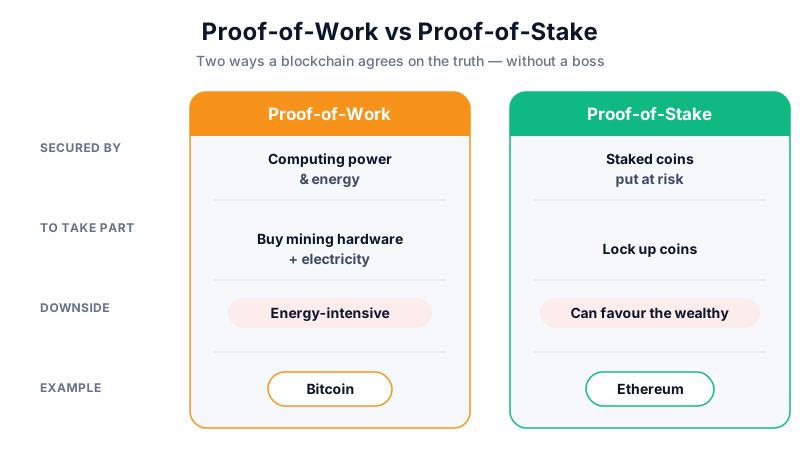
- Proof of work asks participants to spend real computing power (and electricity) through mining.
- Proof of stake asks participants to lock up coins as a deposit through staking.
- In both, cheating costs you something real — wasted energy or a forfeited stake.
Why it matters
The consensus mechanism shapes a network's security, speed, energy use and how decentralised it can be. It's why Bitcoin and Ethereum feel so different under the hood, and why debates about 'which is better' get heated. Whichever way you lean, the storage rule doesn't change: serious amounts belong offline, on a hardware wallet like the Ledger Nano X.
No mechanism is perfect
Every consensus design trades off speed, cost, decentralisation and security in some way. A network being 'fast and cheap' can mean it's more centralised. Understanding the trade-offs helps you read projects critically — this is education, not financial advice.
Key takeaways
- Consensus lets independent computers agree on one ledger without a central authority.
- It solves the double-spend problem that broke earlier digital cash attempts.
- Proof of work uses energy; proof of stake uses locked-up coins as a deposit.
- Every design trades off speed, cost, security and decentralisation.
Frequently asked questions
What are the main consensus mechanisms?
The two most common are proof of work (used by Bitcoin) and proof of stake (used by Ethereum and most newer chains). Many variations exist.
Why can't a blockchain just use a central server?
It could, but then it would be a normal database controlled by one party — defeating the point. Consensus is what lets a network run with no single owner.
Does consensus make a blockchain unhackable?
No software is unhackable. Consensus makes rewriting confirmed history extremely expensive, but bugs, scams and individual-account mistakes remain real risks.
Keep reading
Proof of Work vs Proof of Stake
The two main ways blockchains secure themselves, compared plainly: how each works, their trade-offs, and what
What Is Crypto Mining? A Beginner's Guide
What crypto mining actually is, how it secures networks like Bitcoin, why it uses so much energy, and whether
What Is Staking? How It Works and What It Costs
A plain-English guide to crypto staking: how it secures proof-of-stake networks, how rewards work, and the loc