What Is Crypto Mining? A Beginner's Guide
Mining sounds like digging coins out of the ground, but it's really about computers competing to process transactions and secure a blockchain. This guide explains what mining does, why it exists, and why most beginners shouldn't try it at home.
The 20-second version
Mining is how some blockchains — most famously Bitcoin — confirm transactions and create new coins. Computers race to solve a hard maths puzzle; the winner adds the next block and earns a reward. It secures the network but uses a lot of electricity.
What mining actually does
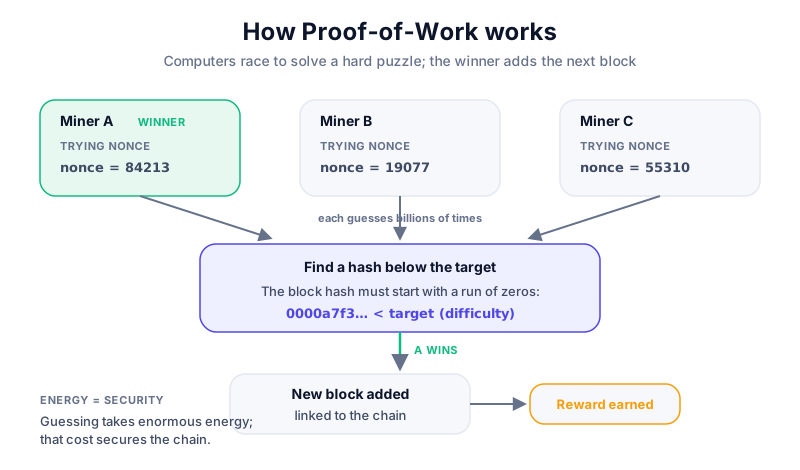
Every blockchain needs a way to agree on which transactions are valid without a central authority. On networks that use proof of work, that job falls to miners. They bundle recent transactions into a block and compete to find a special number that makes the block valid.
Finding that number takes enormous trial and error — billions of guesses per second. The first miner to succeed broadcasts the block, the rest of the network checks it, and the chain moves forward. This whole process is a form of blockchain consensus.
Why miners bother
Miners are paid in two ways, which together give them a reason to spend real money on hardware and electricity.
- Block reward — newly created coins, awarded to whoever mines the block. On Bitcoin this halves roughly every four years.
- Transaction fees — small amounts users attach to get their transactions confirmed.
- Together these make honest mining more profitable than trying to cheat the network.
The energy question
Because mining means running powerful machines around the clock, proof-of-work networks consume a lot of electricity. Supporters argue this energy is what makes the network so hard to attack; critics point to the environmental cost. Both can be true at once.
This is one reason many newer networks, including Ethereum, use proof of stake instead — which secures the chain without mining's energy bill. Whichever way you lean, the storage rule doesn't change: serious amounts belong offline, on a hardware wallet like the Ledger Nano X.
Should you mine at home?
Mining is rarely worth it for beginners
Profitable Bitcoin mining today needs specialised hardware, cheap electricity and scale most people can't match. 'Cloud mining' offers and free apps that promise easy returns are frequently scams. This is education, not financial advice — never spend money you can't afford to lose chasing mining rewards.
Key takeaways
- Mining confirms transactions and creates new coins on proof-of-work chains.
- Miners earn block rewards plus transaction fees for securing the network.
- It uses a lot of electricity — a key reason newer chains use proof of stake.
- Home mining is rarely profitable, and 'cloud mining' offers are often scams.
Frequently asked questions
Can I mine Bitcoin on my laptop?
Not realistically. Bitcoin mining now requires specialised ASIC machines; a laptop would earn essentially nothing while running up your electricity bill.
Does every cryptocurrency use mining?
No. Mining is specific to proof-of-work chains. Networks that use proof of stake, like Ethereum, secure themselves through staking instead.
Is cloud mining a good way to start?
Be very cautious. Many cloud-mining sites are outright scams, and even legitimate ones rarely return what they promise. Treat any guaranteed return as a red flag.
Keep reading
Proof of Work vs Proof of Stake
The two main ways blockchains secure themselves, compared plainly: how each works, their trade-offs, and what
What Is Blockchain Consensus?
How thousands of strangers' computers agree on a single shared ledger without a boss. A plain-English guide to
What Is Staking? How It Works and What It Costs
A plain-English guide to crypto staking: how it secures proof-of-stake networks, how rewards work, and the loc