What Is the Internet Computer (ICP)? A Plain-English Guide
The Internet Computer (ICP) is an ambitious layer-1 blockchain that wants to run entire applications — front end and all — directly on-chain, rather than just handling payments. This guide explains what it is in plain English, how it works, and how to think about it sensibly.
The 20-second version
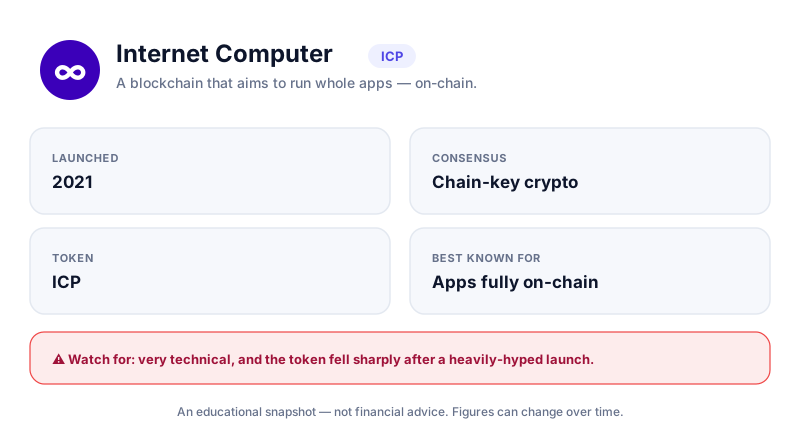
The Internet Computer aims to be a blockchain you can host whole websites and apps on, not just tokens. It's built by the DFINITY Foundation, uses 'canister' smart contracts, and its token, ICP, pays for computation and lets holders vote on upgrades.
What is the Internet Computer?
Most blockchains are great at recording who owns what, but they lean on ordinary web servers to actually show you an app. The Internet Computer's goal is bolder: run the *whole* application — the logic and the website you see — on the blockchain itself, so an app can exist without traditional cloud hosting.
It was launched in 2021 by the DFINITY Foundation, a non-profit research organisation. Its native token is ICP, which is used for computation, governance and securing the network.
How the Internet Computer works
The network runs on specialised hardware operated by independent providers, organised into 'subnets' that work together. Apps are built as canisters — a kind of smart contract that bundles both code and data, and that can serve web pages directly to your browser.
- Canisters are smart contracts that can host full apps, not just simple logic.
- Cycles are a stable unit that pays for computation, topped up by burning ICP — so app costs stay predictable.
- The NNS (Network Nervous System) is an on-chain system where ICP holders vote on upgrades and changes.
'Reverse gas' model
On many chains, the user pays a fee for every action. On the Internet Computer, developers pre-pay in cycles so apps can feel free to use — a model designed to feel more like the normal web.
What it's used for
Developers have used the Internet Computer to host social apps, DeFi tools and on-chain websites. A notable feature is its work on letting canisters interact directly with other chains like Bitcoin and Ethereum, aiming to act as a kind of connective layer.
Why it matters — and the trade-offs
The Internet Computer is one of the most technically ambitious projects in crypto. If 'fully on-chain apps' become genuinely useful at scale, it's positioned for that vision. Supporters value its speed and the idea of reducing reliance on big cloud companies.
The honest counterpoint: it's complex, the hardware requirements make parts of it more centralised than open networks, and it had a rocky start after launch. Ambition and adoption aren't the same thing, and neither tells you where the token's price will go. Whichever way you lean, the storage rule doesn't change: serious amounts belong offline, on a hardware wallet like the OneKey.
A fair warning
ICP is highly volatile, like all crypto. Only ever risk what you can afford to lose, and never borrow to buy. This guide is education, not financial advice — and we don't make price predictions.
Where to go next
If this is your first deep dive, cover the basics first: how to buy Bitcoin, how to store crypto safely, and how to avoid scams. To compare other layer-1 designs, read about VeChain, Filecoin and Injective.
Key takeaways
- The Internet Computer aims to host entire apps on-chain, not just tokens.
- Apps are 'canisters'; computation is paid for in cycles topped up with ICP.
- ICP holders govern the network through the on-chain NNS.
- It's volatile — only risk what you can afford to lose.
Frequently asked questions
What is ICP used for?
ICP is the network's token. It's converted into 'cycles' to pay for computation, used to reward node providers, and staked to vote on network upgrades through the NNS.
Who created the Internet Computer?
It was developed by the DFINITY Foundation, a Switzerland-based non-profit research organisation, and launched publicly in 2021.
How is it different from Ethereum?
Ethereum focuses on smart contracts and usually relies on external servers to show app interfaces. The Internet Computer aims to host the full app — including the web front end — directly on-chain.
Keep reading
What Is VeChain? A Plain-English Guide
A beginner-friendly explanation of VeChain (VET): what the supply-chain blockchain does, how its two-token sys
What Is Filecoin? A Plain-English Guide
A beginner-friendly explanation of Filecoin (FIL): the decentralised storage network, how it pays people to st
What Is Render Network (RNDR/RENDER)? A Plain-English Guide
A beginner-friendly explanation of Render Network: the decentralised GPU rendering marketplace, how it works,