What Is VeChain? A Plain-English Guide
VeChain is a layer-1 blockchain built mainly for businesses that want to track products and data through a supply chain. This guide explains what VeChain is in plain English, how its unusual two-token design works, and how to think about it sensibly — without hype.
The 20-second version
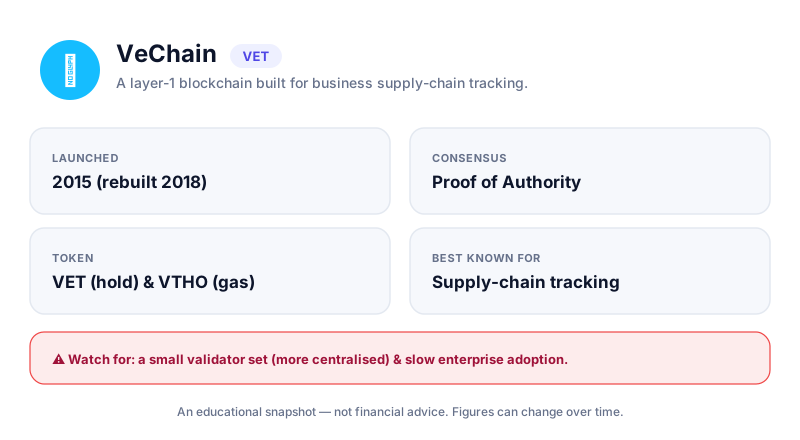
VeChain is a business-focused blockchain for tracking goods and data. It uses two tokens: VET, which you hold, and VTHO ('VeThor'), which pays for transactions. It's run by a smaller set of approved validators rather than anyone-can-join mining.
What is VeChain?
VeChain is a layer-1 blockchain — a base network in the same family as Ethereum — but it was designed with a specific job in mind: helping companies record where products come from, how they move, and whether they're genuine. Think luxury goods, food freshness, or car service histories logged on a shared, tamper-resistant ledger.
Launched in 2015 and rebuilt as 'VeChainThor' in 2018, the network aims to make blockchain practical for real businesses rather than just traders. That focus on enterprise use is what sets it apart from general-purpose chains.
The two-token system
VeChain's most distinctive feature is that it uses two tokens instead of one. This is meant to keep transaction costs predictable for businesses, even when the market price swings.
- VET is the main token. Holding it is how you take part in the network, and it slowly generates the second token.
- VTHO (VeThor) is the 'gas' that actually pays for transactions. Just holding VET produces a trickle of VTHO over time.
- The idea: a company can budget in VTHO without worrying about VET's price every day.
Why split them?
On most chains the same token you hold also pays the fees, so rising prices make the network expensive to use. VeChain separates the two so transaction costs stay steadier.
How VeChain works
Instead of open mining like Bitcoin, VeChain uses a model called Proof of Authority. A limited number of vetted 'Authority Masternodes' — run by known organisations — take turns confirming transactions. This makes the network fast and cheap, but more centralised than chains where anyone can validate.
Like Ethereum, VeChainThor supports smart contracts, so developers can build apps on top of it. In practice, most real-world use has centred on supply-chain tracking and sustainability data rather than DeFi.
Why VeChain matters — and the trade-offs
VeChain is one of the longer-running attempts to give blockchain a clear business purpose. If verifiable supply-chain records become widely valued, a network built specifically for that could find real demand. That's the bull case supporters point to.
The honest counterpoint: enterprise adoption is slow and hard to measure, the validator set is small by design, and a token's price does not always track real-world usage. None of this is a verdict on whether VET will go up or down. And however you weigh the trade-offs, keep meaningful holdings in cold storage — a Trezor Safe 5 — rather than on an exchange.
A fair warning
VET's price is highly volatile, like all crypto. Only ever risk what you can afford to lose, and never borrow to buy. This guide is education, not financial advice — and we don't make price predictions.
Where to go next
If VeChain is your entry point into crypto, build the basics first: learn how to buy Bitcoin safely, how to store crypto safely, and how to avoid scams. To compare designs, see other layer-1s like Filecoin and the Internet Computer.
Key takeaways
- VeChain is a layer-1 blockchain aimed at business supply-chain tracking.
- It uses two tokens: VET to hold, VTHO to pay transaction fees.
- Proof of Authority makes it fast and cheap but more centralised.
- It's volatile — only risk what you can afford to lose.
Frequently asked questions
What's the difference between VET and VTHO?
VET is the token you hold and the network's main asset. VTHO is the 'gas' that pays for transactions, and holding VET slowly generates VTHO over time.
Is VeChain decentralised?
Partly. It uses Proof of Authority, where a limited set of vetted organisations validate transactions. That's efficient but less decentralised than open networks like Bitcoin or Ethereum.
What is VeChain actually used for?
Its core use case is recording supply-chain and sustainability data — tracking goods, verifying authenticity, and logging conditions — on a tamper-resistant ledger.
Keep reading
What Is Filecoin? A Plain-English Guide
A beginner-friendly explanation of Filecoin (FIL): the decentralised storage network, how it pays people to st
What Is the Internet Computer (ICP)? A Plain-English Guide
A beginner-friendly explanation of the Internet Computer (ICP): the blockchain that aims to host full apps on-
What Is Render Network (RNDR/RENDER)? A Plain-English Guide
A beginner-friendly explanation of Render Network: the decentralised GPU rendering marketplace, how it works,