What Is Render Network (RNDR/RENDER)? A Plain-English Guide
Render Network is a project that connects people who need heavy graphics work done with people who have spare graphics-card (GPU) power to spare. This guide explains what Render is in plain English, how the marketplace works, and how to think about it sensibly.
The 20-second version
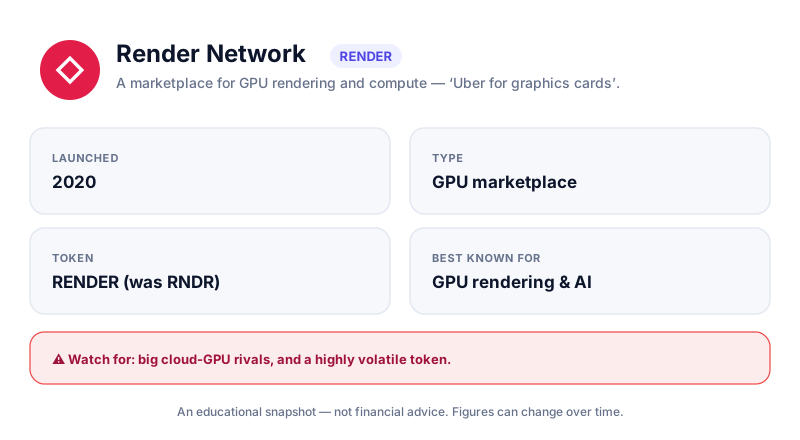
Render Network is a marketplace for GPU power. Artists and studios pay to render 3D graphics or run AI workloads; people with idle GPUs do the work and earn the RENDER token. Think 'Uber for graphics cards', coordinated on a blockchain.
What is Render Network?
Rendering — turning 3D scenes into finished images or video — is enormously demanding. Studios often wait hours and pay a lot for it. Render Network's idea is to tap the world's idle graphics cards instead, matching people who need rendering power with people who have it, and settling payments in its token.
The project grew out of OTOY, a long-established graphics-software company, and launched its token in 2020. Its token migrated from the original RNDR ticker to RENDER when it moved much of its activity to the Solana blockchain.
How Render Network works
The network acts as a coordinator and a payment layer. It splits big jobs into pieces, hands them to available GPU providers, checks the results, and releases payment.
- Creators submit rendering or compute jobs and pay in the RENDER token.
- Node operators contribute GPU power and earn tokens for completed work.
- The network distributes jobs, verifies output and handles payment.
- Beyond graphics, idle GPUs can also be pointed at AI and machine-learning workloads.
Why a blockchain at all?
The blockchain isn't doing the rendering — your GPU is. It's used to coordinate a global pool of strangers, track jobs, and pay people fairly without a single company in the middle.
What it's used for
Render's natural users are 3D artists, animation and VFX studios, and increasingly people running AI workloads that need lots of GPU power. The pitch is cheaper, faster access to compute by using capacity that would otherwise sit idle.
Why it matters — and the trade-offs
Demand for GPU power — for graphics and especially AI — has grown sharply, and Render is one of the better-known crypto projects targeting that 'real compute' market. Supporters see a clear, tangible use case behind the token.
The honest counterpoint: it competes with giant cloud-GPU providers, quality and reliability across a network of strangers is hard, and demand for the token depends on real usage. Usage and token price are not the same thing. Whichever way you lean, the storage rule doesn't change: serious amounts belong offline, on a hardware wallet like the BitBox02.
A fair warning
RENDER is highly volatile, like all crypto. Only ever risk what you can afford to lose, and never borrow to buy. This guide is education, not financial advice — and we don't make price predictions.
Where to go next
Since Render runs largely on Solana, reading about that base layer helps. New to crypto? Start with how to buy Bitcoin, how to store it safely, and how to avoid scams. For comparison, see Filecoin and the Internet Computer.
Key takeaways
- Render Network is a marketplace for GPU rendering and compute power.
- Creators pay in RENDER; people with idle GPUs earn it by doing the work.
- It now runs largely on Solana and serves both graphics and AI workloads.
- It's volatile — only risk what you can afford to lose.
Frequently asked questions
What's the difference between RNDR and RENDER?
They're the same project. The token migrated from the original RNDR ticker to RENDER as the network moved much of its activity onto the Solana blockchain.
What is the RENDER token used for?
Creators use it to pay for rendering and compute jobs, and GPU node operators earn it for completing work. It's the unit that coordinates payment across the network.
Do I need a powerful computer to use Render?
Only if you want to provide GPU power and earn tokens. If you just need rendering done, you submit a job and pay for it — no high-end hardware of your own required.
Keep reading
What Is VeChain? A Plain-English Guide
A beginner-friendly explanation of VeChain (VET): what the supply-chain blockchain does, how its two-token sys
What Is Filecoin? A Plain-English Guide
A beginner-friendly explanation of Filecoin (FIL): the decentralised storage network, how it pays people to st
What Is the Internet Computer (ICP)? A Plain-English Guide
A beginner-friendly explanation of the Internet Computer (ICP): the blockchain that aims to host full apps on-