What Is Lido? Liquid Staking Explained
Lido is the largest liquid staking protocol in crypto. It lets people earn staking rewards on Ethereum without locking up their coins or running their own validator — and gives them a tradeable token in return. This guide explains how it works and the trade-offs to understand first.
The 20-second version
Lido stakes your ETH for you and gives you stETH, a token that represents your staked ETH plus rewards. You can use or trade stETH while the underlying ETH stays staked. LDO is its governance token. The convenience comes with concentration and smart-contract risks.
What is Lido?
Staking means locking up crypto to help secure a network and earning rewards in return. On Ethereum, staking normally requires 32 ETH and the technical know-how to run a validator. Lido removes those barriers: you can stake any amount, and Lido pools everyone's deposits and runs the validators on their behalf.
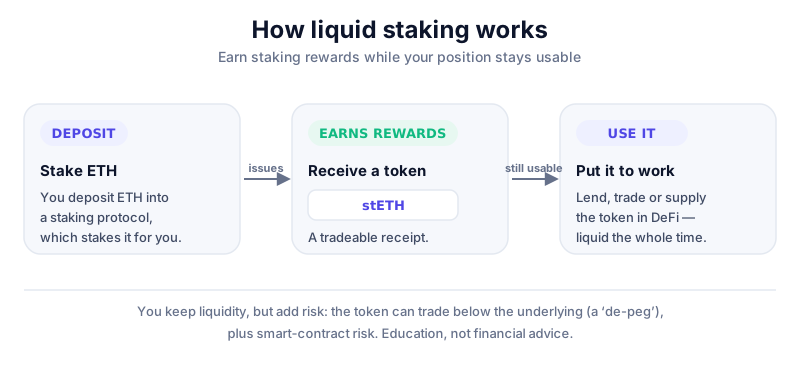
The clever part is liquidity. Normally staked ETH is locked. With Lido, you receive a token called stETH that represents your staked ETH plus accruing rewards. You can hold, trade, or use stETH across DeFi while your original ETH keeps earning — hence 'liquid staking'.
How Lido works
- You deposit ETH into Lido's smart contracts.
- Lido stakes it through a set of professional node operators.
- You receive stETH, which gradually reflects your share of staking rewards.
- You can redeem stETH back for ETH, or trade it on the open market.
Because stETH is a normal token, people use it as collateral on lending platforms like Aave or trade it on exchanges like Uniswap. That composability is powerful — but it also stacks risks on top of each other.
What are stETH and LDO?
It is worth separating the two tokens. stETH is your receipt for staked ETH — its value tracks ETH and the rewards it earns. LDO is Lido's governance token, used to vote on how the protocol is run, such as which node operators are approved. LDO is not the same thing as your staked ETH and is not required to stake. And however you weigh the trade-offs, keep meaningful holdings in cold storage — a SafePal S1 — rather than on an exchange.
The risks of liquid staking
- Smart-contract risk: a bug in Lido's contracts could affect deposited funds.
- Validator (slashing) risk: if node operators misbehave, a portion of staked ETH can be penalised.
- stETH 'de-peg' risk: stETH can trade below the price of ETH in stressed markets, as it briefly did in 2022.
- Concentration risk: Lido controls a large share of all staked ETH, which some worry could threaten Ethereum's decentralisation.
Education, not financial advice
Staking rewards are not guaranteed and your capital is at risk. Liquid staking adds smart-contract and market risks on top of normal volatility. Only risk what you can afford to lose, and never borrow to do it.
Key takeaways
- Lido lets you stake any amount of ETH without running a validator.
- You get stETH — a tradeable token representing your staked ETH plus rewards.
- LDO is a separate governance token; it isn't your staked ETH.
- Liquid staking adds smart-contract, slashing, de-peg and concentration risks.
Frequently asked questions
What is the difference between stETH and ETH?
stETH is a token that represents ETH you've staked through Lido, plus the rewards it earns. It usually tracks ETH closely but can trade at a discount in volatile markets, so they are not identical.
Is liquid staking safe?
It removes the hassle of running a validator but adds risks: smart-contract bugs, validator penalties (slashing), and the chance stETH trades below ETH. It is not risk-free.
Do I need LDO to use Lido?
No. LDO is purely a governance token for voting on the protocol. You stake with ETH and receive stETH — LDO is not involved in earning rewards.
Keep reading
What Is Staking? How It Works and What It Costs
A plain-English guide to crypto staking: how it secures proof-of-stake networks, how rewards work, and the loc
What Is Ethereum? A Plain-English Guide
A beginner-friendly explanation of Ethereum: what it is, how it differs from Bitcoin, what smart contracts do,
What Is DeFi? Decentralised Finance Explained
A beginner's guide to decentralised finance: what DeFi is, how lending, trading and yield work without a bank