What Is Staking? How It Works and What It Costs
Staking is how many blockchains secure themselves: people lock up coins to help run the network and earn rewards in return. This guide explains how it works, what the rewards really cost you, and why 'earning interest' is a misleading way to think about it.
The 20-second version
Staking means locking up crypto to help validate transactions on a proof-of-stake network. In return you earn rewards. But your coins may be locked for a period, rewards aren't guaranteed, and the value of what you stake can fall further than any reward makes up for. It is not a savings account.
What staking is
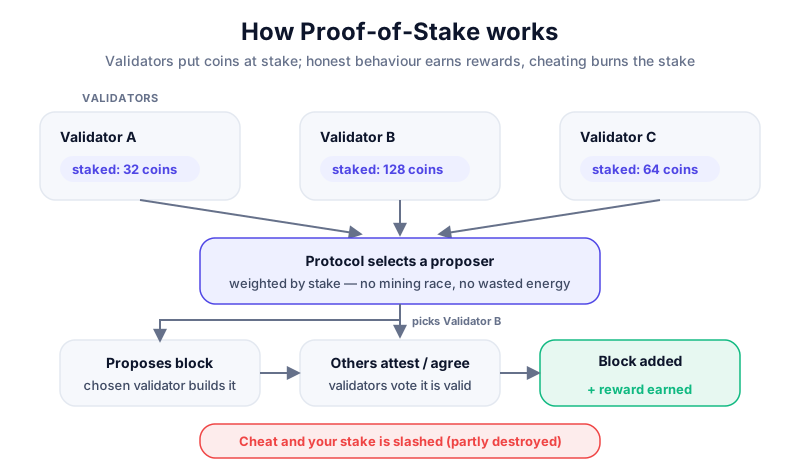
Some blockchains, including Ethereum, secure themselves using proof of stake. Instead of computers racing to solve energy-hungry puzzles (as in Bitcoin's mining), participants lock up — or 'stake' — their coins as a deposit. That deposit is what keeps them honest. This is part of how blockchains reach consensus, the process by which thousands of independent computers agree on a single, shared truth without a boss to settle disputes.
Here's the intuition. Imagine a group agreeing on a shared record, where anyone can help write it. To stop people scribbling lies, each writer has to put down a cash bond first. Write honestly and you're paid a small fee for your trouble; try to cheat, or fail to show up for your shift, and you lose part of your bond. Because lying costs real money and honesty earns it, the maths quietly nudges everyone toward telling the truth. The staked coins are that bond — the network's security guarantee, made of skin in the game.
So when you stake, you're not lending your coins to a company that pays you interest. You're posting a deposit that helps run a public network, and the rewards are your share for helping keep it honest and online. That distinction sounds pedantic, but it changes how you should think about the risks — which we'll get to.
How rewards work
Staking rewards come from two places: new coins the network issues to reward validators, and a share of the transaction fees users pay. They're usually quoted as an annual percentage — say '4% a year' — but that figure is an estimate, not a promise. It moves up and down depending on how many other people are staking and how busy the network is. The more people staking, the thinner the rewards are spread, so today's quoted rate is a snapshot, not a contract.
And here's the part the glossy 'earn 5% on your crypto!' ads tend to bury: those rewards are paid to you in the same coin you staked, not in pounds or dollars. So your percentage return and the coin's price are two completely separate things — and the price is by far the bigger number.
Rewards are paid in crypto
If you earn 4% in a coin whose price falls 20%, you've still lost roughly 16% of your value overall — the reward didn't save you. Staking rewards don't protect you from the coin's volatility, because they're paid in the same volatile asset. A bigger pile of something worth less is still worth less.
Ways to stake
There are a few common routes into staking, and they trade convenience against control and risk. As a rough rule, the easier and more hands-off an option is, the more you're trusting someone else with your coins — and the more ways there are for things to go wrong that you can't see. Here they are, roughly from most control to least:
- Solo staking — running your own validator. The most control and you keep your keys, but it's technical, needs a chunk of capital, and you're responsible for keeping the machine online around the clock.
- Staking pools — combining your funds with other people's so the entry bar is far lower. Easier, but you're now relying on whoever runs the pool to behave.
- Exchange staking — letting a platform stake on your behalf at the click of a button. The simplest option by far, but you hand over custody and trust the platform completely — and platforms have failed before.
- Liquid staking — receiving a tradeable token that represents your staked coins, so you can stake and still move value around. Flexible, but it bolts on extra smart-contract risk via DeFi, because now there's another layer of code that could break.
Each network handles the details differently, so once you know which coin you're dealing with, read the specifics: Ethereum staking, Solana staking and Avalanche staking all have their own lock-up rules and quirks worth knowing before you commit anything.
The risks of staking
Staking is endlessly marketed as 'earning interest on your crypto', and that framing is doing a lot of quiet lying. A savings account is a low-risk place a regulated bank pays you to park money it insures. Staking is none of those things. The rewards are real, but so are the ways you can lose — sometimes more than you ever stood to earn: If you do stake, do it from cold storage — a hardware wallet like the BitBox02 lets you delegate while your keys stay offline.
- Lock-up periods — staked coins are often frozen for days or even weeks before you can withdraw. If the price crashes during that window, you may have to watch it fall, unable to sell.
- Slashing — validators that misbehave, double-sign, or simply go offline too long can have part of the stake taken as a penalty. If you've trusted a careless operator, that loss can be yours.
- Price risk — the coin you stake can fall in value far more than any reward makes up for. This is the big one, and the one most often glossed over.
- Custodial and platform risk — stake through a platform and its failure, freeze, or collapse can put your funds at risk, exactly as has happened to people before.
Beware 'guaranteed' staking returns
Any service promising fixed, high, risk-free staking yields is waving a giant red flag — it's one of the most common scam patterns in crypto. Real rewards vary, fluctuate, and always carry risk. Only stake what you can afford to lose, never borrow to do it, and never share your seed phrase with a staking 'service'. This is education, not financial advice.
Where to go next
To go deeper, see how a specific network handles staking in Ethereum staking explained, get the underlying mechanics straight in how blockchain works, and — before you trust any staking platform with a single coin — read how to avoid crypto scams. Staking can be a reasonable way to support a network you already hold and believe in. It is not a magic income machine, and anyone who sells it to you as one isn't on your side. The Latest Crypto team would rather you understood the trade-offs than chased a number.
Key takeaways
- Staking locks up coins to help secure a proof-of-stake network and earn rewards.
- Rewards are paid in crypto, so the coin's price swings still apply to you.
- Options range from solo staking to exchange and liquid staking, each with trade-offs.
- Lock-ups, slashing and platform failure are real risks — it's not a savings account.
Frequently asked questions
Is staking safe?
It carries real risks: your coins may be locked when you want to sell, can be slashed for an operator's mistakes, and can fall in value. Staking through a platform also means trusting that platform entirely. It's not risk-free, despite how it's usually marketed.
Can I lose money staking?
Yes. Even when rewards arrive, the coin's price can drop more than you earn, leaving you down overall. Slashing or a platform failure can also cost you directly. Never stake more than you can afford to lose.
How much can I earn from staking?
It varies by network and changes over time, and we don't quote specific figures as advice or make predictions. Be very wary of any service promising fixed, high or 'guaranteed' returns — that's a classic scam sign, not a real opportunity.
Keep reading
Ethereum Staking Explained
How Ethereum staking works, the main ways to take part, the real risks involved, and why staking rewards are n
What Is DeFi? Decentralised Finance Explained
A beginner's guide to decentralised finance: what DeFi is, how lending, trading and yield work without a bank
How Blockchain Works (Without the Jargon)
A plain-English explanation of what a blockchain actually is, how blocks are linked and confirmed, what makes