What Is Stellar (XLM)? A Plain-English Guide
Stellar is an open payments network built to move money across borders quickly and cheaply, and XLM (Lumens) is the digital asset that keeps it running. This guide explains what Stellar is in plain English, how it works under the hood, and how to think about it without the hype.
The 20-second version
Stellar is a payments network designed to send money and issue digital versions of currencies around the world in seconds, for a fraction of a penny. Its native token, XLM (Lumens), pays tiny fees and helps bridge different currencies. You hold XLM in a wallet that you control.
What is Stellar?
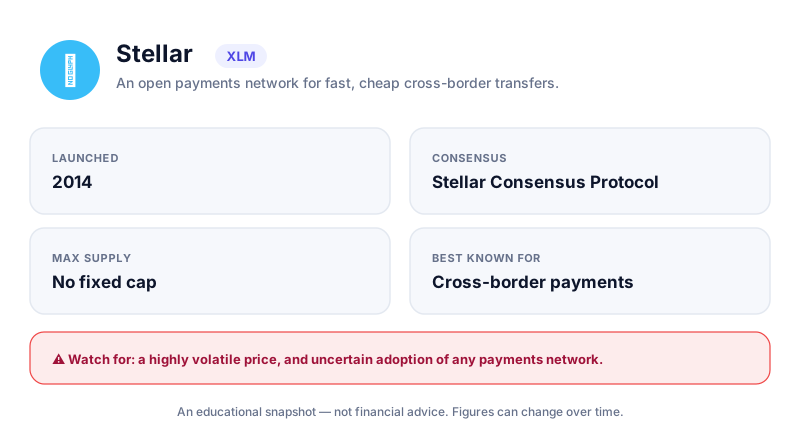
Stellar is an open-source payments network launched in 2014 by Jed McCaleb (a co-founder of Ripple) and Joyce Kim, and is supported by the non-profit Stellar Development Foundation. Its goal is straightforward: make sending money across borders as easy as sending an email.
Like Bitcoin, Stellar records transactions on a public ledger that no single company owns. But where Bitcoin set out to be 'digital gold', Stellar was designed from day one around payments and currency exchange — moving euros, pesos, dollars or stablecoins between people and institutions in a few seconds.
What is XLM (Lumens)?
XLM, or Lumens, is Stellar's native digital asset. It plays two main roles on the network.
- Paying fees. Every transaction costs a tiny amount of XLM (a fraction of a penny). This keeps fees negligible while discouraging spam.
- Bridging currencies. When there's no direct market between two assets, Stellar can route a payment through XLM as a neutral middle step.
- A small minimum balance. Each account holds a small reserve in XLM to keep the ledger tidy and prevent abuse.
Unlike Bitcoin's fixed 21-million cap, Stellar's supply is large (tens of billions of XLM) and includes a modest, fixed annual issuance rule set in 2019. The Stellar Development Foundation also famously burned around half the total supply that year.
How Stellar works
Stellar doesn't use energy-hungry mining like Bitcoin. Instead it uses the Stellar Consensus Protocol (SCP), where a network of independent servers agrees on transactions by trusting overlapping groups of other servers. The result is fast confirmations (typically 3–5 seconds) and very low energy use.
- Anchors are trusted institutions that issue digital tokens backed by real-world assets, like a tokenised US dollar or euro.
- The built-in exchange lets users trade these tokens directly on the ledger.
- Path payments automatically find the cheapest route to convert one currency into another.
A hardware wallet keeps your keys offline and out of reach of hackers. The Ledger Nano X supports XLM — but read our full review first.
Why Stellar matters
Cross-border payments are slow and expensive through the traditional banking system. Stellar's pitch is that it can settle the same transfers in seconds for almost no cost, which is why it has partnered with payment companies and explored use cases like remittances and tokenised cash. It's often compared to Ripple (XRP), which shares some of its origins but targets large banks rather than open access.
A fair warning
XLM's price is highly volatile, and adoption of any payments network is uncertain. Only ever risk what you can afford to lose, and never borrow to buy crypto. This guide is education, not financial advice — and nothing here is a price prediction.
Where to go next
Now you know what Stellar is, the natural next steps are learning how to buy Stellar and — most importantly — how to store it safely. If you're weighing it against its better-known cousin, our Stellar vs Ripple comparison breaks down the differences.
Key takeaways
- Stellar is an open payments network for fast, cheap cross-border transfers.
- XLM (Lumens) pays tiny fees and can bridge between different currencies.
- It uses the Stellar Consensus Protocol instead of energy-hungry mining.
- It's volatile — only risk what you can afford to lose.
Frequently asked questions
Is Stellar the same as Ripple (XRP)?
No. They share a co-founder and both target payments, but Stellar is run by a non-profit and aims at open, individual access, while Ripple focuses on banks and financial institutions. See our Stellar vs Ripple comparison.
How much do I need to start?
Very little. XLM is divisible into tiny fractions, so you can buy a small amount. Note that each Stellar account must keep a small minimum XLM reserve to stay active.
What's the safest way to store XLM?
For larger amounts, a hardware wallet that keeps your keys offline is the gold standard.
Keep reading
How to Buy Stellar (XLM): A Step-by-Step Guide
A clear, beginner-friendly walkthrough of how to buy Stellar's XLM safely: choosing an exchange, paying, and m
How to Store Stellar (XLM) Safely
Keep your XLM safe from hackers and mistakes: hot vs cold wallets, hardware wallets, the Stellar minimum reser
Stellar vs Ripple (XLM vs XRP): What's the Difference?
A fair, balanced comparison of Stellar (XLM) and Ripple (XRP): shared origins, who they're built for, governan