What Is XRP? A Plain-English Guide
XRP is one of the oldest and most talked-about cryptocurrencies — and also one of the most misunderstood. It's closely tied to a company called Ripple and was designed to move money across borders quickly and cheaply. This guide explains what XRP actually is in plain English, how it differs from Bitcoin, and how to think about it sensibly.
The 20-second version
XRP is the digital asset that runs on the XRP Ledger, a fast and low-cost network built for payments. It's often confused with Ripple, the company that uses it — but XRP and Ripple are not the same thing. Transactions settle in seconds for a fraction of a penny.
What is XRP?
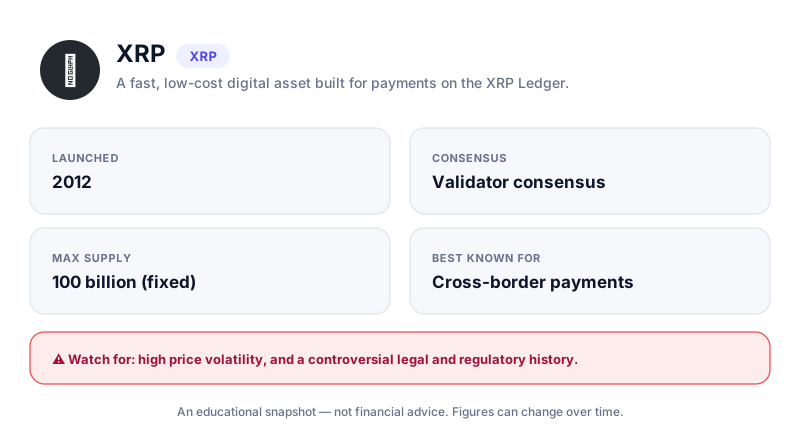
XRP is a cryptocurrency that runs on its own network, the XRP Ledger (often shortened to XRPL). The ledger launched in 2012, making XRP one of the earliest cryptocurrencies — older than Ethereum. It was designed from the start with one job in mind: moving value between people and institutions quickly and at very low cost.
Like Bitcoin, XRP lets you send value over the internet without a bank in the middle, and you hold it in a wallet that you control. Unlike Bitcoin, it isn't mined. All 100 billion XRP were created at launch, and the supply only decreases over time as a tiny amount is destroyed with every transaction.
XRP vs Ripple: clearing up the confusion
This is the single most common point of confusion, so it's worth being precise. Ripple is a private US-based technology company that builds payment software. XRP is a digital asset that exists independently on the open-source XRP Ledger.
- Ripple (the company) holds a large amount of XRP and uses it in some of its products, but does not control the ledger itself.
- The XRP Ledger is run by a decentralised network of independent validators around the world.
- XRP (the asset) would continue to exist even if Ripple the company disappeared.
Why this matters
Because Ripple holds so much XRP and promotes it heavily, critics argue XRP is more centralised than coins like Bitcoin. Supporters counter that the ledger runs independently. Both points are worth understanding before forming a view.
How XRP works
Instead of using energy-hungry mining, the XRP Ledger reaches agreement through a consensus process. A network of independent validators checks and confirms transactions every three to five seconds. There's no race to solve puzzles, which is why XRP transactions are fast and cheap.
- Speed — transactions typically settle in 3–5 seconds.
- Cost — fees are a tiny fraction of a penny per transaction.
- Supply — fixed at 100 billion, with a small amount destroyed on each transaction.
A hardware wallet keeps your keys offline and away from hackers. The Ledger Nano X supports XRP among thousands of other assets — but read our full review before you buy.
What XRP is used for
XRP's headline use case is cross-border payments. Sending money between countries through the traditional banking system can take days and rack up fees. XRP can act as a fast 'bridge' between two currencies, settling in seconds. You can read more in our deeper look at XRP for cross-border payments.
Beyond payments, the XRP Ledger also supports a built-in exchange and the issuing of other tokens, though payments remain its best-known purpose.
Risks and things to know
XRP has a complicated history. For years it was the subject of a high-profile legal battle in the United States — we cover the facts in the Ripple/SEC case explained. That history is part of why XRP is more controversial than some other coins.
A fair warning
XRP's price is highly volatile and its history is closely tied to legal and regulatory news. Only ever risk what you can afford to lose, and never borrow to buy crypto. This guide is education, not financial advice.
Where to go next
Now you know what XRP is, sensible next steps are learning how to buy XRP safely, then — most importantly — how to store XRP safely. If you want the full backstory, read the Ripple/SEC case explained.
Key takeaways
- XRP is a fast, low-cost cryptocurrency built for payments on the XRP Ledger.
- XRP and Ripple are not the same — one is an asset, the other is a company.
- All 100 billion XRP exist already; it isn't mined like Bitcoin.
- It's volatile and legally controversial — only risk what you can afford to lose.
Frequently asked questions
Is XRP the same as Ripple?
No. Ripple is a company that builds payment software; XRP is a digital asset on the independent XRP Ledger. The company uses XRP but does not control the ledger.
Is XRP mined like Bitcoin?
No. All 100 billion XRP were created when the ledger launched in 2012. The network uses a consensus process instead of mining, so no new XRP is created.
What's the safest way to store XRP?
For larger amounts, a hardware wallet that keeps your keys offline is the gold standard.
Keep reading
How to Buy XRP Safely (Step by Step)
A clear, safety-first guide to buying XRP: choosing a reputable exchange, verifying your account, placing your
How to Store XRP Safely (Step by Step)
Keep your XRP safe: hot vs cold wallets, hardware wallets, the XRP reserve requirement, destination tags, and
XRP vs Traditional Payments: How Cross-Border Money Moves
A balanced look at how XRP aims to speed up cross-border payments compared with the traditional banking system